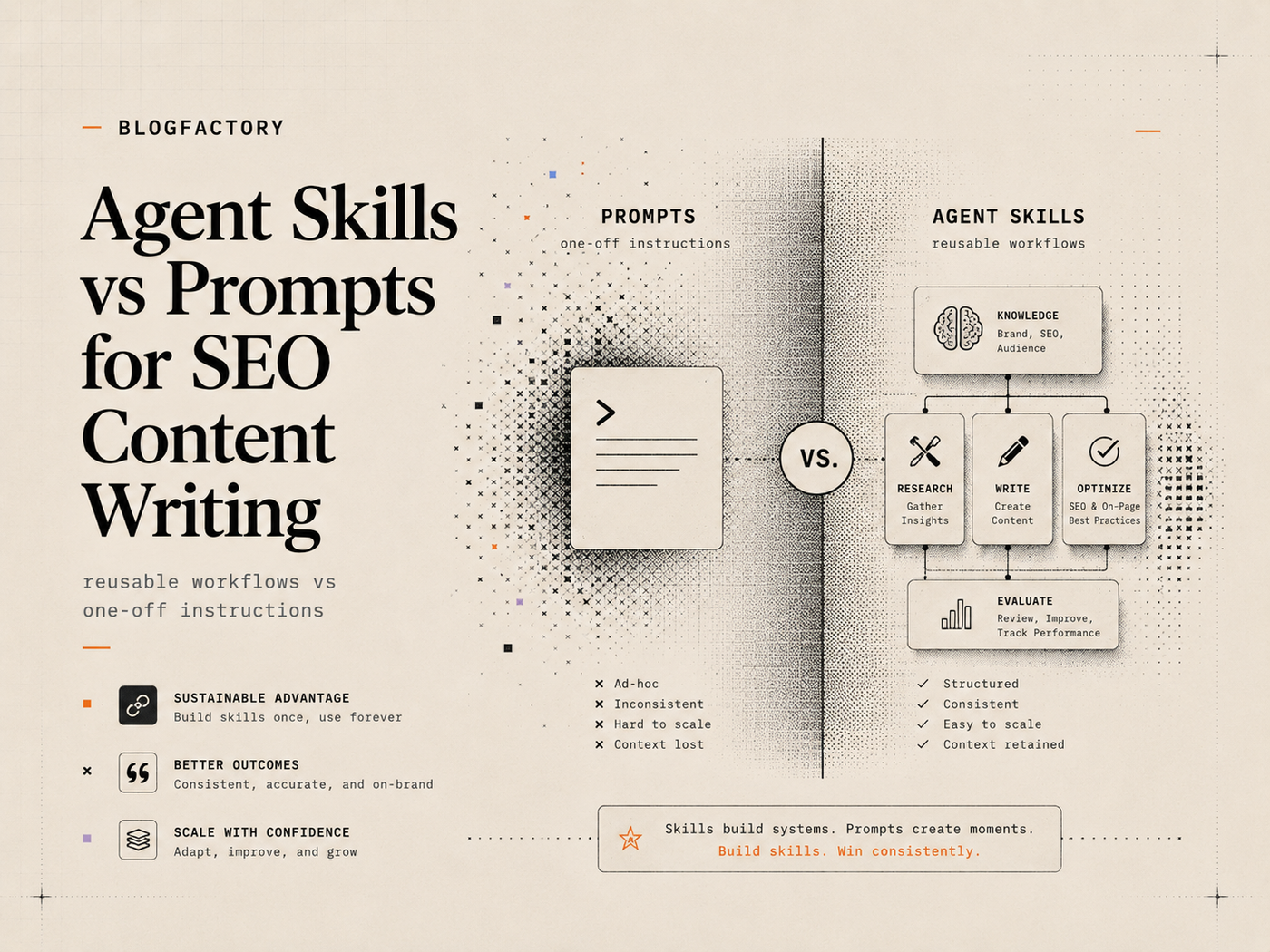
A prompt gives an AI model instructions for the current task. An Agent Skill packages a reusable method—including instructions, references, scripts, templates, and activation metadata—so compatible clients can apply the same workflow across many tasks.
For SEO content writing, prompts are best for one-off assignments and flexible direction. Skills are better when a team needs consistent research, evidence, structure, metadata, validation, and publication-readiness rules that should not be rewritten in every conversation.
Key points
- A prompt is the request; a skill is a reusable operating procedure.
- Skills can include supporting references, scripts, examples, and templates that a single prompt cannot reliably carry.
- Prompts remain useful for the topic, audience, voice, CTA, product facts, and assignment-specific constraints.
- A skill should not replace editorial judgment or grant CMS permissions automatically.
- Versioning and tests make a skill easier to govern across a team than a collection of copied prompts.
- The strongest workflow combines a stable skill with a concise, high-quality brief.
What is a prompt?
A prompt is an instruction or set of messages supplied to a model for a particular interaction. It can define the topic, audience, format, voice, constraints, examples, desired sources, and output.
Prompts are flexible because they can change immediately. A content strategist can ask for a comparison article today, a technical tutorial tomorrow, and a short refresh plan the next day without installing anything.
The weakness is repetition. Long prompts are copied, shortened, modified, or partially forgotten across people and tools. Instructions can conflict, examples become outdated, and important stopping conditions disappear from the version used in the next assignment.
A prompt can request disciplined behavior, but it does not by itself create a maintained workflow artifact.
What is an Agent Skill?
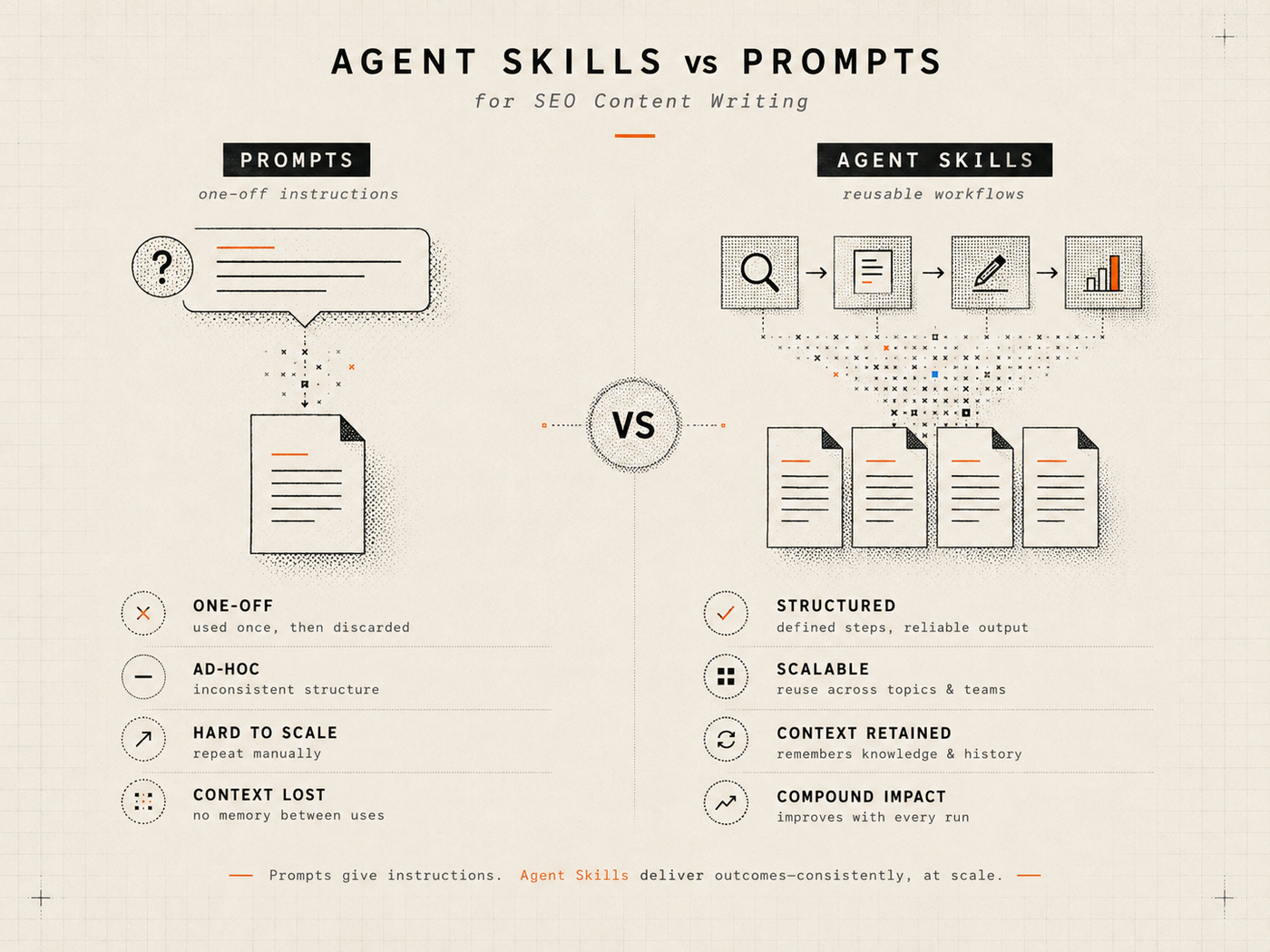
An Agent Skill is a portable folder that describes a reusable capability. The Agent Skills specification requires a SKILL.md file with metadata and instructions and allows additional scripts, references, templates, and assets.[1]
Compatible clients can discover the skill from its name and description, then load the detailed instructions when the task matches or the user invokes it explicitly. The model receives a maintained procedure rather than relying on the user to paste the complete methodology every time.
For SEO writing, a skill can define:
- required brief inputs;
- site and duplicate-content checks;
- search-intent and competitor research;
- source priorities and claim classifications;
- article patterns and structural requirements;
- metadata, FAQ, internal-link, and image fields;
- blocked, draft, and publish-ready conditions;
- deterministic validation scripts.
A skill is still interpreted by a model. It improves repeatability but does not turn editorial work into a perfectly deterministic program.
Agent Skills vs prompts: the core differences
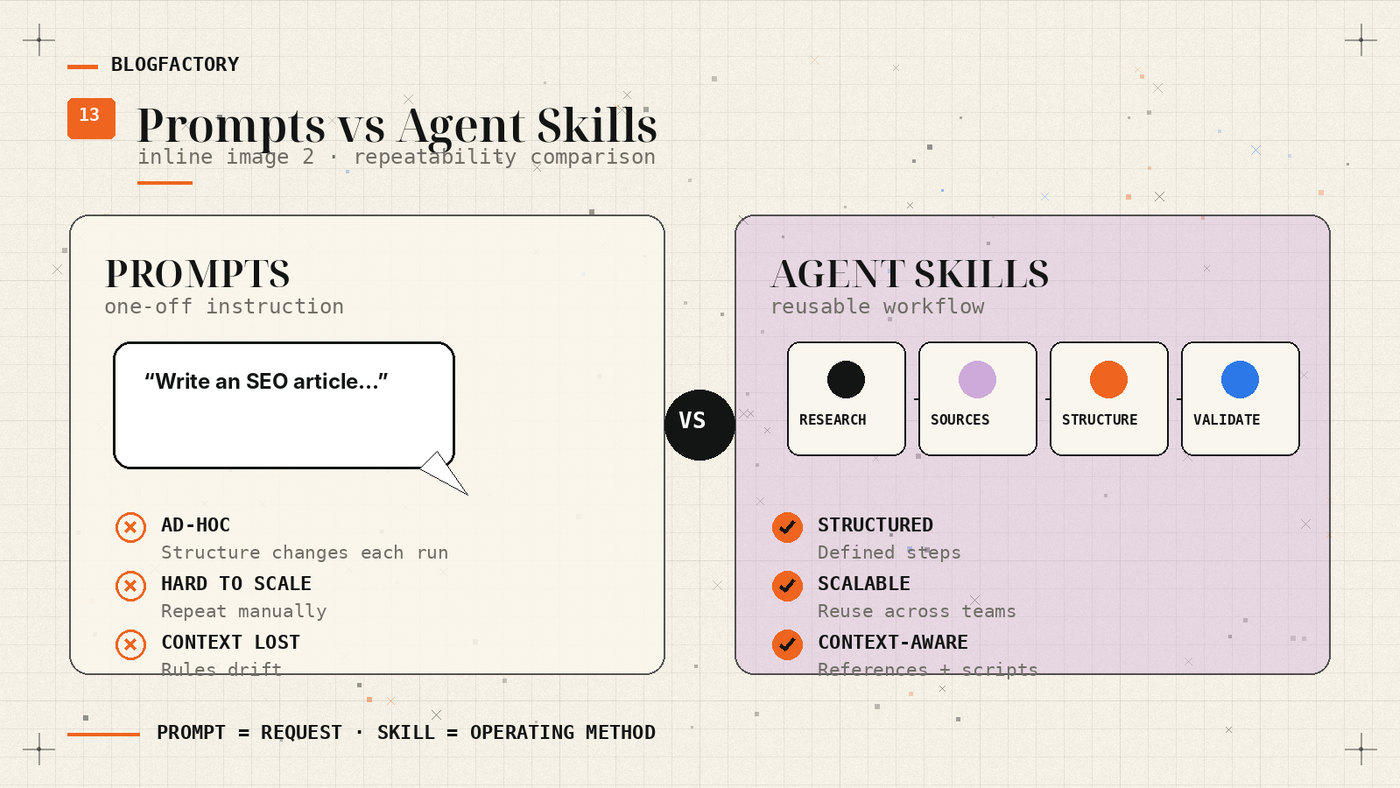
Persistence
A prompt usually belongs to a conversation, document, or prompt library. A skill lives as an installable and versionable folder that can be reused across compatible projects or clients.
Supporting material
A prompt can include examples and context, but large instructions consume conversation space and become difficult to maintain. A skill can keep detailed reference material and scripts in separate files that are loaded or run when needed.
Activation
A prompt is active because the user sends it. A skill may be invoked explicitly or discovered from metadata, depending on the client. Clear descriptions matter because they define when the workflow should be selected.
Validation
A prompt can ask the model to check its work. A skill can additionally include a script that measures structure, metadata, references, placeholders, or other mechanical requirements consistently.
Governance
Teams can review, test, release, pin, and update one skill as a shared standard. Prompt libraries can also be governed, but copied variants often drift more easily.
Portability
Plain prompts work almost everywhere, although tool syntax and model behavior vary. A skill can be portable across clients implementing the Agent Skills format, but availability and invocation still depend on each client.
When a prompt is enough for SEO content
Use a prompt when the task is genuinely one-off, low risk, and easy to review. Examples include brainstorming headline options, rewriting a paragraph, summarizing supplied research, suggesting FAQ angles, or producing a preliminary outline.
A prompt is also appropriate when the methodology changes significantly for each assignment. A journalist investigating one event may need sources, ethical constraints, and interview context that should not be generalized into a broad SEO-writing workflow.
Keep the prompt focused on the assignment:
- topic and primary keyword;
- publishing site and target market;
- audience and reader job;
- brand voice and prohibited language;
- CTA and product details;
- real proprietary evidence;
- delivery format and approval expectation.
Do not turn every assignment into a permanent skill. Reusability should solve a recurring problem, not create unnecessary maintenance.
When an Agent Skill is better
A skill becomes valuable when the same mistakes or instructions recur across many articles, people, and clients.
Typical signals include:
- writers repeatedly forget to check existing site content;
- citations are added without supporting exact claims;
- product comparisons lack a consistent methodology;
- metadata, excerpts, images, or FAQs are missing at handoff;
- the model invents proprietary experience to complete a template;
- different team members use incompatible readiness standards;
- manual structural checks consume repeated editorial time.
A skill turns those recurring requirements into a maintained process.
How prompts and skills work together
A skill should not contain every detail about every future article. The stable method belongs in the skill; the changing assignment belongs in the prompt or brief.
The skill can define the research sequence, source rules, article patterns, package format, and validator. The prompt supplies the keyword, audience, market, product details, author identity, voice samples, proprietary evidence, and CTA.
A useful combined request might say: “Use the installed source-backed writing skill for this topic. The audience is US technical marketers, the CTA is the open-source repository, and our proprietary evidence is the attached implementation log. Stop after the outline for approval.”
This is shorter than pasting the complete methodology, while still giving the workflow assignment-specific context.
The distinction between workflow and system access is explained further in MCP vs Agent Skills.
SEO use cases that benefit from a skill
Source-backed article creation
A skill can enforce site research, search-intent classification, source review, claim mapping, metadata, internal links, FAQs, and evidence-aware readiness.
Product comparisons and alternatives
The workflow can require consistent inclusion criteria, tested-versus-researched disclosure, pricing dates, limitations, and fair treatment of competitors.
Content refreshes
A refresh skill can preserve useful sections, identify stale claims, compare current intent, update sources, record changes, and avoid rewriting only for novelty.
Pre-publication audits
The skill can report issues by severity, point to exact sections, and run mechanical checks without automatically rewriting the article.
Brand voice implementation
A skill can describe how to analyze supplied writing samples and apply a voice profile while prohibiting invented first-person experience.
Brand-specific facts and current product positioning should still come from the brief or approved sources, not from a generic shared skill.
Scripts make skills more than long prompts
The clearest practical difference is that a skill can ship executable validation or transformation scripts. The Agent Skills guidance allows scripts and recommends using them when deterministic behavior improves the workflow.[2]
For SEO content, scripts can:
- count article words and headings;
- validate title, description, excerpt, and slug limits;
- check citation and reference numbering;
- detect unresolved placeholders;
- flag duplicate FAQ questions;
- verify that required image fields exist;
- convert or package content for a downstream workflow.
A script cannot determine whether a claim is true or the article is genuinely useful. Deterministic checks should cover what code can measure; humans and models still handle judgment.
Versioning, evaluation, and team governance
Treat a production skill like maintained editorial software. Store it in version control, review changes, document releases, and test representative assignments before updating the team’s installed version.
Build an evaluation set that includes:
- a topic already covered on the site;
- a topic with missing proprietary evidence;
- a changing software or pricing topic;
- a comparison requiring fair methodology;
- an article with deliberate citation and metadata defects;
- a refresh where most original material should remain.
Evaluate not only output quality but whether the skill chose the correct workflow, stopped when required, preserved evidence, and generated a reviewable package. The Agent Skills documentation recommends task-based evaluations rather than relying only on intuition.[3]
Security and permission boundaries
Skills are not automatically harmless. They can include scripts, file instructions, and guidance for using available tools. Review every installed skill, especially when it comes from an external repository.
Ask what files the scripts read or modify, what dependencies they install, what network access the host allows, and whether the instructions could reveal secrets or trigger external writes.
Keep CMS permissions in a separately controlled tool layer. A writing skill may recommend creating a draft, but the CMS connector should still enforce which site, revision, fields, and publication transitions are allowed.
How to turn a successful prompt into a skill
- Collect several successful and failed prompt runs.
- Separate stable workflow rules from assignment-specific details.
- Define the skill’s trigger description and required inputs.
- Move long examples, patterns, and reference material into supporting files.
- Add explicit stopping conditions for missing evidence or unavailable tools.
- Create deterministic scripts for mechanical checks.
- Build evaluation tasks and compare results with the original prompt.
- Version the skill and document how users install or update it.
Do not copy every sentence from the original prompt into SKILL.md. Use progressive disclosure so the core instructions remain readable and supporting detail is available when needed.
Source-Backed Blog Writer: an SEO writing skill example
Source-Backed Blog Writer is a portable Agent Skill maintained by BlogFactoryHQ. It packages a source-led SEO workflow, article patterns, approval mode, claim tracking, metadata requirements, image recommendations, readiness states, refresh and audit behavior, and a dependency-free validator.[4]
The assignment prompt still matters. Users supply the topic, keyword, publishing domain, audience, market, voice, CTA, product details, proprietary evidence, and author context.
The skill does not connect to a CMS or guarantee traffic. It defines how the model should prepare and evaluate the article package.
Review the workflow on the Source-Backed Blog Writer page or follow the dedicated installation guide.
Frequently asked questions
Is an Agent Skill just a long prompt?
No. The core instructions may resemble a maintained prompt, but a skill also has discovery metadata and can include references, scripts, templates, and assets in a portable structure.
Do I still need a content brief when using a skill?
Yes. The brief supplies the assignment-specific audience, keyword, market, voice, CTA, product facts, sources, and proprietary evidence.
Can a skill guarantee consistent output across models?
No. It improves process consistency, but different models and clients may interpret instructions, use tools, and write differently. Evaluate every supported environment.
Should every company create its own SEO skill?
Only when the workflow is recurring and important enough to maintain. A shared general skill plus a strong brand brief may be sufficient for many teams.
Can an Agent Skill publish an article?
A skill can instruct an agent to use available tools, but it does not grant CMS access itself. Publishing should remain controlled by the connected tool and its permission model.
The practical takeaway
Use prompts for the changing assignment and Agent Skills for the stable method.
A good SEO content system does not choose one and discard the other. It combines a concise brief with a reviewed, versioned workflow that can research, stop, validate, and package content consistently—while keeping human judgment and CMS authority outside the skill’s assumptions.
References
[1] Agent Skills specification
[2] Agent Skills guidance for using scripts