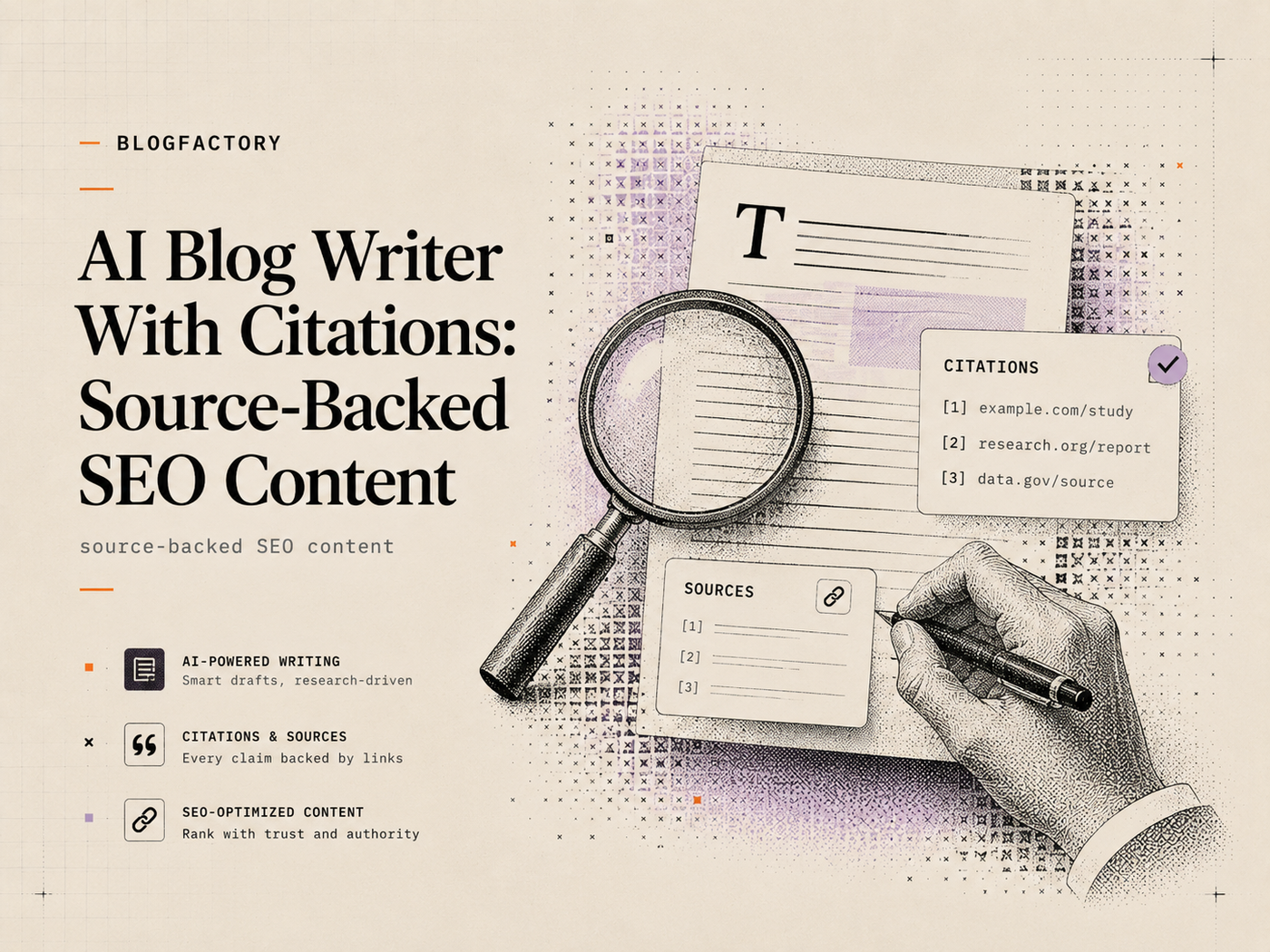
An AI blog writer with citations should do more than generate fluent paragraphs and attach a few links. It should identify the reader’s search intent, inspect existing coverage, select reliable sources, connect each material claim to evidence, and clearly flag anything that cannot be verified.
Citations make claims easier to inspect, but they do not guarantee accuracy. A source can be irrelevant, outdated, low quality, or incorrectly interpreted. The real goal is a source-backed article in which evidence and editorial judgment work together.
Key points
- Citations only help when they support the exact claim beside them.
- The workflow should check the publishing site for duplicate coverage before creating another article.
- Primary and authoritative sources should support important factual claims.
- Proprietary evidence—such as a test, interview, internal result, or firsthand observation—adds value that a generic model cannot invent.
- Unsupported facts should be removed, labeled, or block publish-ready status.
- SEO structure matters, but Google does not recommend writing to an arbitrary word count or mass-producing pages without added value.[1]
What is an AI blog writer with citations?
An AI blog writer with citations is a writing workflow that researches sources and connects factual statements to those sources. It makes evidence part of planning, outlining, writing, and review.
A useful system should answer:
- What search intent does the article serve?
- Does the site already have a page that satisfies the same intent?
- Which claims need external evidence?
- Which claims come from the company or author?
- Which sources are current enough for the topic?
- Does each citation actually support the nearby statement?
- What remains uncertain?
- Is the result blocked, a draft, or ready for editorial review?
Why citations do not automatically make AI content accurate

A model can produce a citation that looks plausible but fails in several ways.
The source does not exist
The model may invent a title, author, report, URL, or publication date. This is one of the clearest forms of hallucination.
The source exists but does not support the claim
A cited page may discuss the same topic without containing the statistic, conclusion, or product detail attributed to it.
The source is outdated
Software features, prices, laws, standards, and product versions change. A source that was accurate last year may no longer support a present-tense statement.
The source is low quality
A roundup that copied another roundup is weaker evidence than official documentation, original research, a filing, a standard, or a directly observed result.
The claim is too broad
A source may support a limited result, while the article turns it into a universal conclusion. Good citation practice preserves the source’s scope and limitations.
The editorial check is not “Does this paragraph contain a link?” It is “Does the evidence justify the exact wording?”
Start with search intent and duplicate-content checks
Research should begin on the publishing site, not on a blank document. A controlled AI SEO content workflow should connect this research stage to review and CMS delivery.
Search the domain for the primary keyword and close variants. Compare the intent and reader job, not only the titles. If an existing article already answers the same question, the right action may be to refresh, consolidate, redirect, or choose a genuinely distinct angle.
This reduces keyword cannibalization and creates stronger internal-link opportunities.
Next, inspect the most relevant organic results for the target query. Record:
- the format used;
- the questions competitors answer;
- the evidence they provide;
- the level of detail;
- how recently the content was updated;
- what important question or limitation they omit.
Use the results to identify expected coverage and a defensible information gain, not to copy competitors.
Google’s people-first content guidance asks whether a page offers original information, research, analysis, comprehensive coverage, clear sourcing, and substantial value compared with other results.[1] Those are better planning questions than “How many times should the keyword appear?”
Build a source hierarchy before drafting
A source hierarchy helps the writer choose stronger evidence.
Primary sources
Use official documentation, standards, legislation, filings, original datasets, research papers, product repositories, release notes, and direct statements from the responsible organization whenever possible.
Primary sources are especially important for:
- software behavior and current features;
- product requirements;
- licenses;
- regulatory or legal details;
- exact dates and versions;
- research methods and results.
Reliable secondary sources
Use reputable reporting or expert analysis when interpretation, independent context, or comparison is necessary. Secondary sources are valuable, but the article should not cite a summary as if it were the original evidence.
Proprietary sources
Company data, interviews, customer observations, field tests, and internal experiments can create original value. They must be real, attributable, and described with enough context to understand what was measured.
Analysis
The author may synthesize sources and draw a conclusion. Label that conclusion as analysis rather than pretending a source stated it directly.
A source-backed workflow should record when time-sensitive information was checked.
Use a claim ledger
A claim ledger is a small table maintained during research. It separates evidence management from prose.
Useful columns are:
- Claim
- Classification
- Source
- Verified date
- Status or limitation
Classifications may include primary source, secondary source, proprietary evidence, user-provided, calculated, analysis, or unverified.
For example:
- “Ghost Admin API keys must remain private” → primary source → Ghost documentation → verified date.
- “Our team reduced the manual publishing path from about 30 minutes per post to reviewed batches in minutes” → proprietary evidence → documented operator case study → scope and limitations attached.
- “This workflow is safer than every alternative” → unverified and overly broad → remove or narrow.
The ledger can remain internal. Its purpose is to stop unsupported claims from disappearing inside polished prose.
Add proprietary evidence without inventing experience
A source-backed article should not merely summarize the same public pages every competitor can access.
Original value may come from:
- a controlled product test;
- an implementation lesson;
- an interview quote;
- internal performance data;
- a field observation;
- a customer workflow;
- a calculated comparison using disclosed inputs;
- an expert decision framework.
The model must not invent any of these. If the brief requires firsthand evidence and none is available, the workflow should stop or insert a visible placeholder approved by the editor.
Fluent copy is not a substitute for real experience.
Map citations to exact claims

After the first draft, review every sentence containing a number, date, named result, technical behavior, product capability, quotation, or causal statement.
For each one:
- Open the cited source.
- Find the passage or data that supports the claim.
- Check whether the article preserves the original scope.
- Confirm the source is current enough.
- Rewrite or remove anything that goes beyond the evidence.
- Make sure the citation marker resolves to one clear reference.
A single source may support several nearby claims, while a paragraph with unrelated claims may need multiple citations. Remove decorative references that support nothing in the article.
How SEO fits into source-backed writing
Source discipline and SEO are complementary, but neither replaces the other.
A useful SEO article should still:
- answer the primary question early;
- use a descriptive title and headings;
- cover relevant entities and subtopics naturally;
- include verified internal links;
- provide helpful image alt text;
- use accurate metadata;
- address real long-tail questions;
- make the page easy to scan.
Google says generative AI can help with research and structure, but automatically generating many pages without added value may violate its scaled content abuse policies. Its guidance emphasizes accuracy, quality, relevance, and useful context around how content was created.[2]
There is no required Google word count, no safe keyword-density formula, and no citation format that guarantees rankings or inclusion in AI-generated answers. The article still has to satisfy the reader better than the available alternatives.
What a complete source-backed article package includes
A review-ready package normally includes:
- primary and related keywords;
- search intent;
- the competitor gap covered;
- proprietary evidence used;
- a clear readiness label;
- a concise slug;
- meta title and description;
- CMS excerpt;
- article body;
- FAQs based on evidenced questions;
- internal-link targets;
- image concepts, filenames, and alt text;
- numbered references.
Mechanical validation can catch missing fields, duplicate FAQs, broken citation numbering, metadata problems, placeholders, or invalid structure. It cannot prove that evidence supports the prose; that still requires source review.
How to evaluate an AI blog writer with citations
Before choosing a tool or workflow, test it with a topic you understand.
Ask these questions:
Does it check existing site content?
A tool that ignores the publishing domain may create a duplicate article even when a strong page already exists.
Does it show where claims came from?
Look for claim-to-source mapping, not only a generic reading list.
Can it distinguish evidence from analysis?
The system should not present the writer’s synthesis as a direct statement from a source.
What happens when evidence is missing?
The correct behavior may be to stop, narrow the wording, or mark the draft incomplete. Inventing a plausible answer is not acceptable.
Does it support approval before drafting?
For high-value or product-led pages, reviewing the target questions, claims, and outline can prevent an expensive full-draft rewrite.
Does it validate the package?
Check whether the workflow reviews metadata, citations, images, FAQs, placeholders, and structure—not only grammar.
Does it publish automatically?
Writing and CMS authority should be separate decisions. A research skill does not need access to the publish button; that separation is central to open-source content automation.
Source-Backed Blog Writer: an open-source option
Source-Backed Blog Writer is a portable Agent Skill maintained by BlogFactoryHQ. It is designed for researching, planning, drafting, refreshing, and auditing SEO articles without inventing evidence.
The skill includes:
- publishing-site and search-intent research;
- checks for competing existing pages;
- article-pattern selection;
- source and claim discipline;
- optional outline approval;
- metadata, excerpt, FAQs, and image recommendations;
- blocked, draft, or publish-ready labels;
- a dependency-free Python validator for mechanical checks.
It works independently from a CMS. That separation is deliberate: the skill defines the editorial procedure, while a separately authorized workflow such as BlogFactory or Ghost Publisher can handle draft delivery after review.
The full source and installation instructions are available in the GitHub repository.
Frequently asked questions
Can AI citations still be hallucinated?
Yes. A model can invent a source or misrepresent a real one. Every material citation should be opened and checked against the exact claim.
Should every sentence have a citation?
No. Common explanations, clearly labeled analysis, and editorial guidance may not require one. Specific facts, numbers, dates, quotations, product behavior, and consequential claims usually do.
Are primary sources always enough?
Not always. Primary sources establish original facts, while independent secondary sources may provide necessary context, criticism, or comparison.
Do citations improve Google rankings?
Citations are not a guaranteed ranking mechanism. Clear sourcing can improve trust and usefulness, but the page must still satisfy search intent and provide original value.
Can an AI writer invent a case study placeholder?
It can mark where proprietary evidence is needed, but it should not fabricate the result, quote, participant, or method.
Should the AI writer publish directly to the CMS?
Not by default. Research, drafting, review, CMS delivery, and public publishing have different risk levels and should use separate permissions.
The practical takeaway
An AI blog writer with citations is valuable when citations are part of an evidence workflow, not decoration added to generated text.
Start by checking the site and search intent. Choose strong sources. Track material claims. Add real proprietary evidence. Verify every important statement. Label unresolved uncertainty. Then validate the article package before it reaches the CMS.
The result is not merely content with links. It is a draft whose claims, originality, and readiness can be inspected by a human editor before it enters a CMS draft delivery workflow.