
The easiest AI content workflow to build is also one of the worst:
Keyword → prompt → article → publish
It looks efficient because every step is automated. It is also fragile.
The model may misunderstand search intent, repeat an article you already have, invent a claim, use an outdated source, miss an important internal link, overwrite a newer revision or send the content to the wrong destination. If the same automation also has live publishing access, every upstream mistake becomes a production mistake.
A better AI SEO workflow does not remove humans from the process. It changes where humans spend their attention.
Machines should handle repetitive collection, transformation and first-pass execution. Humans should own strategy, judgment and the final publishing decision.
This guide shows how to build that workflow from search data to CMS draft.
What is an AI SEO workflow?
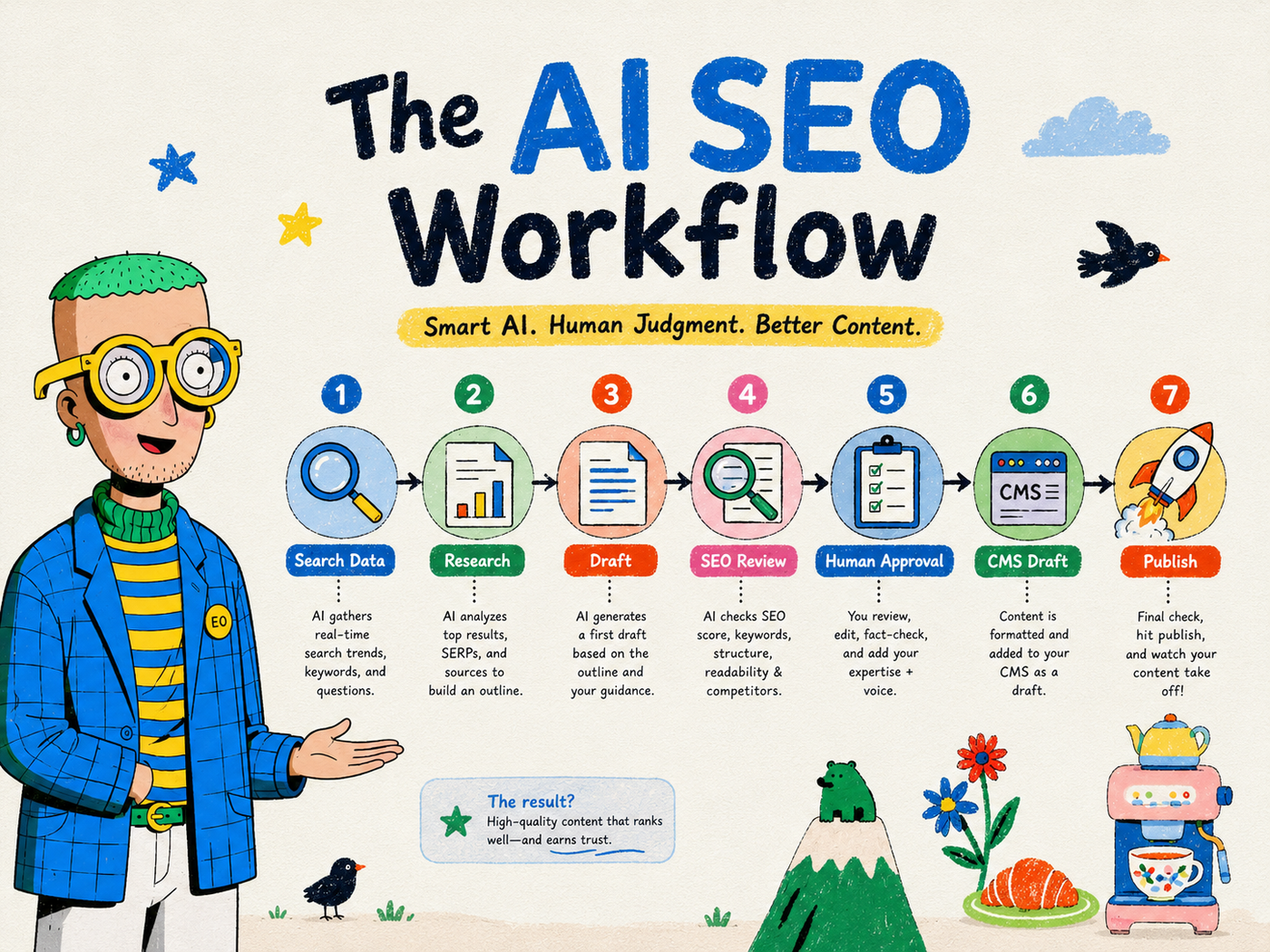
An AI SEO workflow is a repeatable process where AI models or agents help perform SEO and content tasks using real data, defined tools and controlled actions.
A mature workflow might look like this:
Search data → opportunity detection → research → brief → draft → SEO checks → editorial review → CMS draft → human publish → measurement
AI can participate in several steps, but it should not be treated as the source of truth for all of them.
The key design principle is simple:
Give AI enough authority to remove work, but not enough authority to turn an unreviewed mistake into a public incident.
Why “one prompt to publish” fails
The promise of fully autonomous content is seductive. It removes coordination and makes output almost infinitely scalable.
Unfortunately, content quality is not a linear function of output volume.
AI can hallucinate
A fluent sentence can still be wrong. This is especially dangerous for statistics, legal claims, product specifications, medical information, financial information and quotations.
Search intent is contextual
A model can generate a generic article for almost any keyword. That does not mean the page is the right format, angle or level of depth for the current search results.
Your site already has history
A new article may cannibalize an existing page. A refresh may be better than a new URL. An internal link may solve the problem more efficiently than another 2,000 words.
Production systems require version safety
If an editor changes a draft while an agent is still working from an older version, a blind update can overwrite the human’s work.
Publishing is a high-risk action
A draft can be fixed. A live page can be indexed, shared, cached and seen by customers before anyone notices the problem.
That is why a robust workflow separates generation authority from publishing authority.
Step 1: Start with first-party search data
Do not begin every content decision with a keyword database.
Google Search Console provides first-party evidence about how your existing site appears in search. That makes it particularly useful for finding opportunities involving pages you already own.
Look for patterns such as:
- pages gaining impressions but not clicks
- pages losing clicks over a meaningful period
- queries where average position is near page-one visibility
- pages ranking for topics they only partially cover
- URLs receiving impressions for several related intents
- strong pages that could distribute authority through internal links
The goal is not to ask AI to interpret every fluctuation. Search data is noisy. Dates may be incomplete, seasonality matters and ranking changes can have many causes.
Use AI to help triage evidence, not to invent certainty.
Step 2: Classify the opportunity before creating content
One of the most valuable automation steps is deciding what kind of work should happen next.
Possible actions include:
- create a new article
- refresh an existing article
- improve title and description
- expand a section
- consolidate overlapping pages
- add internal links
- fix technical issues
- do nothing yet
This classification prevents the content machine from treating “more content” as the answer to every SEO problem.
A good agent can help summarize evidence, but the workflow should make the available action types explicit.
Step 3: Build a research packet
Before drafting, collect the evidence the writer or agent needs.
A useful research packet can contain:
- primary query and related queries
- Search Console performance
- current page content if refreshing
- relevant internal pages
- product or company documentation
- approved brand claims
- source URLs
- competitor SERP patterns
- audience and funnel stage
- content objective
- constraints or claims to avoid
This is more reliable than asking a model to “research the topic” without boundaries.
The better the source packet, the less the model has to improvise.
Step 4: Turn research into a structured brief
The brief is where SEO strategy becomes an executable task.
A useful AI-assisted content brief should define:
Search intent
What is the reader actually trying to accomplish?
“Best open-source SEO tools” is commercial investigation. “How to self-host an SEO crawler” is procedural. “What is MCP?” is informational.
The page should match the job.
Primary topic
Use a primary keyword as a directional signal, not a phrase that must be inserted every 150 words.
Supporting topics
Include entities, subquestions and related problems that make the article complete.
Recommended structure
Define the H2/H3 hierarchy before drafting. This reduces repetition and gives reviewers a clearer framework.
Evidence requirements
Specify which claims need a source and which internal documentation the draft must use.
Internal links
Identify pages that should receive or provide contextual links.
Conversion goal
An informational article should not suddenly become a 500-word product pitch. Define the appropriate CTA before writing.
Step 5: Generate a first draft — not a final answer
The model’s first output should be treated as a working revision.
That changes how you evaluate it.
A first draft should aim for:
- complete coverage of the brief
- logical structure
- factual grounding in the provided sources
- clear language
- useful examples
- a consistent audience level
It does not need to be perfect. In fact, trying to make one generation do everything often leads to bloated prompts and less predictable results.
A staged workflow is easier to debug.
Generate first. Review second. Revise deliberately.
Step 6: Run deterministic SEO checks
Not every quality check needs AI.
Use rules where rules are enough.
Examples:
- title exists
- meta description exists
- one clear H1 exists
- heading hierarchy is valid
- canonical destination is known
- slug is present
- required internal links are included
- prohibited phrases are absent
- article length falls within a sensible range
- destination fields are mapped correctly
Deterministic checks are cheap, explainable and repeatable.
An LLM should not be deciding whether a required field is blank.
Step 7: Use AI for qualitative review
AI is more useful for questions that require interpretation.
For example:
- Does the introduction answer the query quickly?
- Are sections repetitive?
- Does the article make unsupported claims?
- Is the tone aligned with the brand?
- Are key reader objections missing?
- Does the conclusion over-sell the product?
- Is the comparison balanced?
- Is the text genuinely useful without the CTA?
This can be a separate model call or a different agent role.
Separating writer and reviewer behavior often produces better results than asking the same generation to declare itself excellent.
Step 8: Keep a human review gate
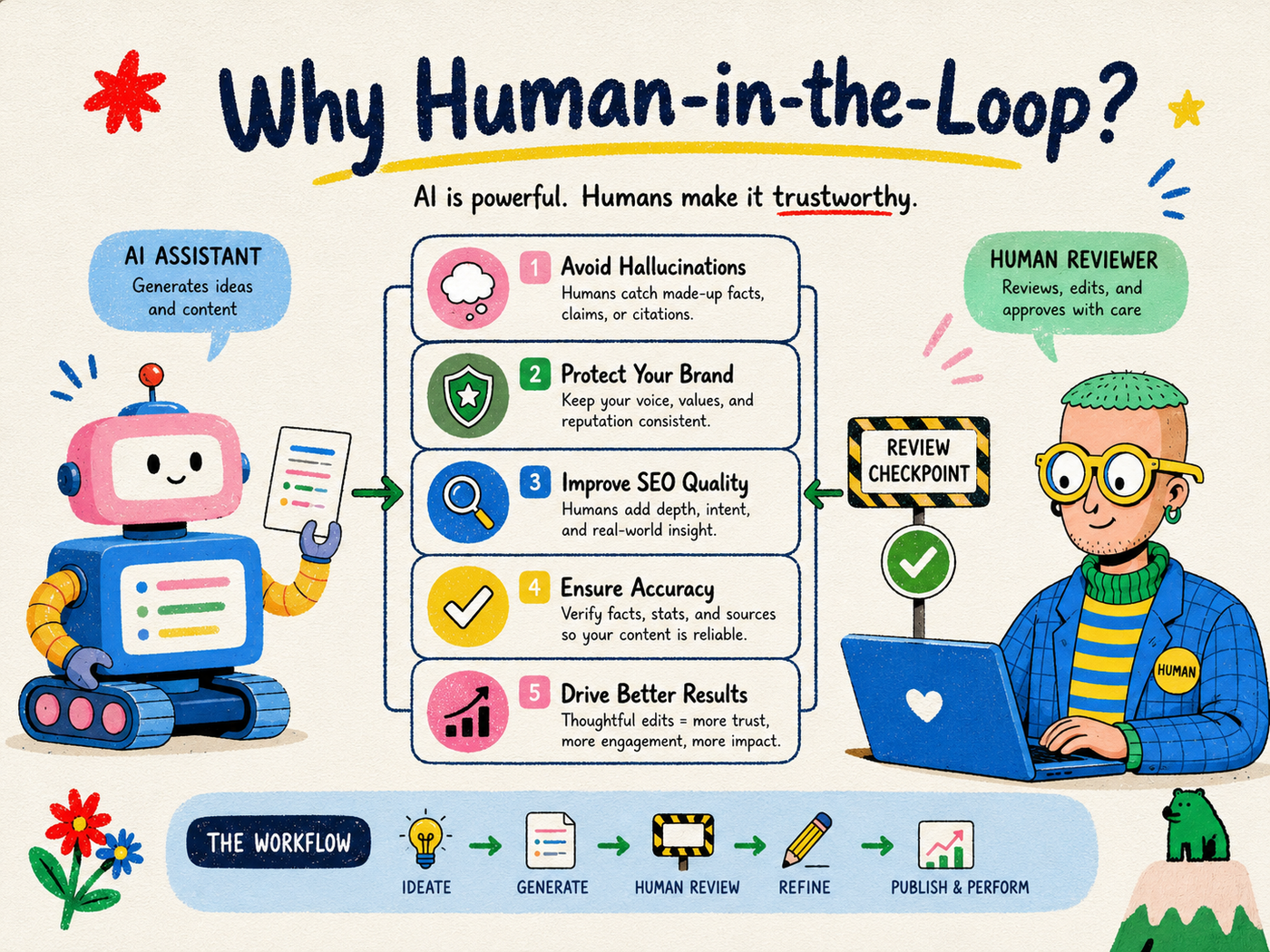
Human review is not a failure of automation.
It is the point where the organization applies judgment that is hard to encode completely.
A reviewer should be able to see:
- the current draft
- relevant sources
- what changed
- SEO metadata
- warnings or blockers
- the intended destination
The review interface matters. If approving an AI draft requires opening five tools and reconstructing the context manually, people will either skip the review or hate the workflow.
The goal is to make human judgment fast, not to remove it.
Step 9: Send approved content to the CMS as a draft
This is one of the strongest safety boundaries you can add.
After review, the automation can create or update a draft in the selected CMS destination.
A human can then preview the actual page, verify formatting and publish through the CMS’s normal controls.
Why not publish automatically?
Because the marginal time saved is often small compared with the risk added.
The workflow has already automated research, drafting, revision and transfer. Requiring one explicit production decision preserves accountability with very little operational cost.
Step 10: Measure what happened
Publishing is not the end of the SEO workflow.
After enough time has passed, review:
- clicks
- impressions
- average position
- click-through rate
- conversions
- engagement
- assisted conversions
- new queries
- internal-link effects
Do not promise that a content update “caused” a ranking increase simply because the dates line up. Search performance is influenced by competition, algorithm changes, seasonality, SERP features and many other variables.
Treat the observation as evidence, not proof.
Then feed useful learning back into the next content decision.
The architecture of a controlled AI SEO workflow
A modular architecture could look like this:
Data layer
- Google Search Console
- keyword/SERP provider
- web crawler
- analytics
Reasoning layer
- AI model
- agent
- retrieval system
Automation layer
- schedules
- APIs
- deterministic rules
- workflow routing
Content operations layer
- content inventory
- briefs and drafts
- revisions
- SEO metadata
- review
- destination selection
Publishing layer
- WordPress
- Ghost
- headless CMS
- another publishing system
The important point is that the model does not need direct ownership of every layer.
Where MCP fits
The Model Context Protocol makes it easier for compatible AI clients to call tools instead of requiring every integration to be manually copied into a prompt.
For SEO, an MCP-connected agent might:
- read Search Console performance
- inspect an existing post
- create a revised draft
- request a review packet
- hand the approved version to a CMS draft destination
MCP does not automatically make this safe.
The server still needs permissions, authentication and boundaries. A tool protocol tells an agent how to call a capability. Your application still decides whether that capability should exist.
How BlogFactory approaches the workflow
BlogFactory is built around this controlled model.
It combines content inventory, revisions, SEO metadata, Search Console workflows, agent access through MCP, review/preflight and CMS draft delivery.
The platform’s authority ceiling is intentionally narrow. MCP-connected agents can perform useful editorial operations, but the workflow is designed so the CMS handoff remains a draft rather than an autonomous live publish.
Version-aware updates also matter. If the draft changed after the agent last read it, stale updates can be rejected instead of silently overwriting newer work.
This is the kind of operational constraint that becomes important once AI moves from “assistant in a tab” to “agent performing actions.”
Example: refreshing a declining article
Imagine an article that used to receive 4,000 organic clicks per month and has gradually declined.
A controlled workflow could be:
- Search Console flags the page as a refresh candidate.
- The system collects relevant queries and a complete comparison window.
- An agent reads the current article and related internal content.
- The agent creates a suggested brief explaining missing sections and outdated material.
- A human confirms that a refresh is appropriate.
- The agent creates a new revision.
- SEO checks identify missing metadata or internal links.
- An editor reviews factual claims and tone.
- The approved version is sent to the CMS as a draft.
- A human previews and publishes.
- Performance is monitored after the change.
Most of the repetitive work is automated. The consequential decisions remain visible.
Common AI SEO workflow mistakes
Automating before defining the process
If the manual workflow is unclear, automation usually makes the confusion faster.
Giving the model too much context
Dumping thousands of irrelevant tokens into every prompt can make results worse and more expensive. Retrieve only what the task needs.
Letting AI perform deterministic work
Use code and rules for exact checks. Use AI where judgment is necessary.
Giving every agent the same permissions
A research agent does not need CMS delivery access. A writing agent does not need account administration.
Measuring output instead of outcomes
“100 articles generated” is an automation metric, not an SEO result.
Removing the review step to save minutes
The final publish decision is one of the cheapest places to keep human accountability.
A simple rule for AI content automation
Automate the path to a high-quality decision, not the decision you cannot afford to get wrong.
For SEO content, that usually means letting AI move quickly through research, analysis, drafting and iteration while keeping the final public action explicit.
That model scales without pretending the model is infallible.
Explore BlogFactory on GitHub
BlogFactory is an open-source content operations platform built for AI-assisted workflows with Search Console context, revisions, review and CMS draft delivery.
Inspect the implementation, self-host it or contribute to the project: