
MCP is quickly becoming one of the most important interfaces in AI-assisted marketing.
Instead of exporting SEO data, uploading spreadsheets into a chat and manually moving recommendations into other systems, teams can connect AI clients directly to approved tools through the Model Context Protocol.
That changes the role of the AI assistant. It is no longer limited to reasoning over whatever you paste into the conversation. It can call live tools for keyword research, SERP data, crawling, web research, Search Console analysis and content operations.
The best MCP server depends on the job. An SEO data server is not a replacement for a crawler. A web research server is not a content workflow system. The most useful setup often combines several specialized servers.
This guide covers the most relevant MCP options for SEO and content marketing in 2026 and explains where BlogFactory fits.
Best SEO and content MCP servers at a glance
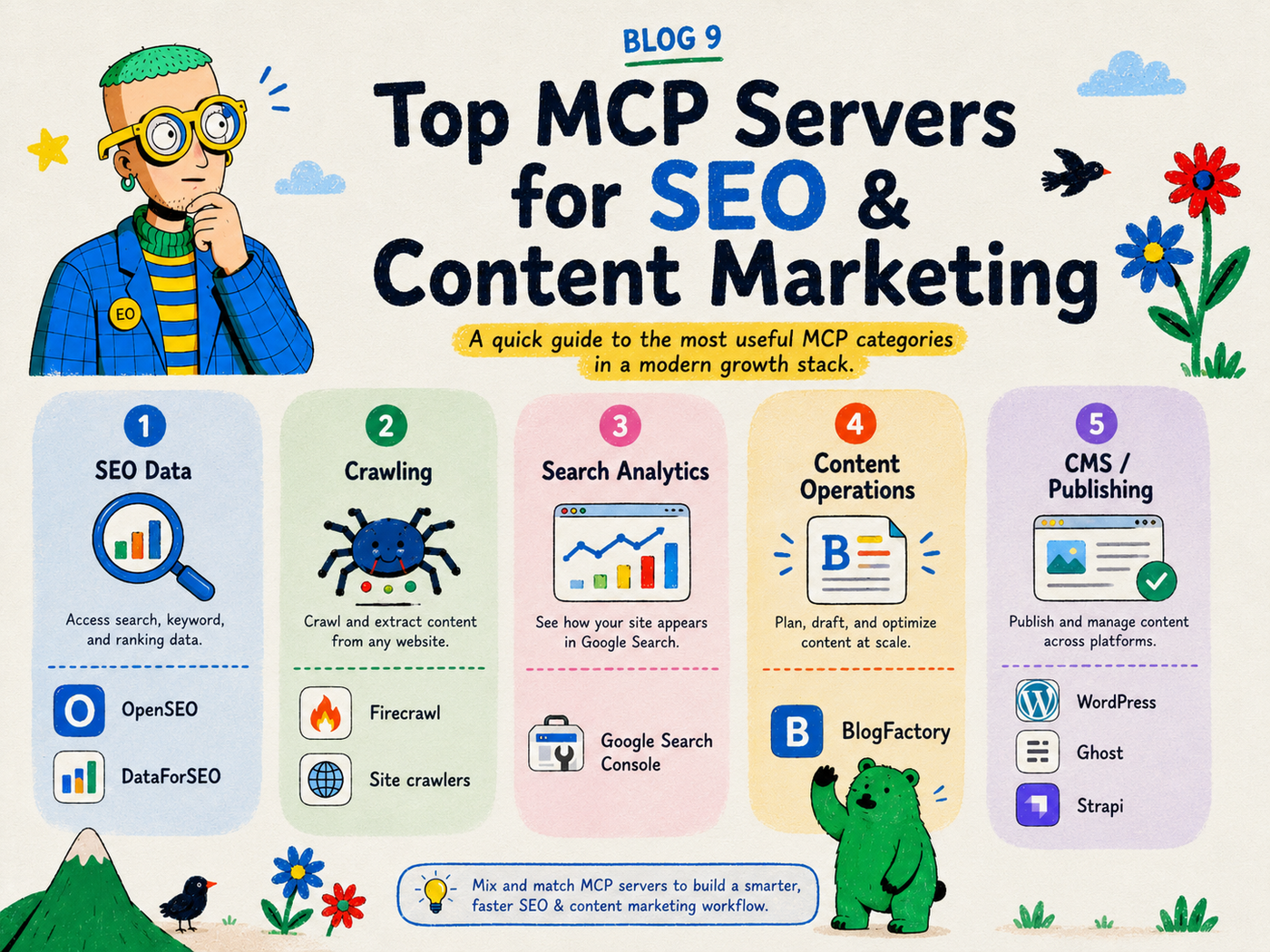
| MCP server | Best for | Open source | Main role |
| Ahrefs MCP | Ahrefs SEO data | No | SEO intelligence |
| Semrush MCP | Semrush data and research | No | SEO intelligence |
| DataForSEO MCP | Programmatic SEO datasets | Yes server | SEO data infrastructure |
| OpenSEO MCP | Open-source SEO workflows | Yes | SEO workspace |
| Firecrawl MCP | Web search, scraping and extraction | Yes | Research/crawling |
| Scouter MCP | Technical SEO crawling | Yes | Technical SEO |
| LibreCrawl MCP projects | Technical audits | Yes | Technical SEO |
| Search Console MCP integrations | First-party search data | Varies | Search performance |
| CMS MCP integrations | Direct CMS actions | Varies | Publishing layer |
| BlogFactory MCP | Governed content operations | Yes | Drafting/review/delivery |
The important question is not “Which MCP server has the most tools?” It is “Which server exposes the right capabilities with the right permission boundaries?”
1. Ahrefs MCP — best for teams already using Ahrefs
Ahrefs provides an official hosted MCP server that lets supported AI clients access Ahrefs data.
That makes it possible for an agent to work with real keyword, backlink and domain information instead of relying on static exports.
Potential use cases include:
- finding keyword opportunities
- checking referring domains
- investigating competitors
- exploring ranking pages
- enriching content research with current Ahrefs data
For teams already paying for Ahrefs and using its datasets as a core part of their SEO process, MCP makes the existing subscription more useful inside agent workflows.
The main limitation is obvious: the MCP layer is still tied to Ahrefs data and plan requirements. It is not an open-source replacement for the Ahrefs platform.
Best for: Ahrefs customers who want AI agents to query their existing SEO dataset.
2. Semrush MCP — best for teams operating in the Semrush ecosystem
Semrush also offers an MCP endpoint for connecting AI agents to Semrush data.
Like Ahrefs MCP, the value is not simply “chat with SEO data.” The larger opportunity is using Semrush as a callable data source inside multi-step workflows.
An agent can potentially combine Semrush data with internal content, Search Console or other tools to answer more operational questions.
For example:
Identify topics where our competitors have organic visibility, compare those opportunities with our existing content inventory and return only gaps that fit our product category.
That task becomes more useful when the agent can pull evidence rather than asking the user to assemble it manually.
Best for: teams already standardized on Semrush data and workflows.
3. DataForSEO MCP — best for developers and custom SEO agents
DataForSEO is particularly interesting for agent builders because its business is already structured around APIs.
Its official MCP server gives AI clients access to SEO data and documentation through an agent-friendly interface. DataForSEO exposes datasets across areas such as SERPs, keywords, domains, backlinks and on-page analysis.
For a development team, this can provide a lower-level building block than using a large all-in-one SEO application.
You can build your own agent behavior around the data rather than adapting to a predefined dashboard workflow.
DataForSEO’s MCP implementation is also available as open-source server software, while the underlying commercial datasets remain paid services.
That distinction is worth understanding:
open-source connector ≠ free global SEO data
Collecting high-quality search data at scale is expensive.
Best for: developers building custom SEO research and automation systems.
4. OpenSEO MCP — best open-source SEO workspace for agents
OpenSEO combines a self-hostable SEO application with an MCP interface.
The platform covers workflows such as:
- keyword research
- rank tracking
- competitor analysis
- backlinks
- site auditing
- AI visibility
- Search Console-related agent workflows
Its MCP server allows compatible agents to query the SEO tools directly.
This makes OpenSEO a strong option for teams that want more control over the application layer and do not want every SEO workflow locked inside a proprietary interface.
The project can use external SEO data providers, which allows the software layer to remain open while relying on specialized paid infrastructure for expensive datasets.
Best for: technical SEO teams that want an open-source, self-hostable SEO workspace with MCP access.
5. Firecrawl MCP — best for web research and clean page extraction
SEO agents often need more than keyword data. They need to read the web.
Firecrawl’s official MCP server gives compatible clients capabilities around web search, scraping, crawling and structured extraction.
That is useful for tasks such as:
- collecting competitor pages
- reading documentation
- researching a topic
- extracting structured facts
- mapping sections of a site
- gathering source material for briefs
The difference between a generic web fetch and an extraction-focused tool matters. Modern websites are full of JavaScript, navigation, repeated interface elements and messy markup.
A dedicated crawling/extraction layer can give the model cleaner input.
Firecrawl is not an SEO suite, but it can be one of the most useful research components in an SEO agent stack.
Best for: agents that need current web content, search and structured extraction.
6. Scouter MCP — best for AI-native technical SEO audits
Scouter is an open-source SEO crawler designed with AI-agent usage in mind.
Its MCP interface lets agents work with technical crawl data directly. That creates a different experience from opening a crawler dashboard and manually filtering hundreds of issue rows.
You can ask the agent to investigate patterns such as:
- duplicate titles
- missing canonicals
- broken links
- indexability inconsistencies
- template-level issues
- clusters of pages sharing the same problem
The crawler remains responsible for collecting technical evidence. The AI agent becomes a flexible analysis interface over that evidence.
Best for: teams experimenting with agentic technical SEO.
7. LibreCrawl MCP projects — best for open technical SEO experimentation
LibreCrawl is an open-source technical SEO crawler, and MCP-focused projects have been built around its crawling approach.
These tools are interesting because technical SEO is one of the areas where an agent benefits most from structured tool access.
Instead of giving a model screenshots or a handful of manually selected URLs, the agent can query actual crawl results.
This makes questions like “What is structurally wrong with this site?” much easier to ground in evidence.
Open-source crawling also makes it possible for developers to add custom checks or extraction logic that would be difficult to implement in a closed SaaS crawler.
Best for: developers and agencies that want customizable MCP-accessible site audits.
8. Google Search Console MCP integrations — best for first-party organic performance
There is no substitute for your own search performance data.
Keyword platforms estimate demand and visibility. Search Console shows how Google Search actually interacted with your verified property.
An MCP integration can make that data directly usable by an AI agent.
Useful tasks include:
- identifying pages with declining clicks
- finding queries with rising impressions
- looking for low-CTR opportunities
- inspecting date-range changes
- checking sitemap or indexing information where supported
- connecting search performance to existing content
The biggest challenge is not access. It is interpretation.
Search Console data has completeness boundaries, aggregation behavior and context that should be preserved when an agent reads it.
A good integration should not hand the model a number without explaining the date range and freshness behind it.
Best for: any SEO team working on an existing website.
9. CMS MCP integrations — useful, but high-risk
Several CMS platforms and community projects expose content actions through MCP.
That can be convenient. An agent may be able to:
- read posts
- create content
- update fields
- manage drafts
- sometimes publish
However, direct CMS access deserves more scrutiny than read-only SEO data.
A CMS is a production system. If the MCP server exposes broad write, delete or live-publishing capabilities, the potential blast radius is much larger.
Before connecting an AI agent directly to a CMS, ask:
- Can access be limited to one site?
- Can write permissions be separated from publish permissions?
- Can the agent delete content?
- Can the agent read secrets or configuration?
- Is there revision protection?
- Is every action logged?
- Is a human approval step required for live publication?
For many teams, the safer architecture is to place a content operations layer between the agent and the CMS.
10. BlogFactory MCP — best for governed content operations
BlogFactory approaches MCP from the editorial operations side.
The platform exposes a site-scoped MCP work layer for tasks including:
- listing approved sites
- reading content
- creating drafts
- generating drafts
- updating drafts with revision awareness
- reading Search Console dashboards and insights
- inspecting URLs and sitemaps
- reviewing a post
- delivering an approved version to a CMS as a draft
What makes the model different is the authority ceiling.
BlogFactory is intentionally designed so MCP agents do not receive arbitrary administrative capabilities, raw provider credentials, deletion powers or a general live-publishing tool.
The final CMS handoff is a draft.
That makes BlogFactory less like an SEO database and more like the operating layer between SEO evidence, agent work and the publishing system.
Best for: teams that want AI agents to create and revise content without handing them unrestricted production control.
How to combine MCP servers
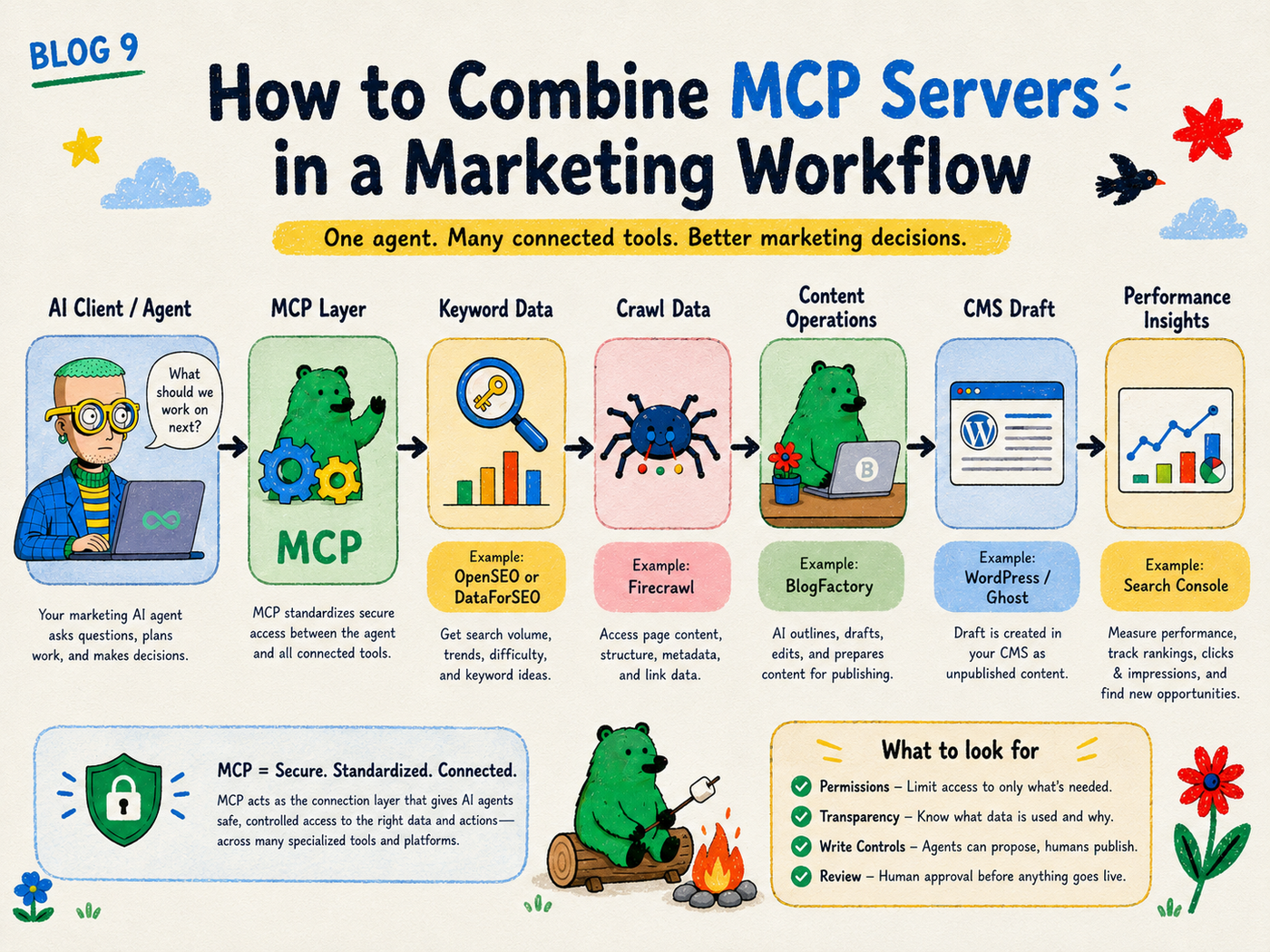
The most capable setup may use several MCP servers together.
Imagine an SEO content refresh task.
Step 1: Search Console or BlogFactory
Identify a page with declining clicks.
Step 2: Ahrefs, Semrush, DataForSEO or OpenSEO
Inspect the current keyword and competitive landscape.
Step 3: Firecrawl
Collect current competitor pages or relevant external sources.
Step 4: Scouter or another crawler
Check whether technical issues affect the section of the site.
Step 5: BlogFactory
Read the current article, create a revision and prepare it for review.
Step 6: Human approval
Review sources, changes, SEO metadata and destination.
Step 7: BlogFactory CMS handoff
Send the approved revision to the CMS as a draft.
No single MCP server needs to become a mega-platform.
The agent can orchestrate specialized tools.
What to look for in an SEO MCP server
1. Data quality
MCP does not improve bad data.
Ask where rankings, search volumes, backlinks and crawl data come from.
2. Freshness
SEO is time-sensitive. Verify how recent the underlying data is.
3. Authentication
Prefer revocable, scoped authentication over static credentials shared everywhere.
4. Tool clarity
The server should expose clearly defined operations rather than ambiguous all-powerful actions.
5. Permission scope
A tool connected to one site should not automatically gain access to every property.
6. Write boundaries
Understand exactly which calls modify data.
7. Production access
Be especially careful with delete and publish actions.
8. Logging
Operational history matters once agents can act.
9. Failure handling
Repeated calls, timeouts and stale state should fail predictably.
10. Human approval
For high-impact actions, explicit approval remains one of the simplest and strongest controls.
The best MCP stack by use case
For keyword and competitor research
Start with Ahrefs MCP, Semrush MCP, DataForSEO MCP or OpenSEO MCP depending on the data ecosystem you already use.
For open-source SEO research
Start with OpenSEO MCP and add specialized data providers where needed.
For web research
Use Firecrawl MCP.
For technical SEO
Use an MCP-enabled crawler such as Scouter or a LibreCrawl-based project.
For existing-site optimization
Prioritize Search Console access because it gives you first-party evidence.
For content production and review
Use BlogFactory MCP as the content operations layer rather than giving every research agent direct production publishing access.
MCP servers should be composable, not omnipotent
The strongest agent architecture is not necessarily the server with the largest tool list.
A smaller server with clear permissions can be safer and easier to reason about.
SEO work naturally splits into domains:
- search intelligence
- crawling
- web research
- analytics
- content operations
- publishing
MCP lets an AI client work across those domains without forcing one vendor to own them all.
That is one of the protocol’s most important implications for marketing teams.
Why the review layer will matter more, not less
As MCP makes more systems callable by agents, teams will automate increasingly complex work.
The bottleneck will move from data access to decision quality.
Agents will be able to gather more evidence, create more drafts and propose more actions than humans could previously produce manually.
That makes review infrastructure essential.
The goal should not be to place a human in front of every trivial tool call. The goal is to reserve explicit human judgment for actions with meaningful external consequences.
For content, the final path to production is one of those actions.
Explore BlogFactory on GitHub
BlogFactory’s MCP server is open source and built around site-scoped content operations, Search Console, revision-aware editing, review and CMS draft delivery.
Read the implementation and documentation directly: