
For years, “SEO software” mostly meant subscribing to a large SaaS platform and adapting your workflow to whatever features and pricing it offered. That model still works for many teams, but open-source SEO has become much more practical.
Today you can self-host rank trackers, crawl websites, run technical audits, analyze first-party search data, automate workflows and even let AI agents query SEO tools through MCP. Open source does not always mean zero cost — SERP, backlink and keyword datasets still cost money to collect — but it can give you far more control over the software layer.
This guide looks at 15 open-source tools worth knowing in 2026. They are not all direct competitors. The better way to think about them is as building blocks for an SEO stack.
Best open-source SEO tools at a glance

| Tool | Best for | Self-hosted | Main category |
| OpenSEO | Keyword, competitor and AI-agent workflows | Yes | SEO suite |
| SerpBear | Rank tracking | Yes | Rank tracker |
| SEOnaut | Technical SEO audits | Yes | Crawler/auditor |
| LibreCrawl | Flexible website crawling | Yes | Crawler |
| CrawlObserver | High-performance SEO crawling | Yes | Crawler |
| Scouter | AI-native crawling and MCP | Yes | Crawler/agent SEO |
| SiteOne Crawler | Website quality and technical checks | Yes/local | Crawler |
| Unlighthouse | Large-scale Lighthouse audits | Yes/local | Performance SEO |
| Lighthouse | Page quality and performance checks | Yes/local | Performance |
| Matomo | First-party analytics | Yes | Analytics |
| Plausible Community Edition | Lightweight web analytics | Yes | Analytics |
| Umami | Privacy-friendly analytics | Yes | Analytics |
| n8n | SEO workflow automation | Yes | Automation |
| Langfuse | LLM observability for AI SEO systems | Yes | AI operations |
| BlogFactory | AI-assisted content operations | Yes | Content operations |
There is no single “best” tool for every SEO team. A crawler solves a different problem from a rank tracker, and a content operations platform solves a different problem from a keyword database.
1. OpenSEO — best open-source all-in-one SEO workspace
OpenSEO is one of the clearest examples of how open-source SEO software has changed. It combines familiar workflows such as keyword research, rank tracking, backlinks, site audits and competitor research with newer AI-agent use cases.
The project is self-hostable and can use external SEO data providers rather than trying to build a global search index from scratch. That is an important tradeoff. You control the application and workflow, but you still pay for the underlying data you consume.
OpenSEO also exposes an MCP server, which means compatible AI clients can work with SEO data directly instead of relying on copy-and-paste exports.
Best for: teams that want a broad open-source SEO workspace and are comfortable bringing their own data provider.
2. SerpBear — best open-source rank tracker
SerpBear focuses on a much narrower problem: tracking where your pages rank for selected keywords.
That focus is a strength. The project supports domain and keyword tracking, scheduled notifications, a REST API and Google Search Console integration. Depending on your setup, ranking data can be collected through supported scraping services or configured providers.
If you already know which keywords matter and primarily need ongoing position tracking, SerpBear can be much simpler than adopting a full enterprise SEO suite.
Best for: self-hosted keyword rank tracking and reporting.
3. SEOnaut — best for straightforward technical SEO audits
SEOnaut is an open-source web-based SEO auditing tool. It crawls a website and surfaces technical problems such as broken links, redirects, missing or duplicate metadata and heading issues.
The interface is built around turning crawl data into an understandable list of issues rather than forcing every user to interrogate raw crawl exports manually.
It is especially useful for smaller teams, developers and consultants who need repeatable site audits without subscribing to a heavyweight crawler platform.
Best for: identifying common crawlability and on-page SEO issues.
4. LibreCrawl — best flexible open-source crawler
LibreCrawl is a multi-user, web-based SEO crawler that can extract page metadata, analyze links, detect issues and export crawl data.
It also supports JavaScript rendering, which is increasingly important for modern websites that do not expose all useful content in the initial HTML response.
For technical SEOs who want to inspect or extend the crawler itself, the open-source model is particularly valuable. Instead of waiting for a vendor to support a niche extraction rule, a developer can change the workflow.
Best for: technical SEO teams that want a customizable crawler.
5. CrawlObserver — best for high-volume crawl analysis
CrawlObserver is built around performance. It extracts a wide range of SEO signals and is designed to make very large crawl datasets queryable quickly.
That makes it interesting for teams working on large sites where the bottleneck is not starting a crawl but analyzing millions of resulting rows efficiently.
For enterprise-size technical SEO, architecture matters. A tool that works beautifully on a 500-page marketing site may behave very differently on a marketplace with millions of URLs.
Best for: large-site crawling and fast analysis of crawl data.
6. Scouter — best AI-native open-source SEO crawler
Scouter represents another trend in 2026: SEO tools designed for AI agents from the beginning rather than adding a chatbot to an old interface.
It is a self-hosted SEO crawler with AI-oriented workflows and an MCP server. That means an agent can potentially initiate or query crawl work through a standardized tool interface.
The value is not that “AI does SEO for you.” The more useful idea is that crawl data becomes callable infrastructure. An agent can use structured site evidence while doing analysis instead of guessing from a few manually pasted URLs.
Best for: developers and SEO teams experimenting with agentic technical SEO.
7. SiteOne Crawler — best for broader website quality checks
SiteOne Crawler goes beyond a narrow keyword-focused definition of SEO. It can be used to inspect links, assets, accessibility-related signals, security and technical quality across a website.
That broader view is useful because many organic search problems are ultimately web quality problems. Broken resources, poor internal linking, oversized assets and malformed pages affect users and crawlers at the same time.
Best for: developers who want a general website crawler with SEO value.
8. Unlighthouse — best for scaling Lighthouse checks across a site
Running Google Lighthouse against one URL is easy. Running meaningful audits across hundreds or thousands of pages is where things become operationally annoying.
Unlighthouse is designed to make site-wide Lighthouse analysis easier. It can crawl a site and give you a broader view of performance and quality signals instead of testing pages one by one.
It is useful for finding templates or page groups that systematically perform worse than others.
Best for: site-wide performance and Lighthouse auditing.
9. Lighthouse — best foundational page-quality audit tool
Google Lighthouse remains one of the most important open-source tools in the web performance ecosystem.
It audits pages across areas such as performance, accessibility, best practices and SEO-related checks. Lighthouse is not a complete SEO platform, but it is a foundational component in many technical auditing pipelines.
Its biggest value is composability. Developers can run it locally, in CI pipelines or as part of larger automated systems.
Best for: repeatable page-level quality and performance checks.
10. Matomo — best self-hosted analytics platform
SEO without analytics quickly turns into ranking theater. You need to know what organic visitors actually do after they land on the site.
Matomo is a mature, open-source analytics platform that can be self-hosted. It gives teams an alternative to depending exclusively on hosted analytics products and is particularly relevant where privacy, data control or custom analytics requirements matter.
For SEO teams, Matomo can help connect acquisition to engagement and conversion rather than measuring success only in clicks and positions.
Best for: teams that want deep first-party web analytics under their own control.
11. Plausible Community Edition — best for simpler web analytics
Plausible became popular by making analytics intentionally smaller and easier to understand.
Its community/self-hosted option is attractive for sites that do not need the depth of a traditional enterprise analytics suite. For content teams, a simple view of traffic sources, landing pages and goals can often be more actionable than hundreds of reports nobody opens.
Best for: lightweight, privacy-conscious analytics.
12. Umami — best lightweight open-source analytics alternative
Umami is another privacy-friendly analytics platform with a clean interface and self-hosting support.
It works well when the goal is to measure page views, referrers, events and visitor behavior without introducing a complex analytics implementation.
For publishers or small SEO teams, that simplicity can make it easier to build a habit around measuring content outcomes.
Best for: simple self-hosted website analytics.
13. n8n — best open-source automation layer for SEO workflows
n8n is not an SEO product, but it belongs in an open-source SEO stack because so much SEO work is workflow automation.
Examples include:
- pulling Search Console data on a schedule
- sending crawl alerts to Slack
- enriching keyword datasets
- creating content tickets from search opportunities
- passing approved information between an SEO tool and a CMS
- orchestrating AI steps with human approvals
The mistake is using automation to replace judgment. The better use is removing repetitive transport work between systems.
Best for: connecting SEO tools and automating repeatable processes.
14. Langfuse — best for observing AI-powered SEO workflows
If your SEO system starts using LLMs heavily, a new question appears: how do you inspect what the model did?
Langfuse is an open-source LLM engineering and observability platform. It can help teams trace model calls, inspect prompts and outputs, compare behavior and understand the AI layer of an application.
This matters when “AI SEO” moves beyond a chat window and becomes a production workflow. If an agent is classifying hundreds of pages, generating briefs or choosing internal links, you need visibility into its behavior.
Best for: teams building custom AI SEO or content systems.
15. BlogFactory — best for governed AI content operations
BlogFactory is not a keyword research tool or a crawler. It sits later in the SEO workflow.
The platform is designed to turn search and content signals into reviewed editorial work. It combines content inventory, revisions, SEO metadata, Search Console context, human review and CMS draft delivery in one operational layer.
Its MCP interface allows compatible AI agents to work with approved content and SEO operations while keeping hard boundaries around higher-risk actions. The agent can help create and update drafts, inspect search data and prepare a CMS handoff, but BlogFactory is intentionally designed around draft delivery rather than autonomous live publishing.
That makes it a useful complement to the tools above.
A crawler can tell you what is broken. A keyword tool can tell you what people search. A rank tracker can tell you where you moved. BlogFactory focuses on what happens when those signals need to become actual content work.
Best for: SEO and content teams that want agentic workflows with human review and CMS draft controls.
Open source does not mean “free SEO data”
This distinction matters.
Software can be open source while the underlying data remains expensive.
Global rank tracking requires search result collection. Keyword volumes require datasets. Backlink analysis requires a continuously maintained link index. AI generation consumes model inference. Crawling large sites consumes compute.
The advantage of open source is not that every input becomes free. The advantage is that you gain more control over the application, integrations, deployment and workflow.
A healthy open-source SEO stack often looks like open software + paid data where necessary.
That can still be cheaper than a large SaaS bundle, but cost is only one reason to choose it.
How to build an open-source SEO stack
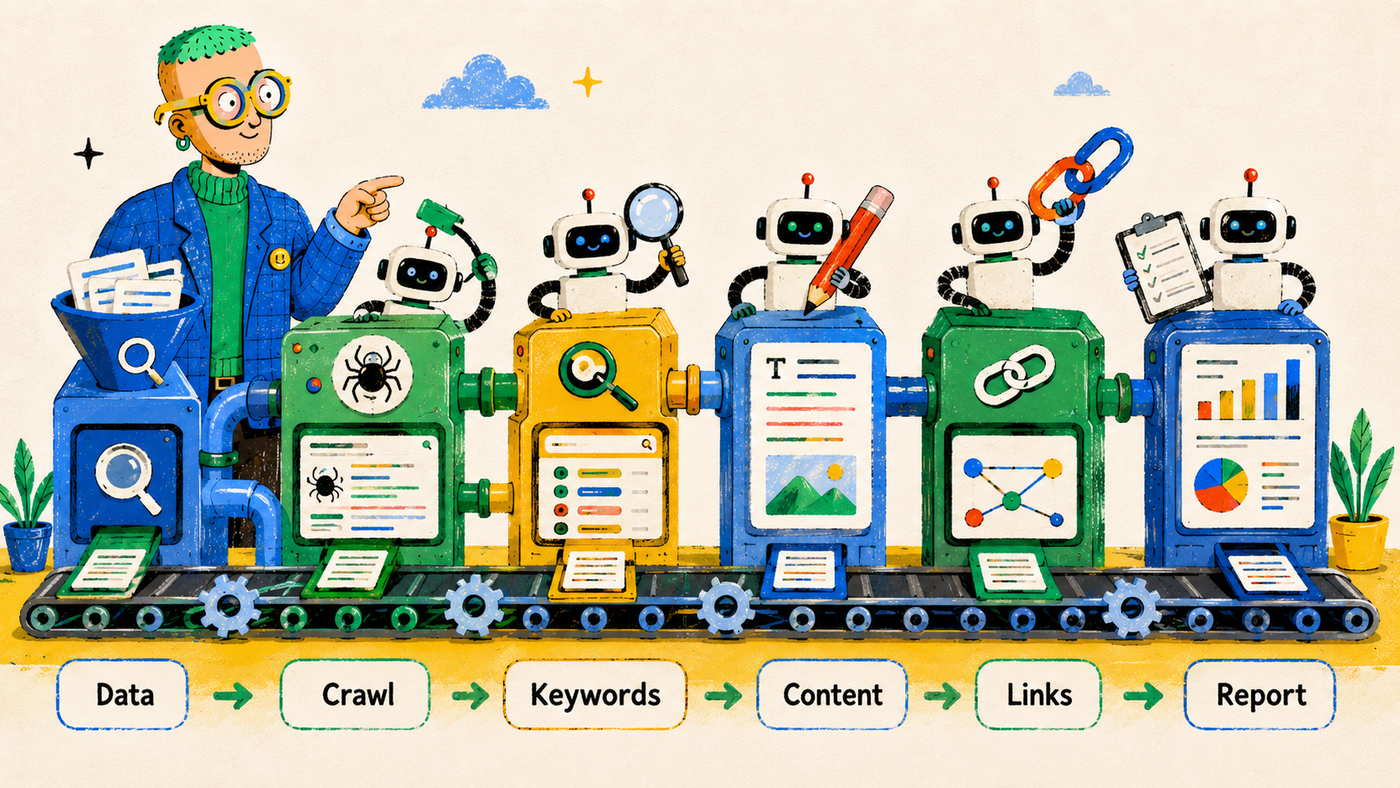
Instead of searching for one product that does everything, build around distinct jobs.
Research and search intelligence
Use a platform such as OpenSEO or an external SEO data provider for keyword, SERP and competitor information.
Rank tracking
Use SerpBear when you want to monitor a stable set of keywords over time.
Technical SEO
Use SEOnaut, LibreCrawl, CrawlObserver or Scouter depending on the size of the site and the depth of analysis you need.
Performance
Use Lighthouse and Unlighthouse to identify page and template quality problems.
Analytics
Use Matomo, Plausible or Umami to understand what users do after they arrive.
Automation
Use n8n to move information between systems without turning every workflow into a custom application.
Content operations
Use BlogFactory to connect search evidence, AI-assisted drafting, revision, review and CMS draft delivery.
That gives you a modular stack where each tool has a clear job.
Open source vs Ahrefs, Semrush and other SEO SaaS platforms
Commercial SEO suites remain excellent choices for many teams. They offer huge proprietary datasets, polished interfaces, support and years of workflow refinement.
Open source becomes more attractive when you prioritize:
- self-hosting
- source-code access
- flexible integrations
- AI-agent connectivity
- data ownership
- custom workflows
- lower software licensing costs
- avoiding dependence on one vendor’s product roadmap
A hybrid approach is often the most practical. You might use commercial data from Ahrefs, Semrush or DataForSEO while running your own automation and content operations stack around it.
The question is no longer “SaaS or open source?” It is “Which layers of the stack do we want to own?”
Which open-source SEO tool should you choose?
Start with the problem, not the GitHub stars.
If you need rank tracking, try SerpBear.
If you need technical audits, start with SEOnaut or LibreCrawl.
If you want an all-in-one research environment with AI-agent support, look at OpenSEO.
If you are building agentic technical SEO, examine Scouter and newer MCP-first projects.
If you need analytics, choose between the depth of Matomo and the simplicity of Plausible or Umami.
And if the bottleneck is turning SEO opportunities into controlled editorial execution, BlogFactory is built for that layer.
The most powerful outcome of open-source SEO in 2026 is not replacing one giant suite with another giant suite. It is being able to compose the workflow you actually want.
Explore BlogFactory on GitHub
BlogFactory is open source and self-hostable. You can inspect the code, run the content operations workflow yourself, review the MCP implementation or contribute to the project.