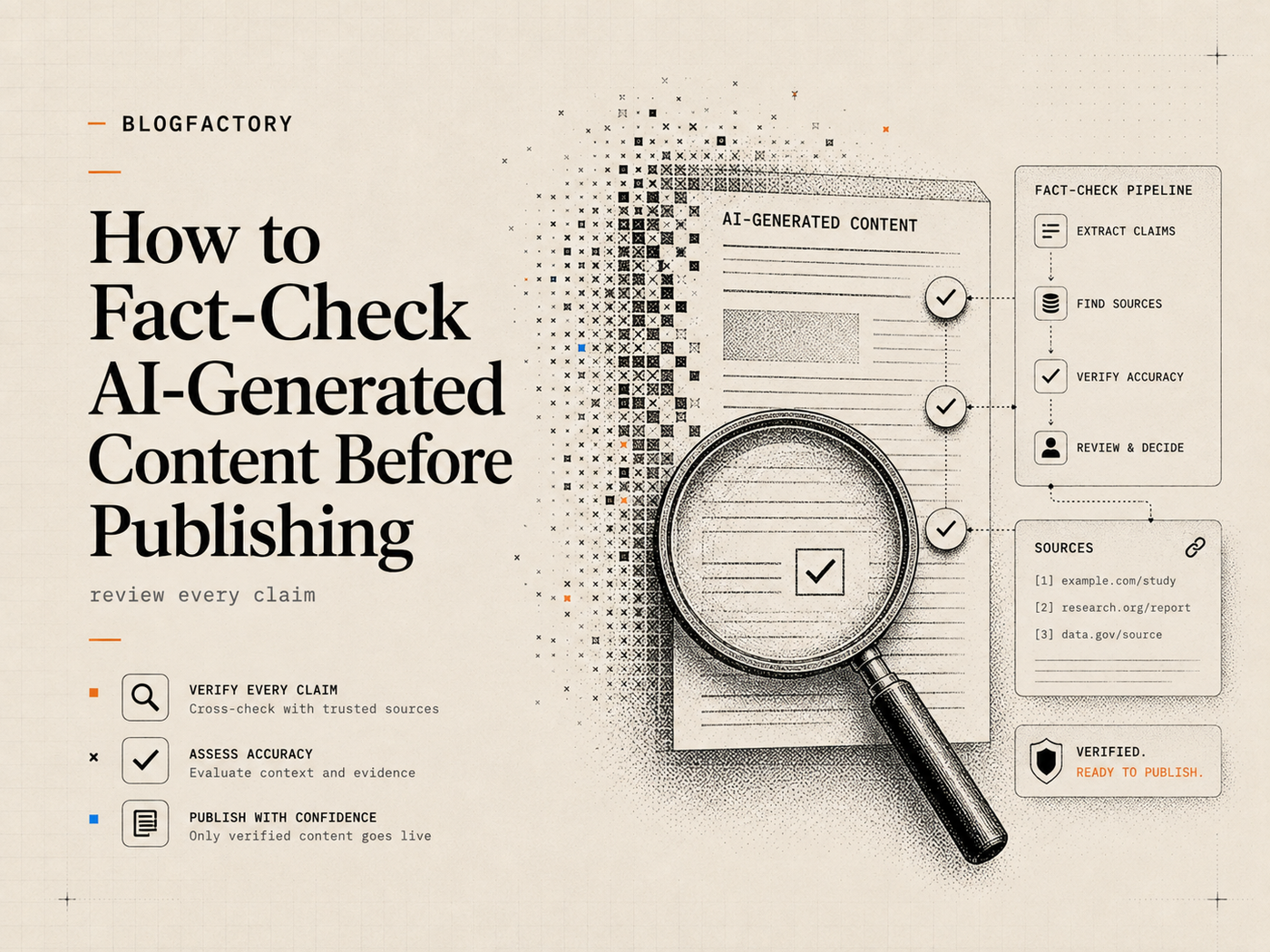
To fact-check AI-generated content, first extract every material claim from the draft. Then classify each claim, locate the strongest available evidence, verify the exact wording, check time-sensitive details, and record what remains unsupported.
A fact check is not complete because the article includes citations. The reviewer must confirm that the cited source exists, is reliable enough for the claim, remains current, and actually supports the nearby statement.
Key points
- Review claims, not only paragraphs.
- Prioritize numbers, dates, quotations, product behavior, legal statements, and claimed outcomes.
- Use primary sources for changing or consequential facts whenever possible.
- Verify proprietary evidence with the person, dataset, test, or internal record that produced it.
- Check scope, methodology, version, and date—not only whether a source mentions the topic.
- Unsupported material claims should block publish-ready status.
What fact-checking AI-generated content means
Fact-checking is the process of testing factual statements against evidence and correcting or qualifying the draft before publication. It is different from proofreading, which focuses on language, and from SEO review, which focuses on search intent, structure, metadata, links, and discoverability.
AI-generated text deserves the same editorial scrutiny as human-written text, plus additional attention to fabricated citations, invented experience, blended sources, outdated product details, and confident claims formed from weak context.
The reviewer’s job is not to prove that every sentence is universally true. It is to determine whether each material statement is supported strongly enough for the way the article expresses it.
Step 1: freeze the draft and record its context
Fact-check a defined revision, not a moving document. Save the draft version, title, author, intended publication, market, audience, primary keyword, review date, and sources supplied with the assignment.
Record whether the article was generated from public research, internal documents, interviews, product access, a test, or a previous article. This context determines which claims can be supported.
If the draft changes during review, require a new diff or review the changed sections again. Otherwise, the published version may contain statements that were never checked.
Step 2: extract every material claim
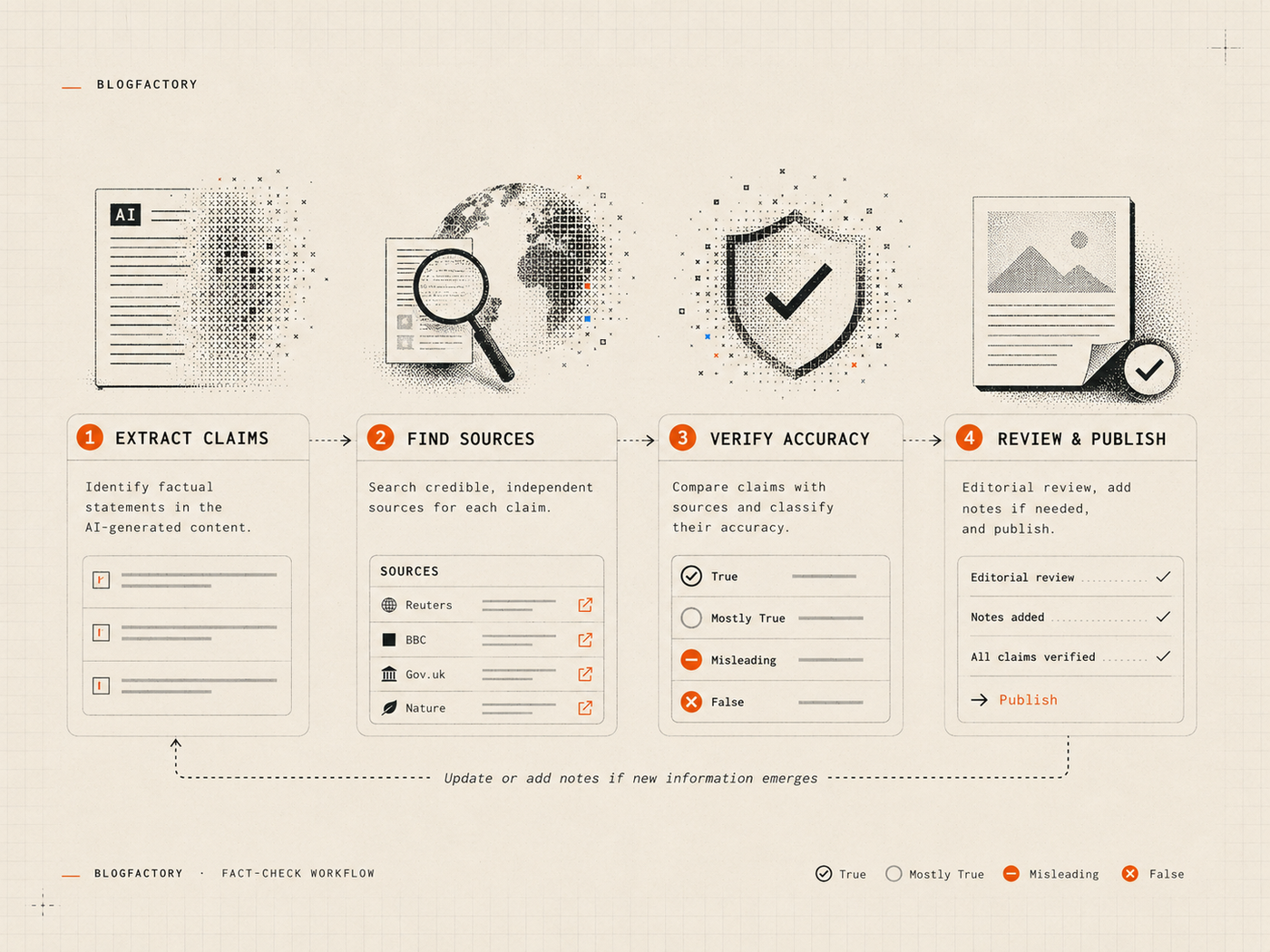
Read the article once for meaning, then a second time to identify claims. A material claim is a statement whose accuracy could change the reader’s understanding, decision, trust, or action.
Always extract:
- numbers, percentages, prices, dates, counts, and rankings;
- quotations and attributed opinions;
- product capabilities, limitations, versions, and requirements;
- legal, regulatory, medical, financial, privacy, or security statements;
- claims of testing, first-hand use, internal data, or customer outcomes;
- comparative claims such as faster, safer, cheaper, easier, or best;
- causal statements and guaranteed outcomes;
- definitions presented as official or standard.
General advice and clearly labeled opinion may require less formal evidence, but it should still be reasonable and not contradict known facts.
Step 3: classify each claim
Classification makes the required proof explicit. Use categories such as:
- Primary-source fact;
- Secondary-source fact;
- Proprietary evidence;
- User-provided information;
- Calculated result;
- Editorial analysis;
- Unverified.
A claim can use more than one class. A product comparison may combine official feature documentation, a calculated price table, and the author’s analysis. Labeling prevents the final recommendation from being mistaken for a direct statement by a source.
Step 4: build the fact-check table
Use a table or claim ledger with these fields:
- Claim;
- Location in draft;
- Classification;
- Source or evidence owner;
- Verification date;
- Supporting passage, data, or calculation;
- Scope and limitations;
- Decision: keep, qualify, correct, remove, or escalate.
The table creates an audit trail and prevents unresolved statements from being forgotten during copy editing.
For a preventive workflow before drafting, see How to Prevent AI Hallucinations in Blog Content.
Step 5: verify public facts with the strongest source
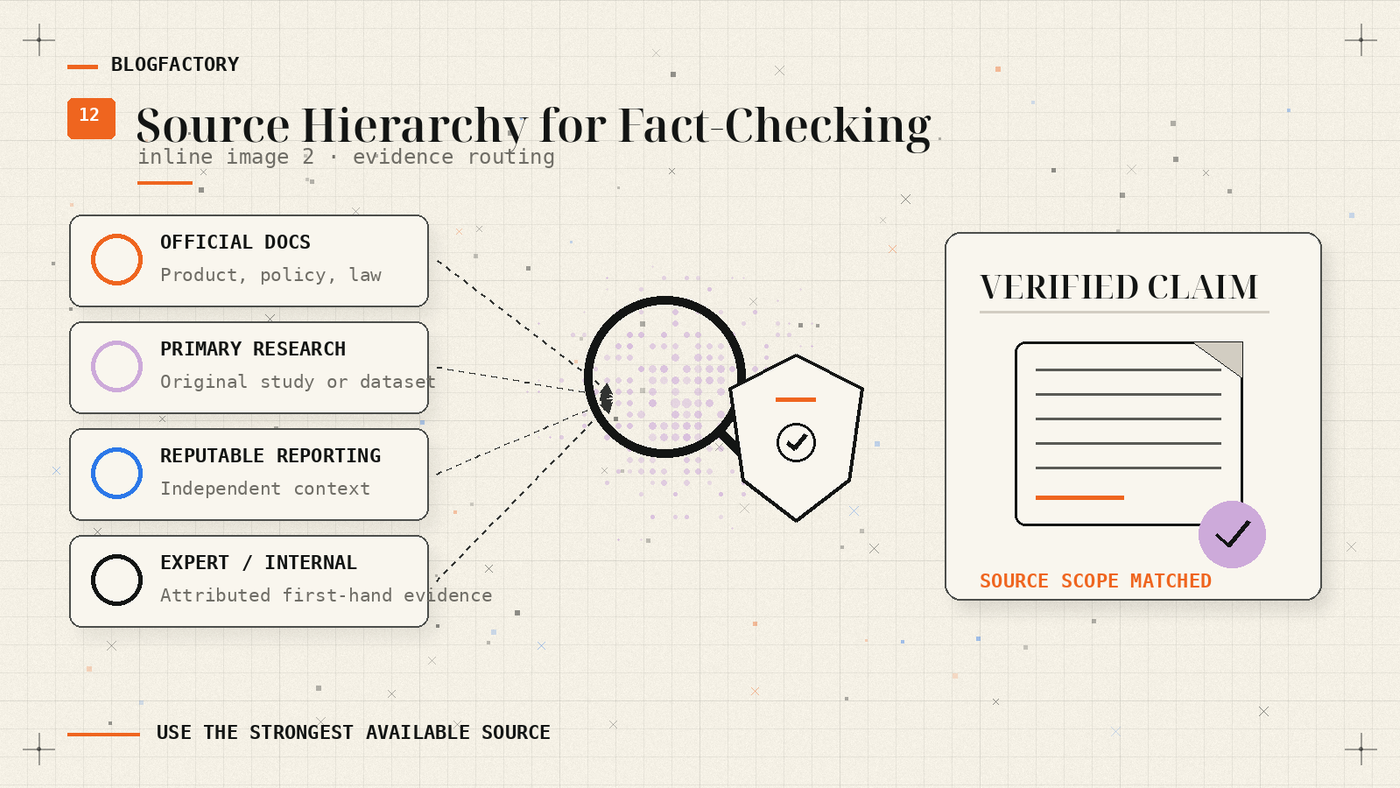
Prefer the responsible authority or original evidence. Use official documentation for product behavior, legislation for legal text, standards bodies for standards, original research for study results, company filings for reported financial data, and repositories or release notes for software versions.
Secondary reporting is valuable for context, criticism, and independent interpretation. It should not replace the original source when the article makes a precise claim that can be checked directly.
For each source, ask:
- Does the page exist and identify a responsible publisher?
- Is it the original evidence or a summary?
- Does it support the exact statement?
- Does the article preserve conditions and limitations?
- Is it current enough for the wording?
- Is there a conflict with another authoritative source?
When reliable sources disagree, present the disagreement or narrow the claim instead of selecting the most convenient result.
Step 6: recheck dates, versions, prices, and availability
Time-sensitive claims require immediate verification. Software interfaces, pricing, laws, office holders, schedules, product availability, and platform policies can change after the source was published.
Record the verification date and, when useful, include a date or version in the article. Prefer “As of August 25, 2026, the repository requires Node.js 22 or newer” over an unqualified statement that may be copied long after it changes.
Check whether prices exclude tax, vary by region, require annual billing, or apply only to a particular plan. Check whether product capabilities are generally available, in preview, deprecated, or limited to selected accounts.
Step 7: verify quotations and attribution
Locate the exact quotation in the original transcript, recording, document, or published source. Confirm the speaker, wording, context, and permission to publish when the quote came from a private interview.
Do not combine several sentences into a quotation, silently fix meaning, or attribute a paraphrase as exact words. Use quotation marks only for verified wording.
For paraphrases, check that the revised language does not strengthen the source’s claim. Preserve uncertainty and conditions.
Step 8: verify proprietary evidence
Internal data, field tests, customer stories, interviews, and first-hand observations require a different path because public search cannot prove them.
Ask for:
- the person or system that produced the evidence;
- the date and context;
- the sample, method, inputs, and exclusions;
- the original data or an authorized summary;
- approval for names, quotes, and confidential information;
- the limitations that should appear in the article.
A maintainer-reported workflow result should be labeled as maintainer-reported. A customer quote should not become a general performance guarantee. A small internal test should not be described as an industry benchmark.
If the evidence cannot be supplied or confirmed, remove the claim, narrow the article, or leave an approved placeholder and keep the package in draft status.
Step 9: recalculate numerical claims
Do not trust arithmetic because it appears simple. Recalculate percentages, changes, averages, totals, unit conversions, time savings, and per-item costs from the original inputs.
Check the denominator. A “200% increase” from one event to three events is mathematically different from a two-percentage-point increase. Distinguish percentage change from percentage-point change.
Preserve the formula or calculation notes in the fact-check table. Round consistently and disclose estimates.
Step 10: test causal and comparative language
AI drafts often strengthen relationships into conclusions. “Traffic increased during the publishing period” may become “the tool increased traffic.” Unless the evidence isolates causation, retain the more limited wording.
For comparisons, confirm that the same criteria, dates, versions, and methods were applied to every option. State which products were tested, which were desk-researched, and which information remains unknown.
Remove unsupported superlatives such as “best,” “safest,” “fastest,” or “most accurate,” or define the narrow criterion under which the conclusion is made.
Step 11: audit citations and references
Every numbered citation should resolve to exactly one reference, and every numbered reference should support at least one cited claim.
Check for:
- invented or malformed URLs;
- references that discuss the topic but not the claim;
- one citation used for several unrelated assertions;
- outdated pages cited for present-tense statements;
- competitor research presented as independent evidence;
- references added for appearance but never used.
The article on an AI blog writer with citations provides a complete source-mapping model.
Step 12: verify internal links and editorial context
Fact-check internal links because invented or outdated site URLs can mislead users and waste crawl signals. Open every internal link and confirm that the page exists, matches the anchor, and is the best destination for the claim.
Check whether the article conflicts with the company’s current product documentation, pricing, terms, security statements, or published policies. An external source may be accurate while the article still misrepresents your own product.
Step 13: review SEO metadata and structured fields
Metadata can contain factual claims too. Verify the title, meta description, excerpt, image caption, alt text, FAQ answers, author bio, schema fields, and social copy—not only the main body.
Remove promises such as “guaranteed rankings,” “zero hallucinations,” or “fully secure” unless the wording is truly supportable. Ensure the metadata accurately describes what the reader will find.
Google’s guidance encourages useful, reliable, people-first content and clear sourcing. It does not provide a guaranteed ranking reward for citations or a required article length.[1]
Step 14: assign a publication-readiness status
Use a readiness status that reflects the remaining evidence.
Blocked
A material claim lacks evidence, a specialist review is required, or the draft depends on missing proprietary input.
Draft
The article contains approved placeholders, minor unresolved checks, or awaits standard editorial review.
Publish-ready
Material claims have been verified, limitations are included, mechanical checks pass, and required editorial or specialist approvals are complete.
Publish-ready does not mean error-free forever. Record a next-review date for changing topics.
A fast risk-based fact-checking order
When time is limited, review in this order:
- Legal, medical, financial, security, regulatory, and safety claims.
- Proprietary outcomes, customer stories, quotes, and first-hand statements.
- Numbers, dates, prices, versions, and availability.
- Product capabilities and competitor comparisons.
- Causal claims and strong recommendations.
- Citations, links, metadata, FAQs, and image fields.
This triage does not replace a complete review. It directs attention to statements with the greatest potential consequence.
How Source-Backed Blog Writer supports fact-checking
Source-Backed Blog Writer is an open Agent Skill that incorporates site checks, source priorities, a claim ledger, verification dates, proprietary-evidence rules, numbered references, readiness states, and a deterministic validator.[2]
It can also audit an existing article and report findings by severity without rewriting unless asked. The skill cannot prove claim support mechanically; a reviewer still needs to inspect the evidence.
Review the workflow on the Source-Backed Blog Writer page.
Frequently asked questions
Can AI fact-check AI-generated content?
AI can extract claims, locate candidate sources, compare text, and flag inconsistencies. It should not be the only reviewer, especially for high-risk or proprietary claims.
How do I check whether a citation supports a claim?
Open the original source, find the relevant passage or data, and compare its scope, date, method, and limitations with the exact sentence in the article.
Should I remove every unverified sentence?
Remove or qualify material factual claims that cannot be supported. Clearly labeled opinion or analysis may remain when it is reasonable and not presented as sourced fact.
How often should an article be fact-checked again?
Set the interval according to change risk. Software, prices, regulations, and current statistics need more frequent review than stable historical or conceptual content.
Does a fact-checked article become publish-ready automatically?
No. It may still need editorial, legal, brand, accessibility, SEO, design, or CMS review. Fact-checking is one part of publication readiness.
The practical takeaway
Fact-checking AI content is a claim-by-claim evidence process. Do not review only whether the article sounds credible.
Freeze the revision, extract and classify material claims, verify primary and proprietary evidence, recheck changing details, recalculate numbers, test causal language, audit citations and links, review metadata, and assign an honest readiness state. The result is an article whose remaining uncertainty is visible before anyone presses publish.
References
[1] Google: creating helpful, reliable, people-first content