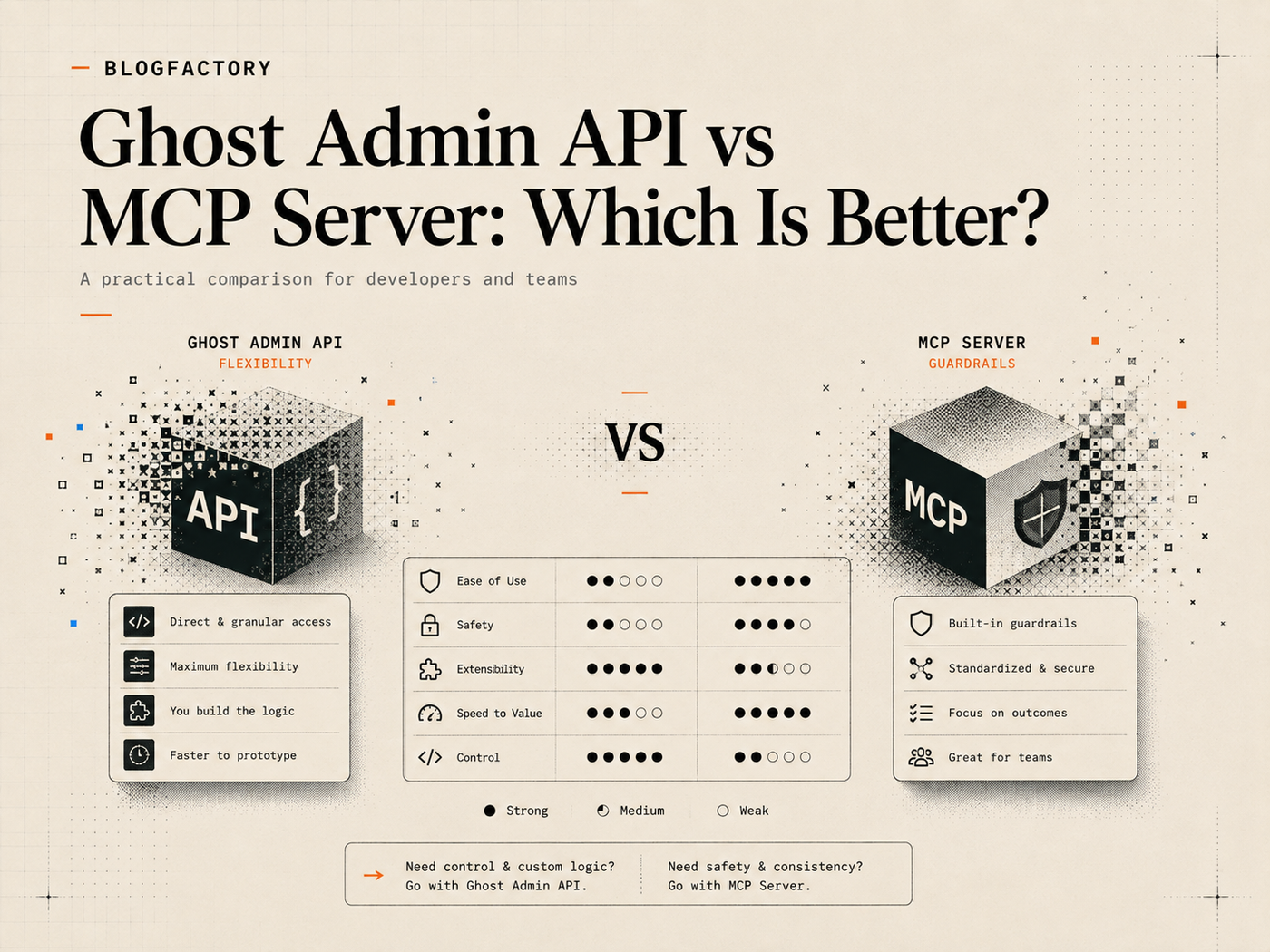
The Ghost Admin API and a Ghost MCP server are not competing content stores. The Admin API is Ghost’s authenticated management interface. An MCP server usually sits in front of that API and translates selected operations into tools an AI client can discover and call.
Choose a direct API integration when you are building a fixed application and want complete implementation control. Choose MCP when several compatible AI clients need a shared, structured tool surface. Use a hybrid when your application owns core business logic but exposes a narrow subset to agents.
Key points
- The Ghost Admin API is the underlying authenticated interface for content management.
- An MCP server defines an AI-facing set of tools, schemas, descriptions, and boundaries.
- Direct API code offers maximum flexibility but requires you to design every validation and approval control.
- MCP improves portability across compatible clients but adds another dependency to review and maintain.
- Neither option is safe automatically; security depends on credentials, exposed operations, and write controls.
- A narrow MCP server can deliberately expose less than the full Ghost administration surface.
What the Ghost Admin API provides
Ghost’s Admin API is designed for authenticated management of a Ghost site. It supports token-based integration authentication and endpoints for posts, Pages, images, tags, members, newsletters, users, themes, webhooks, and other administrative resources.[1]
A developer can call the API directly through HTTP or use Ghost’s official JavaScript Admin API client. The client requires the Ghost URL, an Admin API key, and an API version declaration.[2]
The API gives you building blocks. It does not prescribe whether an article must begin as a draft, whether a publish action needs human confirmation, how to handle stale revisions, what fields an AI may modify, or how to verify a separate headless frontend. Your application must define those policies.
What an MCP server adds
The Model Context Protocol standardizes how an AI application connects to servers that expose tools, resources, and prompts. Each tool has a name, description, and input schema, allowing the client to discover how to call it.[3]
A Ghost MCP server can wrap Admin API calls in higher-level operations such as “create a draft,” “audit these exact posts,” “preview this metadata change,” “plan a schedule,” or “publish this approved batch.” The server can validate arguments and enforce policies before the request reaches Ghost.
That does not mean every MCP server is narrow. Some projects intentionally expose broad Ghost administration. Others focus only on publishing. The value comes from the particular tool surface, not from the protocol name alone.
For an introduction to the architecture, read What Is a Ghost MCP Server? before choosing an implementation.
Direct Ghost Admin API integration: advantages
Complete implementation control
Your application determines every endpoint, request, retry, log, data model, approval, and user interface. There is no generic agent layer between the product and Ghost.
A smaller runtime stack
A fixed service can call Ghost directly without starting an MCP process or supporting MCP lifecycle behavior. This may be easier to deploy, observe, and secure in a conventional backend.
Application-specific user experience
You can build purpose-designed forms, previews, queues, and role controls instead of relying on natural-language interaction. For repetitive high-volume workflows, a deterministic interface may be more efficient than asking a model to choose tools.
Freedom to use the full API
When the application legitimately needs broad Ghost administration, direct API access avoids forcing every capability through an agent-oriented abstraction.
Direct Ghost Admin API integration: trade-offs
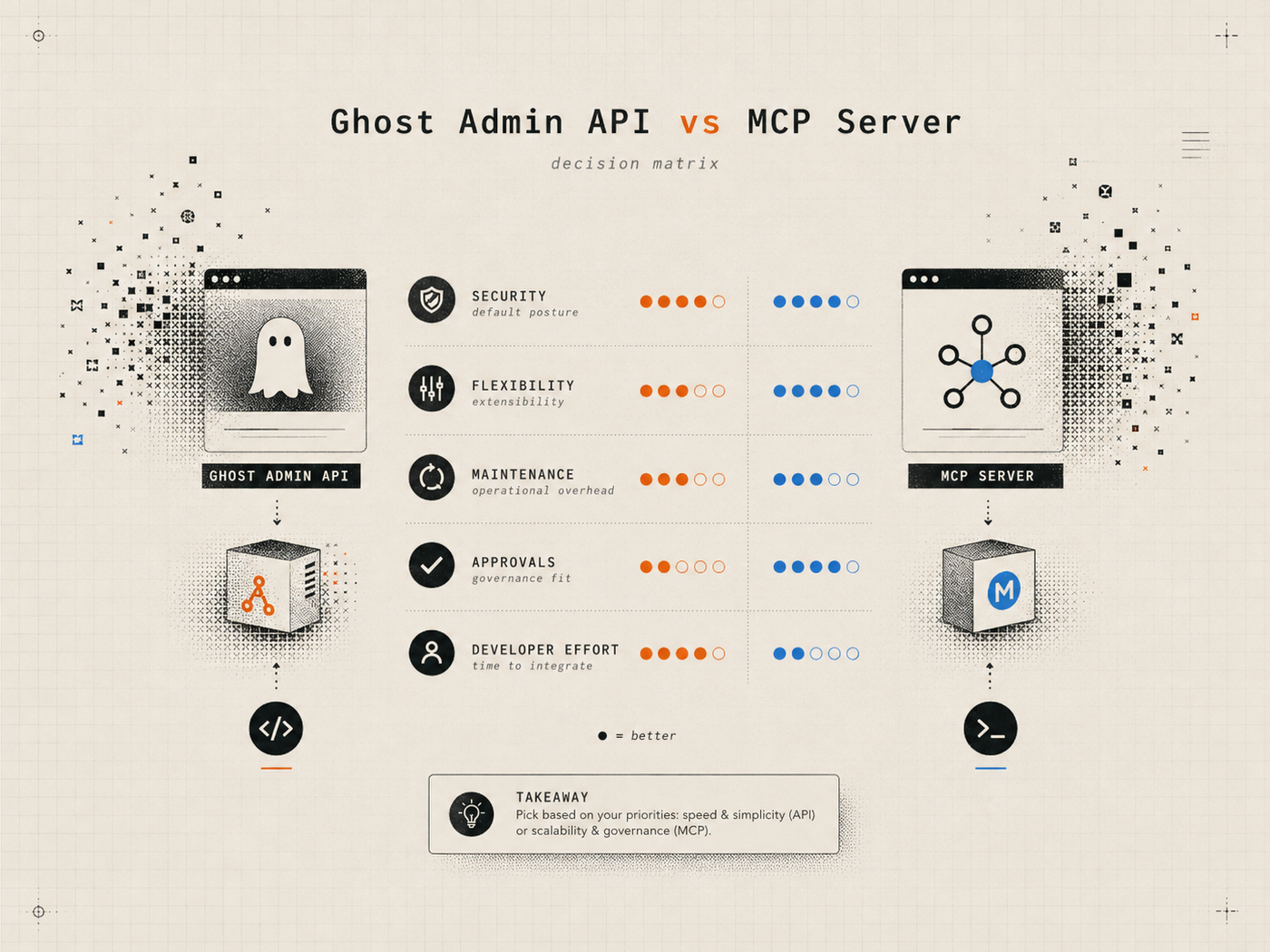
The flexibility is also the responsibility. You must build authentication handling, input validation, revision checks, safe retries, partial-failure behavior, logging, audit receipts, confirmation flows, and public-result verification.
If several AI products need the same capability, each client may require a custom integration or another shared API. The application also needs a method for converting model requests into approved operations without allowing free-form endpoint access.
A raw API wrapper that accepts arbitrary paths or payloads can silently recreate the full Ghost Admin surface. It is convenient for developers but difficult to reason about as an AI permission boundary.
Ghost MCP server: advantages
Shared compatibility across AI clients
Compatible clients can discover the same named tools without every client implementing a Ghost-specific interface. This is useful for operators who work in Codex, Cursor, Claude Desktop, or another MCP host.
A visible tool inventory
The operator can inspect registered capabilities such as read, create draft, upload image, schedule, publish, or delete. A well-designed server makes its intended boundary easier to review than a general endpoint dispatcher.
Higher-level workflow operations
A tool can perform preflight checks, require exact IDs, compare revisions, return typed receipts, and verify readback. These controls are reusable across all connected clients.
Natural-language orchestration
An operator can coordinate research, review, CMS actions, deployment, and verification from an AI client while the server keeps Ghost-specific details behind structured tools.
Ghost MCP server: trade-offs
The server is another software dependency with its own package supply chain, release process, configuration, logs, and vulnerabilities. Local execution avoids sending credentials to a hosted vendor, but it does not make unreviewed code trustworthy.
Tool selection is also probabilistic. The server can validate a request, but the AI client may choose the wrong tool, target, or argument. Important writes still need exact scopes, revision checks, and confirmation.
A generic MCP abstraction may be unnecessary for an application that already has a stable backend and fixed interface. Adding MCP solely because it is fashionable can increase complexity without improving the user’s workflow.
Authentication and credential storage
Both approaches ultimately need trusted access to Ghost. The Admin API key should remain in a server-side environment, a private local client configuration, or a secret manager. It should never be embedded in browser code, prompts, public repositories, or screenshots.
In a direct integration, the backend owns the secret. In a local MCP setup, the local process receives the key through the client’s private configuration or environment. In a remote MCP service, the service needs a separately designed credential architecture, authorization model, tenancy boundary, and incident-response process.
The deployment model changes who you must trust; it does not change the sensitivity of the Ghost key.
Permission boundaries and available actions
Direct API applications usually enforce permissions through their own routes, service accounts, roles, or business logic. MCP servers enforce them through which tools are registered, what arguments are accepted, and what additional checks occur before mutation.
A useful publishing boundary separates:
- read and audit operations;
- draft creation and draft-safe editing;
- image uploads from approved roots;
- schedule and unschedule transitions;
- publish and unpublish transitions;
- deployment and live verification;
- general administration such as users, members, newsletters, themes, and deletion.
A publishing-focused system rarely needs the final category. Excluding capabilities can be more meaningful than adding another prompt warning.
Approval, revision, and confirmation controls
The critical question is not whether the integration can update a post. It is whether it can prove which post, which revision, which fields, and which approval the update refers to.
A direct application can implement this through a preview screen and optimistic concurrency. An MCP server can implement it through read tools, signed or hashed previews, exact scopes, revision-bound plans, and a separate apply tool.
Publishing, scheduling, unpublishing, and deployment deserve their own confirmation because they change public or time-sensitive state. Draft creation should never silently inherit live-publishing authority.
The review and approvals layer should preserve the exact revision that was approved, regardless of whether the final action uses a REST route or an MCP tool.
Maintenance and client compatibility
A direct integration follows your application’s release cycle. You update Ghost API compatibility, dependencies, tests, and deployment as part of the product.
An MCP server follows its own release cycle plus the behavior of every host client. Changes in tool schemas, transport support, client configuration, or package startup can affect the workflow. Pin reviewed versions when stability matters and test upgrades in staging.
MCP is attractive when interoperability is a genuine requirement. If only one backend service ever calls Ghost, a direct integration may be simpler and more predictable.
Decision guide: API, MCP, or hybrid
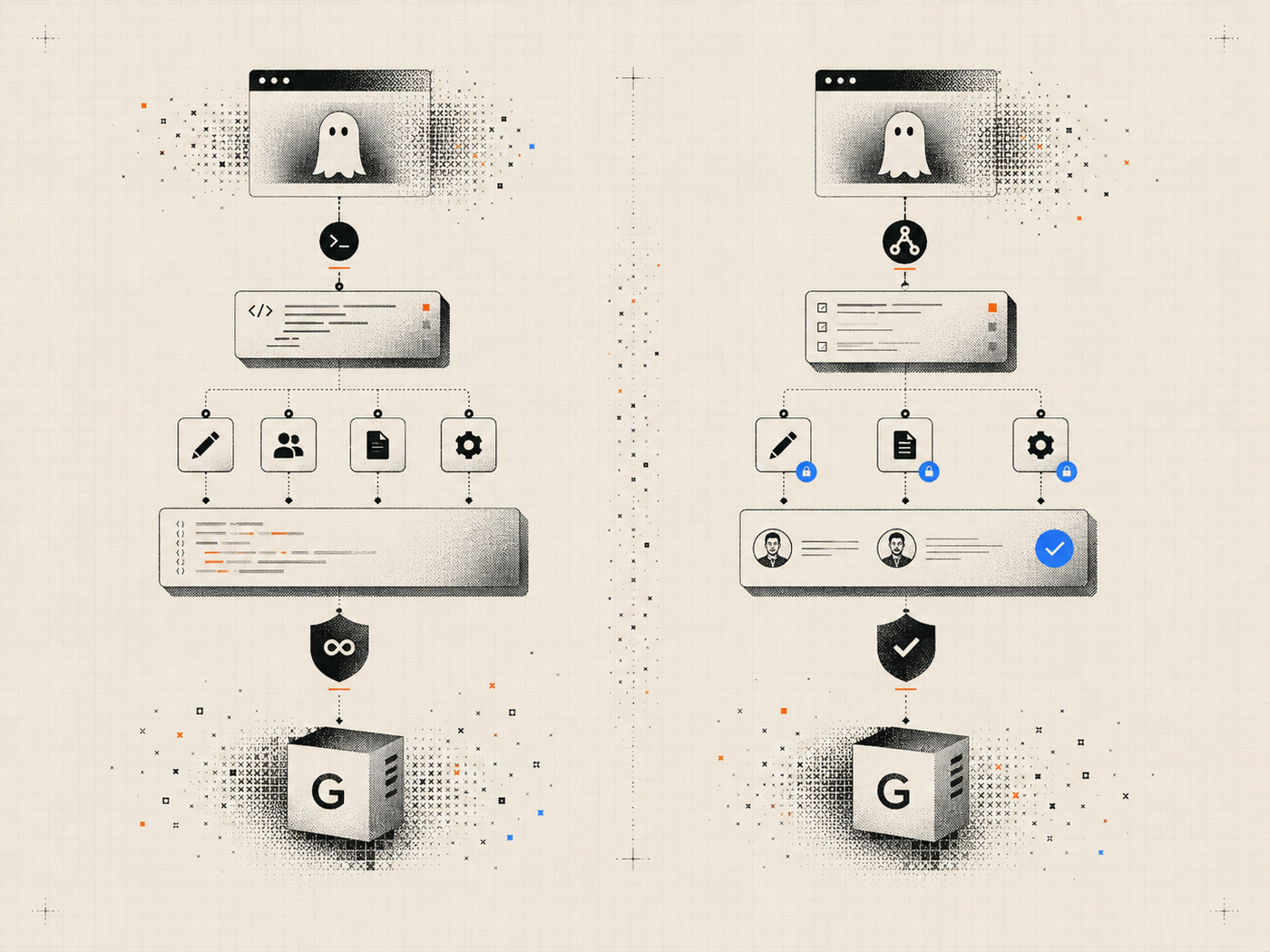
Choose a direct Ghost Admin API integration when
- you are building a fixed product or backend service;
- the workflow has a deterministic user interface;
- you need deep or broad Ghost administration;
- your team already owns authentication, queues, approvals, and observability;
- AI-client portability is not a requirement.
Choose a Ghost MCP server when
- operators work from several MCP-compatible AI clients;
- the desired Ghost operations can be expressed as a bounded tool set;
- natural-language orchestration improves the workflow;
- you want one reusable validation layer across clients;
- the package and local credential model have been reviewed.
Choose a hybrid when
your backend owns credentials, policy, queues, and audits, while an MCP server exposes a narrow agent interface to approved application operations. This avoids duplicating business rules inside every AI client.
Where Ghost Publisher MCP fits
Ghost Publisher MCP is designed for operators who want a local, Ghost-specific, approval-gated tool surface rather than a mirror of the entire Admin API. It focuses on posts, Pages, images, schedules, bounded audits, deployment, and live checks.
Its deliberate exclusions include deletion, members, newsletters, themes, arbitrary API calls, and general user administration. Those exclusions make it appropriate for a narrower publishing job, not universally superior to broader servers or direct integrations.
Review the current tool list and installation boundary on the Ghost Publisher MCP page before deciding whether it matches your workflow.
Frequently asked questions
Does an MCP server replace the Ghost Admin API?
Usually not. The MCP server calls the Admin API or an application built on top of it. MCP changes the AI-facing interface and workflow boundary.
Is a direct API integration more secure?
Not automatically. A carefully designed backend may have fewer moving parts, while a narrow MCP server may expose fewer capabilities than a broad custom wrapper. Compare actual architecture and controls.
Can an MCP server use the Ghost Content API instead?
A read-only server can use the Content API for published content. Creating, editing, scheduling, or publishing requires the authenticated Admin API.
Which option is better for a headless Ghost site?
Either can work. The important requirement is to separate the Ghost transition, frontend deployment or revalidation, and public verification.
Should an AI client receive arbitrary Ghost API access?
Generally no. Prefer named operations with validated schemas and explicit permission boundaries. Arbitrary endpoint dispatch is difficult to audit and easy to over-authorize.
The practical takeaway
Use the Ghost Admin API as the foundation. Decide whether your users need a fixed application interface, a portable AI tool layer, or both.
Direct API integration wins when control and deterministic product behavior matter most. MCP wins when compatible AI clients need a shared, discoverable set of bounded actions. The strongest solution is the one whose credentials, permissions, revisions, approvals, retries, and public verification are easiest to understand.
References
[2] Ghost Admin API JavaScript client