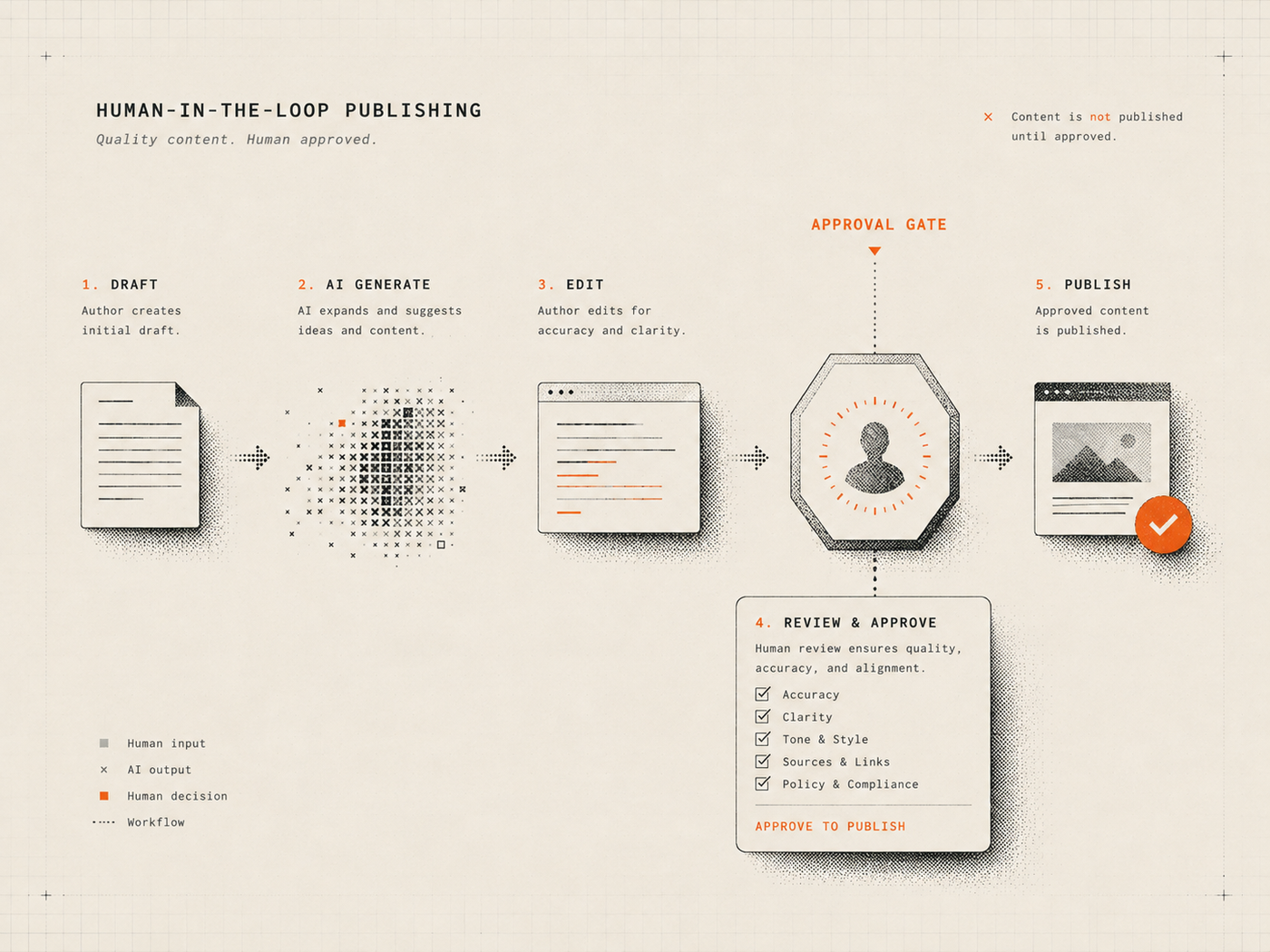
Human-in-the-loop AI publishing means people retain authority over the decisions that create editorial, legal, reputational, security, or public-state risk. The AI can perform research, drafting, classification, validation, and system preparation, but approval gates determine which work may proceed and which external actions are allowed.
The goal is not to ask a human to repeat every mechanical step. It is to place review at the points where the next action becomes expensive to reverse, difficult to audit, or capable of affecting readers and production systems.
Key points
- Use risk-based approval gates rather than requiring the same review for every task.
- Approve the intended question and evidence before long-form drafting.
- Bind approval to an exact content revision, destination, scope, and next action.
- Separate editorial approval from CMS draft creation, scheduling, publishing, unpublishing, and deployment.
- Let deterministic checks clear low-risk mechanical requirements before a person reviews the draft.
- Record approvals and receipts so the team can reconstruct what was reviewed and what changed.
- Do not call a workflow human-in-the-loop when the person merely watches an agent publish after the decision has already been made.
What human-in-the-loop publishing actually means
A human-in-the-loop system assigns people a meaningful control role inside an automated process. The human can review evidence, reject a proposal, change the scope, require more information, or authorize a specific external action.
Three weaker patterns are often confused with it:
Human-on-the-loop
A person monitors an automated process and intervenes when something looks wrong. This can be useful for low-risk operations, but the default path proceeds without approval.
Human-out-of-the-loop
The system makes and executes decisions without a required human checkpoint. It may still generate logs or alerts, but the public action does not wait for review.
Ceremonial approval
A person clicks approve without receiving the claims, changes, target, revision, or consequences needed to make an informed decision. This adds friction without reliable control.
Meaningful human oversight requires enough context, time, authority, and system feedback to change the outcome. NIST’s AI Risk Management Framework emphasizes governance, documented roles, risk measurement, and mechanisms for managing AI risks across the lifecycle.[1]
Human review does not mean doing everything manually
A human reviewer should not need to copy metadata between systems, count characters, renumber citations, compare every unchanged paragraph, or repeatedly check whether required fields exist. Those tasks can be automated or validated deterministically.
Automation should prepare the decision:
- summarize search intent and existing-site overlap;
- list material claims and supporting sources;
- show unresolved evidence and risk;
- display a section-level or field-level diff;
- verify mechanical requirements;
- name the exact CMS target and current revision;
- state the operation and likely consequence.
The person then decides whether the evidence, wording, scope, and action are acceptable. Human attention is reserved for judgment, not clerical repetition.
Four principles for placing approval gates

1. Place gates before irreversible or public actions
Review should occur before publication, deletion, newsletter sending, member changes, deployment, or other actions whose consequences extend beyond an internal draft.
2. Approve the exact revision and scope
An approval applies to a particular version, target, field set, schedule, or batch. If the content changes materially, the approval should expire or require a new review.
3. Match review depth to risk
Correcting a typo in a draft does not need the same process as publishing medical advice, changing a pricing page, comparing competitors, or sending a newsletter.
4. Keep approval separate from execution
The system that records approval should identify what may happen next, while the action layer still enforces permissions, revisions, confirmation, and destination. A prompt saying “approved” should not bypass technical controls.
Approval gate 1: topic, audience, and search intent
The first gate decides whether the proposed page should exist. Review the topic, primary keyword, audience, market, reader job, CTA, and existing-site coverage.
The reviewer should receive:
- the proposed intent classification;
- existing URLs with overlapping intent;
- the intended audience and decision stage;
- the reason a new page, refresh, or consolidation is recommended;
- the proposed CTA and destination.
Reject or redirect the assignment when it duplicates a strong existing page, targets the wrong market, or has no distinct reader value.
The source-backed SEO brief provides the information required for this decision.
Approval gate 2: sources, claims, and proprietary evidence
The second gate determines whether the article’s important claims can be supported. It should occur before those claims are hidden inside polished prose.
Review the claim ledger, including classification, source, verification date, scope, limitations, and unresolved status. Pay special attention to statistics, dates, quotations, product behavior, security statements, legal or regulatory claims, customer outcomes, and causal conclusions.
Confirm that proprietary evidence is real and publishable. An implementation lesson needs an identifiable operator or record. A customer result needs authorization and context. A test needs a method, date, sample, and limitations.
When evidence is missing, the reviewer can block the article, narrow the claim, supply the input, or approve a visible placeholder that keeps the package in draft status.
The guide to preventing AI hallucinations explains how source and proprietary-evidence rules reduce unsupported certainty.
Approval gate 3: title, questions, and outline
The third gate approves the shape of the article. Review two or three title options, target questions, information gap, article pattern, proposed H2 and H3 hierarchy, internal-link targets, visuals, and CTA placement.
Each major section should answer a distinct reader question or advance the decision. Remove sections that exist only to reach a word count or repeat an earlier point.
For comparisons, approve a methodology that states inclusion criteria, evaluation dimensions, tested versus desk-researched products, pricing and research dates, relationships, unknowns, and limitations.
This gate is especially useful for expensive articles, regulated subjects, product comparisons, and pages that represent the company’s positioning.
Approval gate 4: complete draft and metadata
The fourth gate is the editorial approval of the complete package. The reviewer should receive the article body, meta title, meta description, excerpt, slug, internal links, FAQs, image recommendations, references, and readiness status.
Automated checks should run first. They can catch missing fields, invalid lengths, duplicate FAQs, unresolved placeholders, broken citation numbering, missing image fields, and structural inconsistencies.
The human reviewer then focuses on support, usefulness, tone, originality, brand alignment, risk, accessibility, competitive fairness, and the match between the headline promise and the article.
Bind the approval to a revision ID, document version, or content hash. The system should make later changes visible and invalidate approval when material sections or claims change.
Use the AI content fact-checking checklist for a claim-level review before approving publication readiness.
Approval gate 5: CMS draft delivery
Editorial approval does not automatically grant permission to write into every CMS. The next gate confirms the destination site, content type, author, tags, status, and fields included in the delivery.
A low-risk delivery action creates a draft only. The tool should return the exact external ID, slug, status, and updated timestamp. The operator can then compare the Ghost or CMS draft with the approved package.
For draft creation, a team may use standing approval when the site, content type, and field boundary are fixed. Higher-risk changes—such as replacing a body, altering a published canonical, or writing to several sites—deserve an explicit preview.
BlogFactory’s CMS draft delivery model treats the reviewed version and destination selection as part of the handoff.
Approval gate 6: draft changes and image uploads
A CMS draft may need corrections after delivery. Before applying them, read the current revision and present a field-level or section-level preview.
The reviewer should see:
- the exact CMS item and current revision;
- every field or section that will change;
- the before and after values;
- whether protected or unknown content structures will be preserved;
- the requested permission scope.
Image uploads also deserve review. Confirm that the file comes from an approved directory, is valid, can be published legally, does not expose private information, and has accurate alt text.
If the CMS revision changes after preview, stop and generate a new plan. Approval for an old version is not permission to overwrite new human work.
Approval gate 7: scheduling
Scheduling changes when content becomes public and may affect campaigns, embargoes, author coordination, and newsroom timing. Use a separate plan-and-apply process.
The plan should show the exact drafts, current revisions, local time-zone name, local timestamps, converted UTC timestamps, order, conflicts, and any dates that are invalid or in the past.
Planning should not write. Apply the schedule only after approval and verify every stored status and timestamp through readback.
Approval gate 8: publishing or unpublishing
Publishing and unpublishing directly affect the public site. The approval must name the site, exact post or Page IDs, titles, current revisions, old statuses, intended new statuses, and whether deployment will follow.
Preflight the whole batch before the first mutation. If any target no longer matches the plan, stop the batch unless partial publication is an explicitly approved mode.
After execution, read each item back and return a receipt. Do not automatically retry a timed-out write; the original request may have succeeded.
The publish-to-Ghost-with-AI guide provides a concrete least-privilege example.
Approval gate 9: deployment or cache revalidation
In a headless architecture, a Ghost status change and a public frontend update are different operations. A deployment gate confirms that the approved batch may trigger the configured build, revalidation, or cache action.
The destination should be stored in trusted configuration. The approval can authorize one call to that destination after complete batch success. Generated content should never supply an arbitrary deploy-hook URL.
If publishing succeeds and deployment fails, report partial success. Do not automatically roll back the CMS or retry the hook unless that recovery action is separately defined and approved.
Approval gate 10: remediation after live verification
Public checks are read-only and generally do not need case-by-case approval. However, the response to a failed check may require a new gate.
For example, a verifier may find a wrong title, broken canonical, missing image, stale frontend build, or accidental noindex directive. It should report the observation and proposed remedy without automatically editing, redeploying, or unpublishing.
The remediation approval should name the exact problem, proposed change, current revision, affected public page, and whether another deployment will occur.
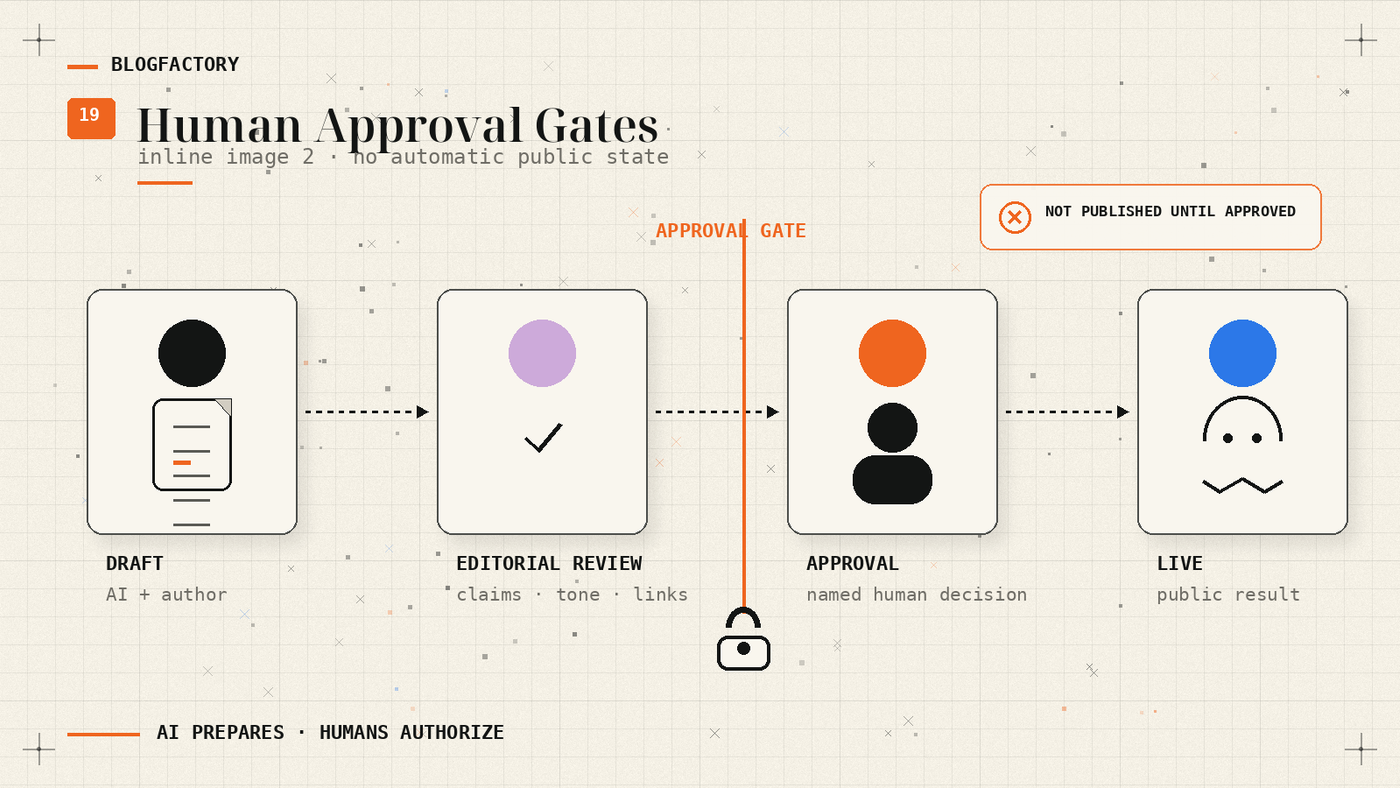
A responsibility matrix for AI publishing
Content strategist
Owns audience, intent, content architecture, topic priority, and CTA.
Researcher or subject-matter owner
Owns source quality, proprietary evidence, technical truth, methods, and limitations.
Editor
Owns structure, clarity, brand voice, citation use, final wording, and article readiness.
CMS operator
Owns destination, author and tag mapping, images, draft creation, revision-aware changes, and CMS receipts.
Publisher
Owns schedule and publication timing, batch approval, public transitions, and deployment authorization.
AI agent
Performs the permitted research, drafting, validation, comparison, preview, and tool calls. It does not become the owner of claims or public decisions.
One person may hold several roles in a small team, but the workflow should still distinguish the decisions.
How to avoid approval bottlenecks
Poorly designed human review can become a queue where every action waits for the same senior editor. Use risk tiers and standing policies.
Examples of lower-risk actions that may use standing approval:
- read-only content inventory;
- mechanical validation;
- draft creation on one approved site from an approved revision;
- read-only public checks;
- correction of specified low-risk metadata fields while the item remains a draft.
Higher-risk actions should remain explicit: regulated claims, competitive accusations, customer data, live body replacement, author impersonation, pricing changes, publishing, unpublishing, deletion, newsletters, and deployment.
Batch related approvals, route work to the appropriate subject-matter owner, show concise diffs, and require the system to resolve mechanical failures before a person reviews the item.
What an approval record should contain
For important decisions, store:
- the approving person or role;
- timestamp and time zone;
- site, document, and revision identifiers;
- the approved operation and scope;
- the preview or diff reviewed;
- unresolved limitations or follow-up conditions;
- the resulting action receipt and final state.
Do not store secrets or unnecessary sensitive article data in approval logs. The record should support accountability without becoming another data-exposure path.
How BlogFactory’s open-source tools support the model
Source-Backed Blog Writer creates a research and drafting workflow with an optional outline-approval mode, proprietary-evidence requirements, claim tracking, readiness states, and deterministic validation.[2]
Ghost Publisher MCP creates a separate Ghost action boundary with permission profiles, draft-only creation, exact revision checks, previews, explicit confirmations, scheduling, publishing, optional deployment, and live verification.[3]
Together they demonstrate a useful separation: the skill prepares and evaluates the editorial package, while the MCP server controls what a connected AI client may do in Ghost. Neither project removes the need for human ownership.
Explore both on the open-source tools page or follow the complete Ghost workflow from research through public verification.
Frequently asked questions
Does every AI-written article need human approval?
Every public article should have accountable editorial ownership. The depth and role of review can vary according to topic, evidence, risk, and the organization’s policy.
Can approval be automated for low-risk changes?
A standing policy can authorize narrowly defined actions such as draft creation or specified metadata corrections. The system should still enforce exact scope, revision, destination, and audit receipts.
Who should approve factual claims?
The appropriate source owner or subject-matter reviewer should approve consequential claims. An editor can coordinate the process but may not be qualified to verify every technical, legal, medical, or financial statement.
Should one approval cover drafting and publishing?
Usually no. Editorial approval confirms the content; publication approval confirms the exact CMS target, revision, status transition, timing, and delivery consequence.
What happens when the draft changes after approval?
Material changes should invalidate or narrow the approval. Show the diff and require a new review of the affected claims, sections, or fields.
The practical takeaway
Human-in-the-loop publishing works when the person controls a real decision and the system supplies enough evidence to make it.
Place approval gates before the topic becomes a full draft, before unsupported claims become polished copy, before an exact revision enters the CMS, before time-sensitive or public transitions, and before remediation changes a live result. Automate preparation and validation, keep permissions technical, and record what was approved and executed. That gives the team speed without making human review a ceremonial click.
References
[1] NIST AI Risk Management Framework 1.0
[2] Source-Backed Blog Writer repository
[3] Ghost Publisher MCP repository
[4] Google: creating helpful, reliable, people-first content