
SEO has always involved moving information between tools.
You export keywords from one platform, copy Search Console data into a spreadsheet, paste a competitor page into an AI chat, move the recommendation into a content brief and eventually transfer the result into a CMS.
AI made the analysis faster, but for a while the integration model remained surprisingly manual: copy data into the model and copy the answer back out.
MCP changes that.
The Model Context Protocol (MCP) gives compatible AI clients a standardized way to connect to external tools and data. For SEO, that means an agent can potentially query keyword data, inspect Search Console, run a crawl, read existing content or create a draft through approved tool calls.
That is more powerful than pasting a CSV into a chatbot. It is also more dangerous if permissions are poorly designed.
This guide explains what MCP means for SEO, where it is useful and how to think about agent access safely.
What is MCP?
MCP is a protocol for connecting AI applications with external capabilities.
A simple way to think about it is:
AI client ↔ MCP server ↔ tool or data source
The AI client might be an assistant, coding agent or other MCP-compatible application.
The MCP server exposes a defined set of capabilities. Those capabilities might read data, perform a search, create a draft or trigger an operation.
Instead of teaching every AI application a custom integration for every product, MCP provides a shared interface pattern.
It is useful to compare this with APIs.
An API is usually designed for software developers to call programmatically.
MCP packages capabilities in a way AI clients can discover and use as tools during a task.
The underlying system may still call APIs. MCP is the agent-facing layer.
Why MCP matters for SEO
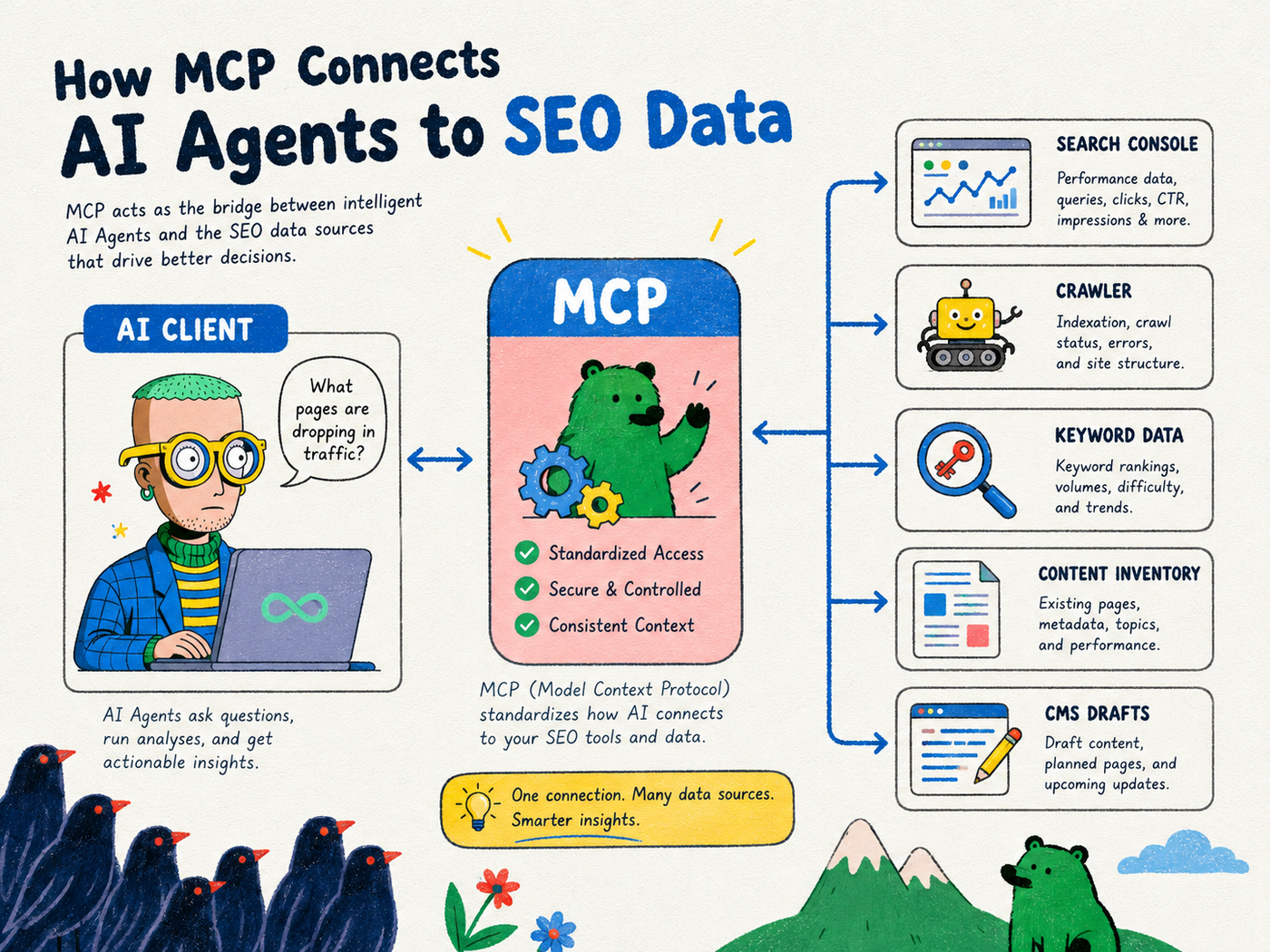
SEO is unusually well suited to tool-connected agents because much of the work depends on structured external evidence.
A model cannot know your current Search Console performance from its training data.
It cannot know today’s ranking positions unless it queries a current source.
It does not automatically know which articles exist in your private CMS.
It cannot accurately audit a 50,000-page site from a single pasted URL.
MCP gives the model a way to ask the relevant systems for that information when it needs it.
The workflow changes from:
Human exports data → human uploads data → model analyzes → human copies answer
to:
Human defines task → agent calls approved SEO tools → agent analyzes → human reviews action
The time saved can be significant, but the more important change is that the agent works with fresher and more structured evidence.
What can an SEO agent do through MCP?
The exact capabilities depend on the server.
Keyword research
An SEO MCP server can expose keyword discovery, search volume, intent, CPC, trends or related-query data.
An agent might be asked:
Find informational keywords related to self-hosted content tools, group them by intent and return only topics that do not overlap with our existing articles.
The agent can collect data and reason over it in the same task.
SERP inspection
Current search results matter because intent changes.
An agent with SERP access can inspect which page types currently rank and identify patterns such as:
- listicles
- product pages
- documentation
- category pages
- videos
- forums
- comparison pages
That is more grounded than assuming a keyword always deserves a generic blog post.
Competitive research
MCP can expose domain, keyword and backlink data from SEO platforms.
An agent can compare competitors, identify topic gaps or investigate which pages earn visibility.
The quality still depends on the underlying dataset. MCP does not create SEO data; it gives the agent access to it.
Google Search Console analysis
This is one of the highest-value use cases because Search Console contains first-party performance data for your own property.
An agent can help find:
- pages losing clicks
- queries gaining impressions
- URLs close to stronger positions
- low-CTR opportunities
- performance changes over time
- indexing or sitemap issues, depending on the integration
Technical crawling
Open-source crawlers are increasingly adding MCP interfaces.
An agent can work over crawl results to answer questions such as:
- Which templates have missing canonicals?
- Where are the most common broken internal links?
- Which pages have duplicate titles?
- Which sections contain orphan-like pages?
- Are there recurring hreflang or metadata patterns?
The crawler generates evidence. The agent makes that evidence easier to interrogate.
Content operations
MCP can also act on the editorial side.
An approved agent might:
- list existing posts
- read a current article
- create a draft
- revise a draft
- inspect SEO context
- request review information
- hand an approved revision to a CMS draft destination
This is where permission design becomes critical.
MCP vs traditional SEO automation
Traditional SEO automation is usually deterministic.
For example:
- Fetch Search Console data every morning.
- Filter rows where clicks declined by more than a threshold.
- Send an alert to Slack.
That workflow does exactly what it was programmed to do.
Agentic automation is more flexible.
You might ask:
Investigate the pages with the most meaningful organic decline, exclude obvious seasonal cases, compare affected queries with the current content and propose the smallest useful action for each page.
The agent has to choose tools and interpret evidence.
This flexibility is powerful, but less predictable.
The best systems combine both approaches:
- deterministic automation for schedules, filters and exact rules
- agents for interpretation and open-ended investigation
- humans for high-impact judgment and approval
MCP does not make an integration safe by itself

This is the most important point in the article.
MCP standardizes tool access. It does not automatically solve authorization.
Imagine two MCP servers.
Server A exposes:
- read Search Console
- read content
- create draft
Server B exposes:
- read all sites
- edit any page
- delete any page
- reveal credentials
- publish live
Both can be “MCP servers.” Their risk profiles are completely different.
When evaluating an SEO or content MCP integration, ask:
- What tools are exposed?
- Which actions are read-only?
- Which actions write data?
- Can the connection be scoped to one site?
- Can the agent publish live?
- Can the agent delete data?
- Are credentials ever returned to the client?
- Is authentication revocable?
- Is there an operation log?
- Are sensitive fields excluded from logs?
The protocol is only one layer of the security model.
The principle of least privilege for SEO agents
A useful rule is to give each agent only the authority required for its job.
Research agent
Needs:
- keyword data
- SERP data
- competitor data
- read-only site content
Does not need:
- CMS write access
- deletion
- account administration
Technical SEO agent
Needs:
- crawl tools
- Search Console read access
- sitemap inspection
May not need:
- draft generation
- publishing
Content agent
Needs:
- existing content
- approved sources
- draft creation and revision
- SEO metadata
Does not necessarily need:
- production publishing
- credentials
Delivery workflow
May need:
- explicit CMS draft creation
Should not automatically need:
- live publishing
- delete permissions
Splitting authority reduces blast radius.
Real SEO platforms are adopting MCP
MCP is no longer only a developer experiment.
Major SEO data providers have started exposing official MCP access, while open-source projects are building MCP directly into their product architecture.
Examples include:
- Ahrefs MCP, which connects supported AI tools to Ahrefs data
- Semrush MCP, which exposes Semrush data through a remote MCP endpoint
- DataForSEO MCP, which provides agent access to its SEO APIs
- OpenSEO MCP, which gives agents access to open-source SEO workflows
- crawler-focused MCP projects, which let agents trigger or analyze technical site audits
- BlogFactory MCP, which focuses on content operations, Search Console and reviewed CMS draft delivery
This is a sign of a broader shift: the SEO interface is becoming conversational and agentic, while the underlying data remains structured.
Example MCP SEO workflow: finding a content refresh
Here is a practical workflow.
1. Read Search Console
The agent identifies pages with a meaningful decline using a complete date range.
2. Read the current article
Instead of asking the user to paste the page, the agent loads the approved content through a site-scoped tool.
3. Inspect current queries
The agent finds which queries changed and whether the page is gaining visibility for adjacent topics.
4. Inspect the SERP if needed
A separate SEO MCP server can show current ranking page types and competitor patterns.
5. Recommend an action
The agent chooses between refresh, consolidation, metadata change, internal linking or no action.
6. Create a draft revision
If approved, the agent prepares the update.
7. Review
A human sees the revision, source context, warnings and destination.
8. CMS handoff
The reviewed version is sent to the CMS as a draft.
The workflow is agentic without being autonomous at the highest-risk step.
MCP and Google Search Console
Search Console is particularly valuable in an MCP environment because it contains private site-specific data that an AI model cannot know otherwise.
However, SEO teams should be careful with interpretation.
Search Console data has practical nuances:
- recent dates may be incomplete
- query data may be sampled or limited in some interfaces
- average position is an aggregate metric
- changes may be caused by seasonality or SERP layout
- correlation around an update is not proof of causation
A good MCP integration should preserve metadata about date range, freshness and completeness instead of handing the agent a naked number.
Context is part of data quality.
MCP and content management systems
Direct CMS MCP access can be useful, but it should be treated carefully.
A CMS contains production state. Giving an agent generic write access can create far more risk than giving it read-only access to analytics.
For content workflows, consider separating the stages:
Agent creates/revises content in an operations layer → human reviews → system delivers CMS draft → human publishes
This is slower than fully autonomous publishing by perhaps a few clicks.
It is much easier to trust.
How BlogFactory uses MCP for content operations
BlogFactory exposes a site-scoped MCP endpoint designed around editorial work.
Its tool catalog includes operations for reading site content, creating or updating drafts, reading Search Console context, reviewing a post and delivering an approved version to a CMS draft destination.
The authority ceiling is intentionally limited. MCP clients are not given arbitrary provider access, credentials, delete capabilities or general live-publishing authority through the content workflow.
The system also uses revision-aware updates. An agent working from stale state should not silently overwrite a newer revision.
This is an important pattern for agentic SEO: tool access plus operational constraints.
Building your first MCP SEO stack
A simple stack could use three specialized layers.
SEO intelligence
Use an MCP server from OpenSEO, Ahrefs, Semrush, DataForSEO or another provider for keyword and competitor data.
Technical evidence
Use an MCP-enabled crawler when you need site-wide technical information.
Content operations
Use BlogFactory or another controlled workflow layer for content inventory, drafting, review and delivery.
Then connect those tools to an MCP-compatible AI client.
The agent becomes the interface across systems without requiring one product to own every dataset and workflow.
What to evaluate before connecting any MCP server
Before adding an MCP server to a production workflow, review:
Authentication
Does it use OAuth, scoped tokens or another revocable mechanism?
Tool surface
Can you see exactly what actions the agent will be able to call?
Write permissions
Which tools mutate data?
Scope
Can access be limited by site, project or workspace?
Secrets
Does the agent ever receive raw provider credentials?
Logging
Are operations recorded without storing sensitive content unnecessarily?
Failure behavior
What happens if a request is repeated, stale or partially completed?
Human approval
Which actions require an explicit decision before they affect production?
These questions are more important than whether the integration has a polished demo.
MCP is turning SEO software into agent infrastructure
For years, SEO products were designed around dashboards.
Humans clicked filters, exported reports and manually moved the findings somewhere else.
Dashboards are not disappearing, but MCP introduces another interface: software that an agent can operate on your behalf.
That changes product design.
The best SEO systems will not simply expose more tools. They will expose the right tools with clear scope, trustworthy data and safe write boundaries.
That is the difference between “AI can access our SEO stack” and “AI can operate inside our SEO stack responsibly.”
Explore BlogFactory on GitHub
BlogFactory is an open-source content operations platform with a site-scoped MCP work layer for content, Search Console, review and CMS draft delivery.
Inspect the server, tool boundaries and self-hosting architecture directly: