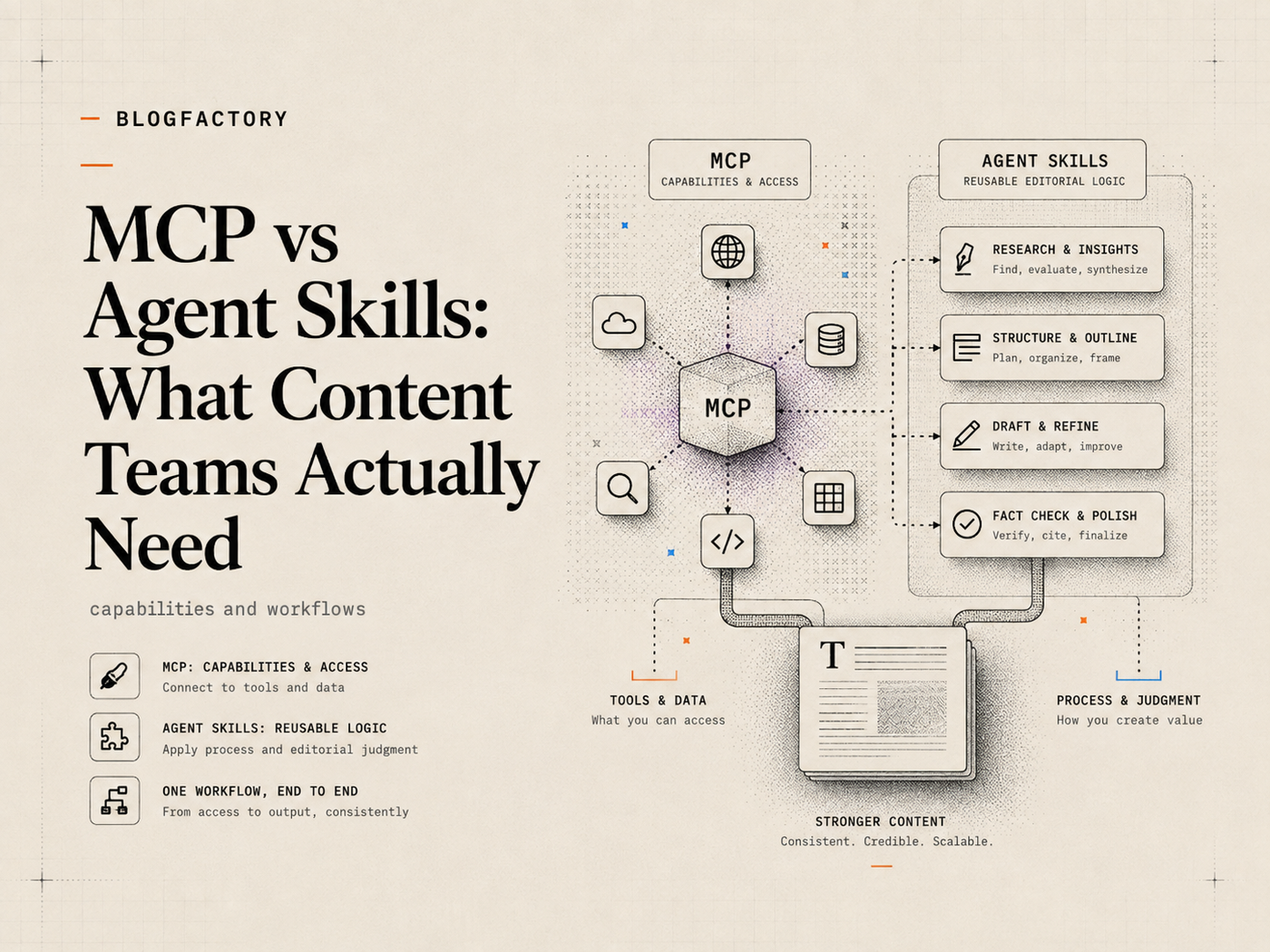
MCP and Agent Skills solve different parts of an AI workflow. Model Context Protocol gives an AI application structured access to external data and actions. An Agent Skill gives the model a reusable procedure for performing a particular job.
For content teams, the distinction is practical: MCP can let an agent read a CMS, create a draft, inspect Search Console data, or upload an image. A skill can tell the agent how to research search intent, evaluate evidence, structure an article, validate metadata, and stop when a claim cannot be supported.
Key points
- MCP is primarily a connection and capability layer.
- Agent Skills are primarily reusable instructions, references, scripts, and workflow knowledge.
- A skill does not automatically grant access to a CMS, database, or API.
- An MCP connection does not automatically teach the model a reliable editorial method.
- The strongest content workflows often combine a skill for procedure with MCP for bounded actions.
- Permissions belong to the tool layer; quality rules and process discipline belong to the workflow layer.
The direct answer: MCP provides capability, Agent Skills provide procedure
The Model Context Protocol is an open standard for connecting AI applications to external systems. MCP servers can expose tools that perform actions, resources that supply context, and prompts that package reusable interactions.[1] The host application decides which servers to connect and which capabilities to make available.
The Agent Skills specification defines a portable folder format. A skill contains at least a SKILL.md file with metadata and instructions, and it may also include scripts, references, templates, or other assets.[2] The skill guides how the agent approaches a job, but it does not create a network connection or grant credentials by itself.
A useful shorthand is: MCP answers “What can the agent reach or do?” A skill answers “How should the agent perform this kind of work?”
What MCP does in a content workflow
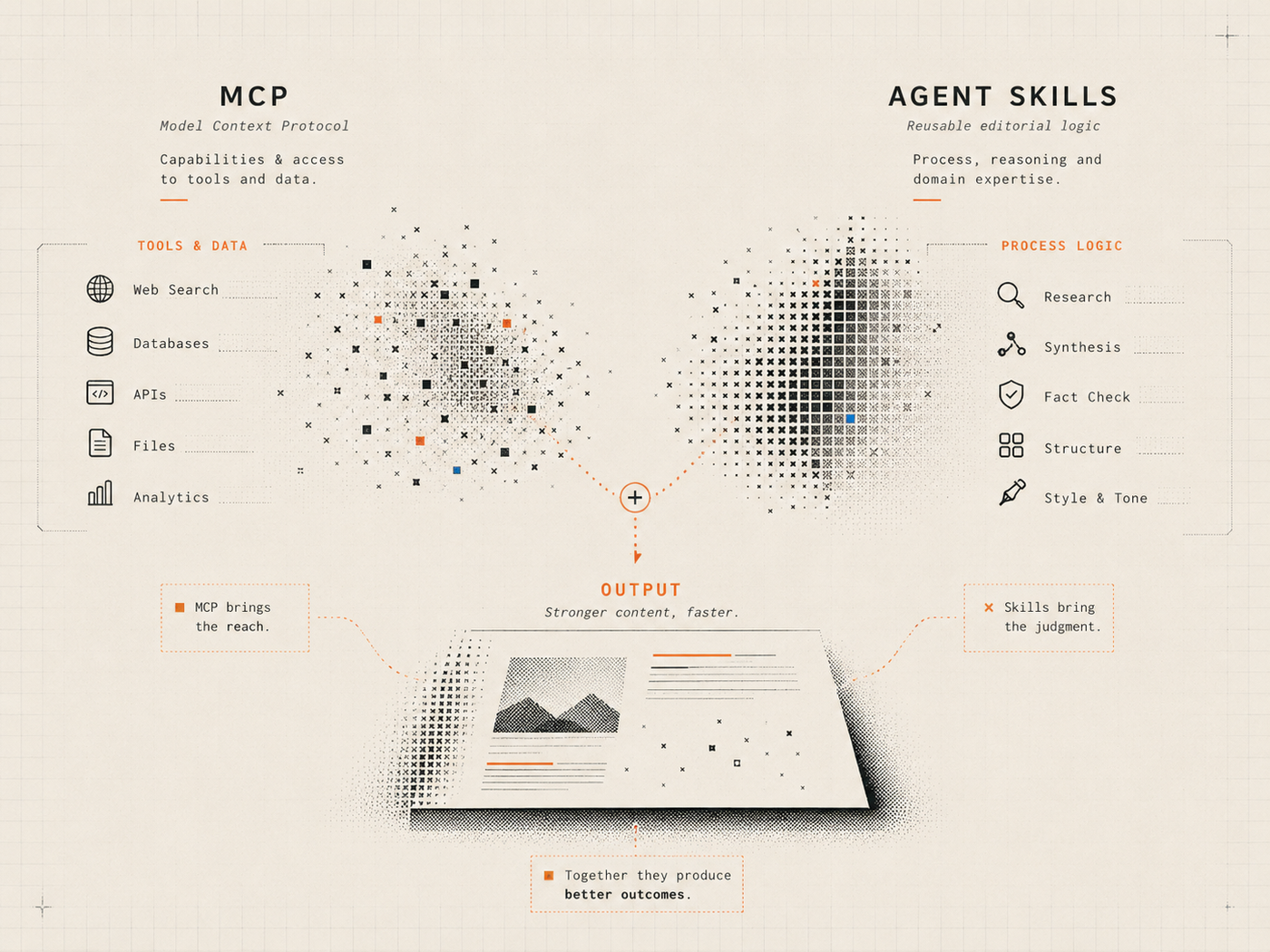
A content operation usually spans several systems. Search data may live in Search Console, articles in a CMS, drafts in an editorial workspace, media in object storage, and deployment in a separate hosting platform. Without an integration layer, the operator repeatedly copies data between interfaces.
An MCP server can translate selected system capabilities into structured tools. Depending on the server, an AI client might be able to list posts, read one exact revision, create a draft, inspect a sitemap, retrieve search queries, upload an approved file, or trigger a separately authorized workflow.
The server defines the actual boundary. Two servers can both use MCP while exposing radically different authority. One may be read-only. Another may include publishing, deletion, user administration, or arbitrary API calls. The protocol is not a substitute for reviewing the registered tools, credentials, permission model, and confirmation requirements.
For a broader example, read MCP for SEO, which explains how agents can work with search and content data without treating every connection as a general administrator account.
What Agent Skills do in a content workflow
A prompt is usually written for the current conversation. A skill packages a repeatable method so the agent can apply the same standards across topics, projects, and compatible clients. It can define required inputs, source priorities, stopping conditions, output structure, and validation steps.
For example, a source-backed writing skill can require a site duplicate check before drafting, classify search intent, review relevant results, distinguish primary from secondary evidence, map claims to sources, and label a package blocked when proprietary evidence is missing.
Skills may also include deterministic scripts. A validator can count headings, check metadata length, detect unresolved placeholders, verify reference numbering, or enforce a package format. The model still performs judgment-heavy work, while the script catches mechanical failures consistently.
The Source-Backed Blog Writer is one example: it defines a research and drafting procedure but deliberately does not connect to or publish through a CMS.
Capability vs procedure: the most important difference
Confusion begins when teams expect a tool connection to supply editorial judgment, or expect a workflow document to provide system access.
- MCP capability example: “Create a draft in Ghost with these fields.”
- Skill procedure example: “Research the site, inspect search intent, verify claims, draft the article, and mark unresolved evidence.”
- Combined workflow: “Use the writing skill to prepare a reviewed package, then use a bounded Ghost tool to create a draft.”
This separation is valuable because the most powerful model instruction should not silently expand the permissions of the connected system. The skill may recommend a change, but the tool layer must still enforce whether that change is allowed.
What happens when you use only MCP
MCP alone can make an AI client operationally capable. It may retrieve content, call APIs, and update systems. However, the model still needs instructions for deciding what good work looks like.
Without a defined editorial procedure, different conversations may produce inconsistent research depth, source quality, metadata, internal links, article structure, or approval behavior. A tool can successfully create a Ghost draft that is still inaccurate, duplicative, poorly targeted, or incomplete.
MCP reduces integration friction. It does not remove the need for a brief, quality rules, evidence review, and a clear definition of done.
What happens when you use only an Agent Skill
A skill can produce a consistent research package and a strong article without any MCP connection. The operator can review the result and move it manually into the CMS. For occasional publishing, that may be sufficient.
The limitation appears when the workflow needs live data or repeatable system actions. A skill cannot discover current CMS revisions, retrieve private analytics, create a real draft, upload media, or verify a public deployment unless the host already provides appropriate tools.
In other words, the skill can prepare the work, but an authorized integration is still required to perform it in an external system.
How MCP and Agent Skills work together
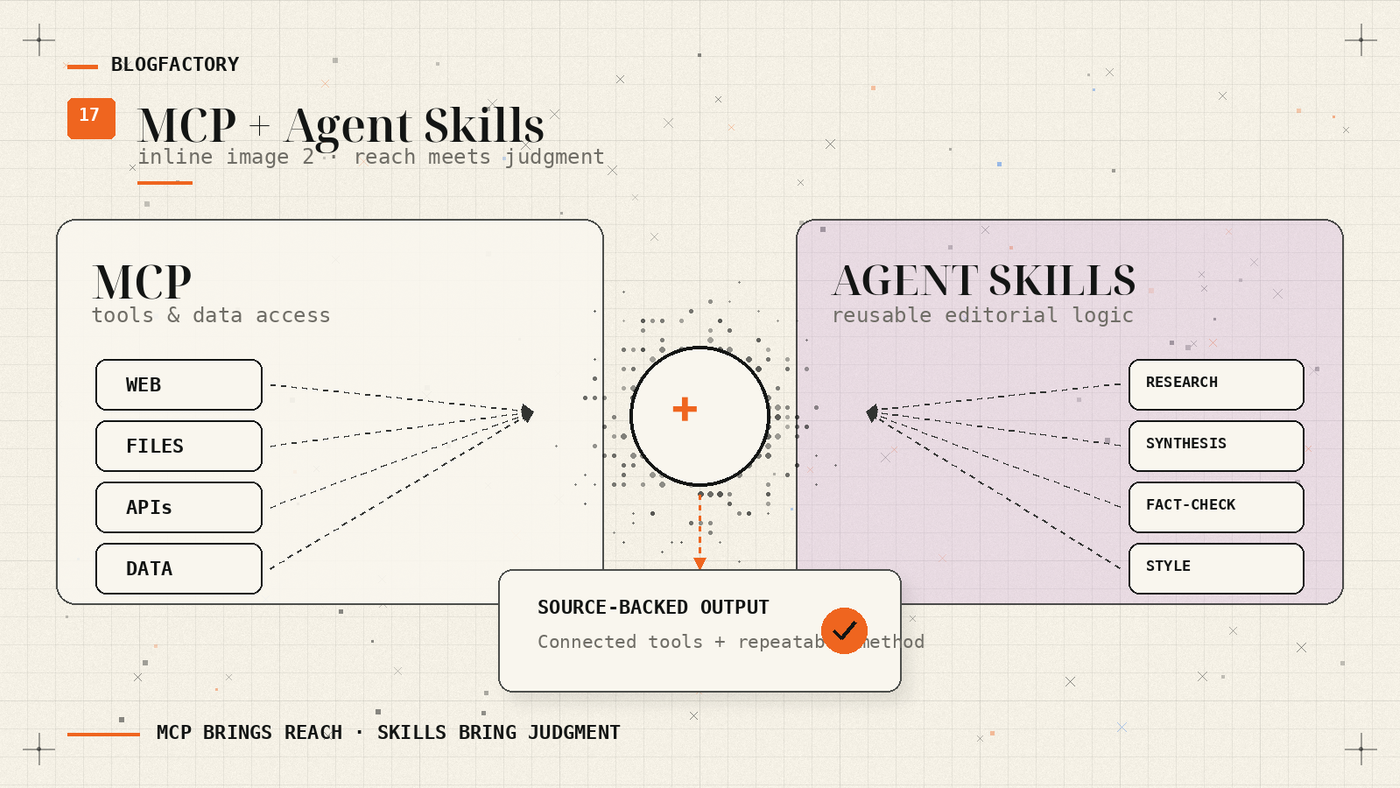
The cleanest architecture keeps the editorial method and the system permissions separate.
- The skill defines the required brief, research method, article pattern, evidence rules, metadata, and readiness status.
- Read-only tools gather approved site content, analytics, or documentation.
- The agent produces a draft and runs mechanical validation.
- A human reviews claims, originality, brand fit, and the intended destination.
- A CMS tool creates a draft using the reviewed package.
- Scheduling or publishing uses a separate permission and confirmation.
- The public result is checked independently after deployment.
Ghost Publisher MCP illustrates the action layer. It exposes a bounded Ghost-specific surface for posts, Pages, images, schedules, audits, deployment, and live checks. The writing skill illustrates the procedure layer. Neither automatically installs or authorizes the other.
Security and permission differences
The largest direct security difference is that MCP tools may hold credentials or execute external actions. A skill normally supplies instructions and local resources, although bundled scripts can still read files, run commands, or produce side effects if the host allows them.
Review both forms of extension, but ask different questions.
Questions for an MCP server
- What tools are registered, and which mutate external systems?
- Where are credentials stored, and what network destinations can the process reach?
- Are read, draft, schedule, publish, and delete capabilities separated?
- Do writes require exact targets, current revisions, previews, and confirmation?
Questions for an Agent Skill
- What instructions are loaded, and when does the skill trigger?
- Which scripts, references, templates, and dependencies are included?
- Does the workflow stop when evidence is missing, or encourage plausible fabrication?
- Can the scripts modify files or call tools, and are those effects visible?
When to choose MCP, a skill, or both
Use MCP when the main problem is system access
Examples include reading private analytics, listing CMS drafts, uploading approved assets, creating records, or checking a live deployment. The tool surface should be as narrow as the task allows.
Use an Agent Skill when the main problem is repeatability
Examples include a house research method, editorial checklist, migration procedure, audit format, or product-comparison methodology that should work the same way across many assignments.
Use both when procedure must lead to controlled action
A mature content operation normally needs both: a consistent method for producing a reviewable package and a permissioned route for moving the approved result into real systems.
BlogFactory is designed around this separation. Explore its open-source tools to see a writing skill and a Ghost MCP server positioned as independent but complementary projects.
Frequently asked questions
Is MCP the same as an Agent Skill?
No. MCP standardizes connections between AI applications and external systems. An Agent Skill packages instructions and supporting resources for a repeatable task.
Can an Agent Skill call MCP tools?
Yes, when the host application provides those tools and the workflow permits their use. The skill can instruct the agent when and how to use them, but it does not grant the connection itself.
Can MCP replace a detailed content brief?
No. MCP can retrieve data and perform actions, but the brief still defines the audience, search intent, evidence, voice, CTA, and editorial goal.
Are skills safer than MCP servers?
They usually have a different risk profile, not an automatic safety advantage. MCP servers can hold credentials and mutate external systems; skills can include scripts and instructions that affect files or tool use. Review both.
Do Codex and Claude Code support both concepts?
Their current extension documentation treats skills and MCP as separate customization layers. Exact installation and availability can vary by client and account, so confirm the current product documentation before deployment.[3][4]
The practical takeaway
Do not choose between MCP and Agent Skills as if they were competing versions of the same technology. Decide whether the problem is access, procedure, or both.
Use a skill to make the editorial method explicit. Use MCP to expose only the data and actions the workflow needs. Keep approval and permission boundaries in the system that performs the action, not only in the prose that recommends it.
References
[1] Model Context Protocol architecture and server features
[2] Agent Skills format specification