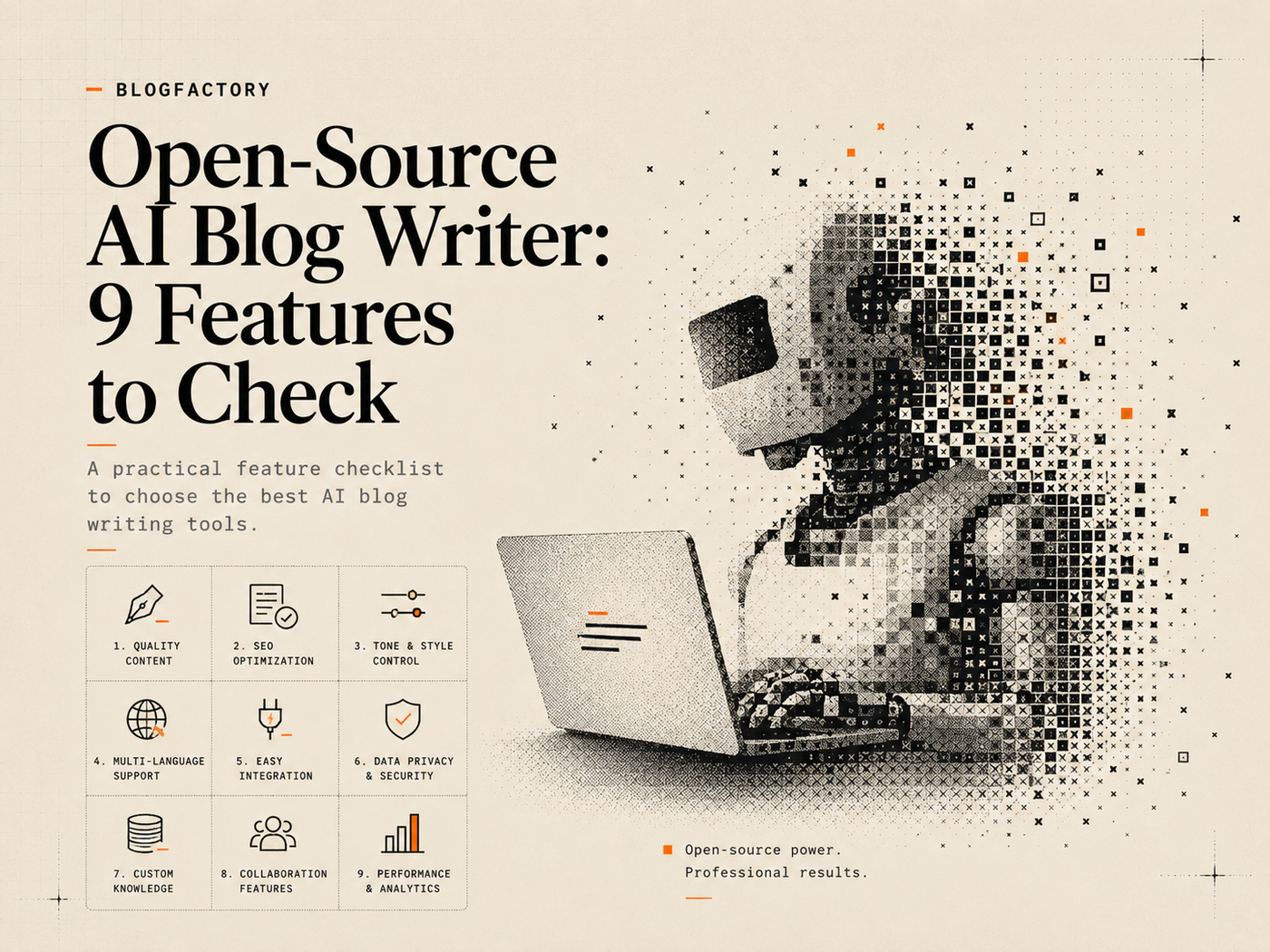
An open-source AI blog writer should be evaluated as a workflow, not only as a text generator. The important questions are whether it researches the right problem, checks existing site coverage, handles evidence honestly, works with your preferred models, validates its output, and keeps CMS permissions separate from writing.
Source code access is valuable, but “open source” does not automatically mean accurate, private, maintainable, self-hosted, or safe to connect to production systems. Review the actual architecture and operating boundary.
Key points
- Clarify whether the project is a hosted app, self-hosted application, command-line tool, or portable Agent Skill.
- Look for research and claim verification, not only fluent article generation.
- The writer should check your site for competing content before creating a new page.
- Missing proprietary evidence should block or visibly limit the draft rather than trigger fabrication.
- Deterministic validation can catch mechanical problems that model review may miss.
- Writing authority and CMS publishing authority should remain separate.
What “open-source AI blog writer” can mean
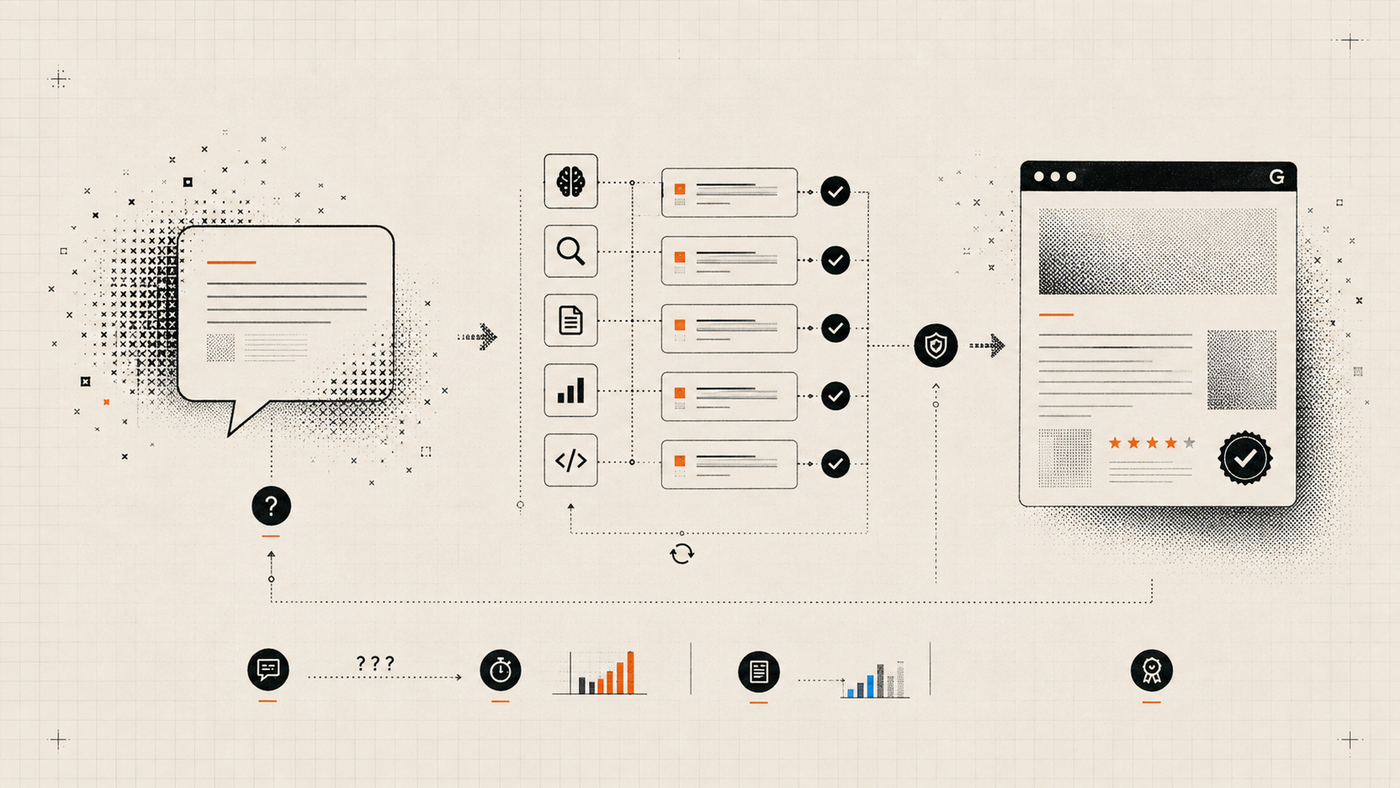
The label covers several different products. Two projects can both be open source while requiring completely different infrastructure, credentials, and operating skills.
Hosted open-source application
The source is public, but a vendor operates the service. Your prompts, sources, documents, and model requests may pass through the vendor’s infrastructure according to its deployment and privacy policy.
Self-hosted application
You deploy the web app, API, database, queues, object storage, and model credentials. This provides infrastructure control but creates responsibility for updates, backups, secrets, monitoring, abuse prevention, and cost management.
Command-line or desktop tool
The tool runs locally and may use model APIs, local models, web search, files, or browser automation. Review where it stores prompts and credentials and what network access it has.
Portable Agent Skill
A skill packages instructions, references, scripts, and assets for use inside a compatible AI client. The Agent Skills specification defines a SKILL.md-based folder format; the client supplies the model, search, files, and other available capabilities.[1]
A skill is lightweight and provider-neutral, but it is not a complete hosted writer or CMS connection. Understand what the repository includes and what your client must provide.
Feature 1: source and citation discipline
A serious AI writer should distinguish research from prose generation. It should collect current sources, prefer primary evidence for material claims, preserve source limitations, and connect each consequential statement to a reference that actually supports it.
Look for a method that answers:
- Which claims need evidence?
- Which source type is appropriate?
- When was time-sensitive information verified?
- Does the reference support the exact wording?
- What remains unverified?
A bibliography added after generation is not enough. Read the detailed guide to an AI blog writer with citations for a claim-led approach.
Feature 2: search-intent and duplicate-content checks
The writer should inspect the publishing site before drafting. Search for the primary keyword, close variants, and pages serving the same reader job. Compare intent and coverage rather than only exact titles.
When an existing page already satisfies the query, the system should recommend a refresh, consolidation, redirect, internal-link change, or genuinely distinct angle. Producing another article may create keyword cannibalization and editorial maintenance debt.
Next, review relevant organic results to understand expected questions, evidence, format, freshness, and omissions. Competitors should inform gap analysis, not supply copied wording.
A writer that begins from a blank prompt without site context is easier to use but more likely to create redundant content.
Feature 3: model and provider independence
An open-source workflow should state whether it is tied to one model vendor, supports several APIs, can use local models, or delegates model selection to the host client.
Provider independence matters because model quality, context windows, search capability, prices, rate limits, and data controls change. The durable asset is the editorial procedure and content history, not a hard-coded dependency on one current model.
Check whether switching providers changes:
- research availability;
- citation behavior;
- structured-output support;
- tool permissions;
- cost tracking;
- data-retention assumptions.
A portable skill often inherits these properties from the client instead of implementing them itself. That is flexible, but results can vary across hosts.
Feature 4: honest handling of proprietary evidence
Public research can explain a topic, but strong commercial and editorial content often needs value unavailable in the search results: a field test, internal dataset, interview, implementation lesson, customer workflow, or expert observation.
The writer must never invent that evidence. If the brief requires a case study and none exists, the correct result is blocked, incomplete, or visibly marked for proprietary input.
Look for readiness states such as:
- Blocked — a material input is missing;
- Draft — visible placeholders or review remain;
- Publish-ready — mechanical checks and claim verification passed.
A system that always returns a polished “final article” may hide uncertainty instead of managing it.
Feature 5: deterministic validation
Language models are useful editors, but they can overlook repeated headings, missing fields, broken citation numbering, inconsistent metadata, unresolved placeholders, or duplicated FAQs.
A deterministic validator can check mechanical requirements every time. Useful checks include:
- exactly one article title;
- required package sections;
- title, description, excerpt, and slug limits;
- heading hierarchy and keyword placement;
- citation-to-reference mapping;
- duplicate FAQ targets;
- image recommendation fields;
- unresolved placeholder markers.
A validator cannot prove that a source supports a claim. Mechanical validation complements, rather than replaces, human evidence review.
Feature 6: complete editorial packaging
A production-ready writer should output more than the article body. The package should include the information an editor and CMS workflow need to evaluate and deliver the content.
Look for:
- search intent and primary keyword;
- related terms and target questions;
- competitor gap and proprietary evidence;
- readiness status and unresolved risks;
- slug, meta title, meta description, and CMS excerpt;
- internal-link opportunities with verified URLs;
- FAQs based on evidenced questions;
- cover and in-article image recommendations;
- numbered references actually used.
This makes review faster and prevents metadata from becoming an afterthought added manually in the CMS.
Feature 7: CMS permission boundaries
An AI writer does not need live publishing rights to research and draft an article. Treat writing, CMS draft creation, scheduling, and publication as separate capabilities.
Ask whether the project:
- has no CMS connection;
- creates drafts only;
- can publish directly;
- can delete or administer unrelated CMS resources;
- supports exact revisions and approval before writes.
The safest default is usually to produce a reviewable package and hand it to a separately authorized draft-delivery workflow. The article on open-source content automation explains this separation.
Feature 8: licensing, privacy, and infrastructure clarity
Read the actual license. Determine whether commercial use, modification, distribution, network deployment, or attribution creates obligations for your organization.
Open source does not describe data flow. Document:
- where prompts and source documents are processed;
- which model, search, analytics, and CMS services receive data;
- where credentials are stored;
- whether logs retain article or user content;
- whether self-hosting still calls external APIs;
- who is responsible for backups and security updates.
A self-hosted user interface can still send content to a third-party model or search provider. The architecture, not the label, determines the data path.
Feature 9: maintenance, tests, and update process
Evaluate whether the project can remain dependable after installation. Review recent commits and releases, open issues, documented limitations, automated tests, dependency updates, schema migrations, compatibility notes, and the maintainer’s response to security reports.
For skills, check whether examples, references, and validators are versioned together. For applications, check database migrations, queues, model adapters, and deployment documentation. For MCP-connected writers, check whether tool permissions can change across upgrades.
Pin a reviewed version when reproducibility matters. Test updates in a non-production workspace before replacing the version used by the editorial team.
How to test an open-source AI blog writer
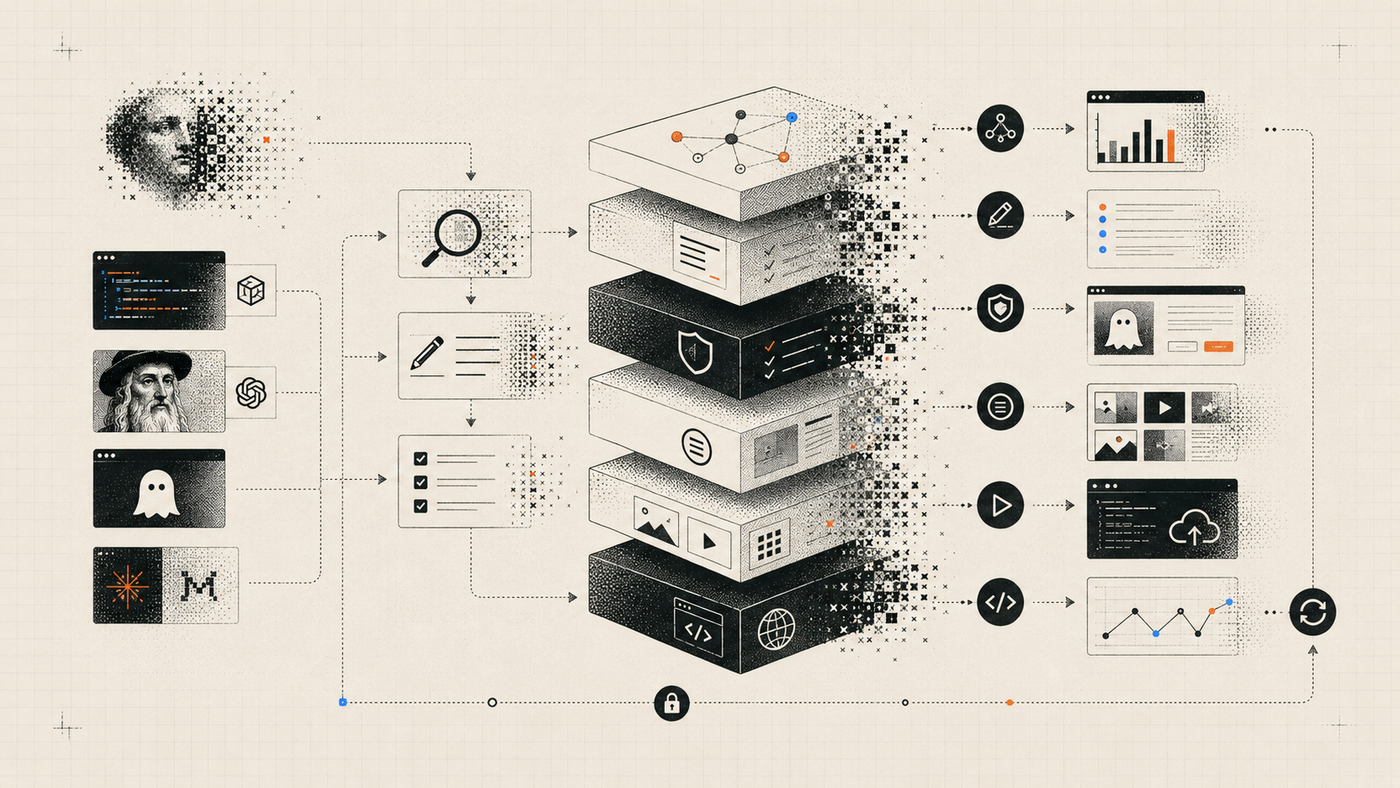
Use a topic your team understands and a site with existing related content. Do not evaluate only the fluency of the final prose.
- Give the system a clear keyword, audience, market, voice, CTA, and one real proprietary fact.
- Check whether it detects an existing competing page.
- Inspect the sources and whether they support material claims.
- Remove the proprietary evidence and observe whether the tool fabricates or blocks.
- Add a conflicting update to an existing page and check whether the writer preserves useful material.
- Run the validator against deliberate metadata, citation, and placeholder errors.
- Confirm that CMS access is absent or limited to the intended draft workflow.
Google’s guidance emphasizes useful, reliable, people-first content and warns that scaled generation without added value can violate spam policies.[2][3] Your test should therefore measure evidence, originality, and reader usefulness—not the number of words produced per minute.
Source-Backed Blog Writer as an open-source option
Source-Backed Blog Writer is a portable Agent Skill maintained by BlogFactoryHQ. It packages a workflow for site research, search-intent analysis, source review, claim tracking, article patterns, approval mode, metadata, FAQs, images, references, readiness states, refreshes, audits, and deterministic validation.[4]
It works inside compatible AI clients and relies on their available model and web capabilities. It does not host a model, supply search-volume data, connect to a CMS, or guarantee rankings.
The project is appropriate when you want a transparent writing procedure that can travel between clients. It is not a substitute for a collaborative editorial application, analytics system, CMS integration, or human review.
Review its workflow and installation instructions on the Source-Backed Blog Writer page.
Frequently asked questions
Does open source mean the AI writer runs locally?
No. The source may be public while the hosted service or configured model APIs process data remotely. Inspect the deployment and network architecture.
Can an open-source AI writer guarantee SEO rankings?
No. It can improve research discipline and article completeness, but rankings depend on demand, competition, site quality, links, technical delivery, and search systems.
Is a portable Agent Skill the same as a self-hosted app?
No. A skill supplies a reusable procedure inside a compatible client. A self-hosted app supplies its own interface, services, storage, and operational environment.
Should the writer publish directly to my CMS?
Not by default. Keep research and drafting separate from draft delivery, scheduling, and live publishing so each stage has an appropriate permission and review step.
What is the most important evaluation feature?
Observe what happens when evidence is missing. A trustworthy workflow names the gap or stops; it does not fill the article with plausible invented experience.
The practical takeaway
Do not select an open-source AI blog writer because the demo produces a polished article from one keyword. Test the complete operating method.
Choose a project that checks your existing content, verifies claims, handles missing evidence honestly, works with your preferred model architecture, validates mechanical requirements, packages the full editorial handoff, and limits CMS authority. Then evaluate the license, data flow, maintenance, and update process before adopting it.
References
[1] Agent Skills specification
[2] Google: creating helpful, reliable, people-first content