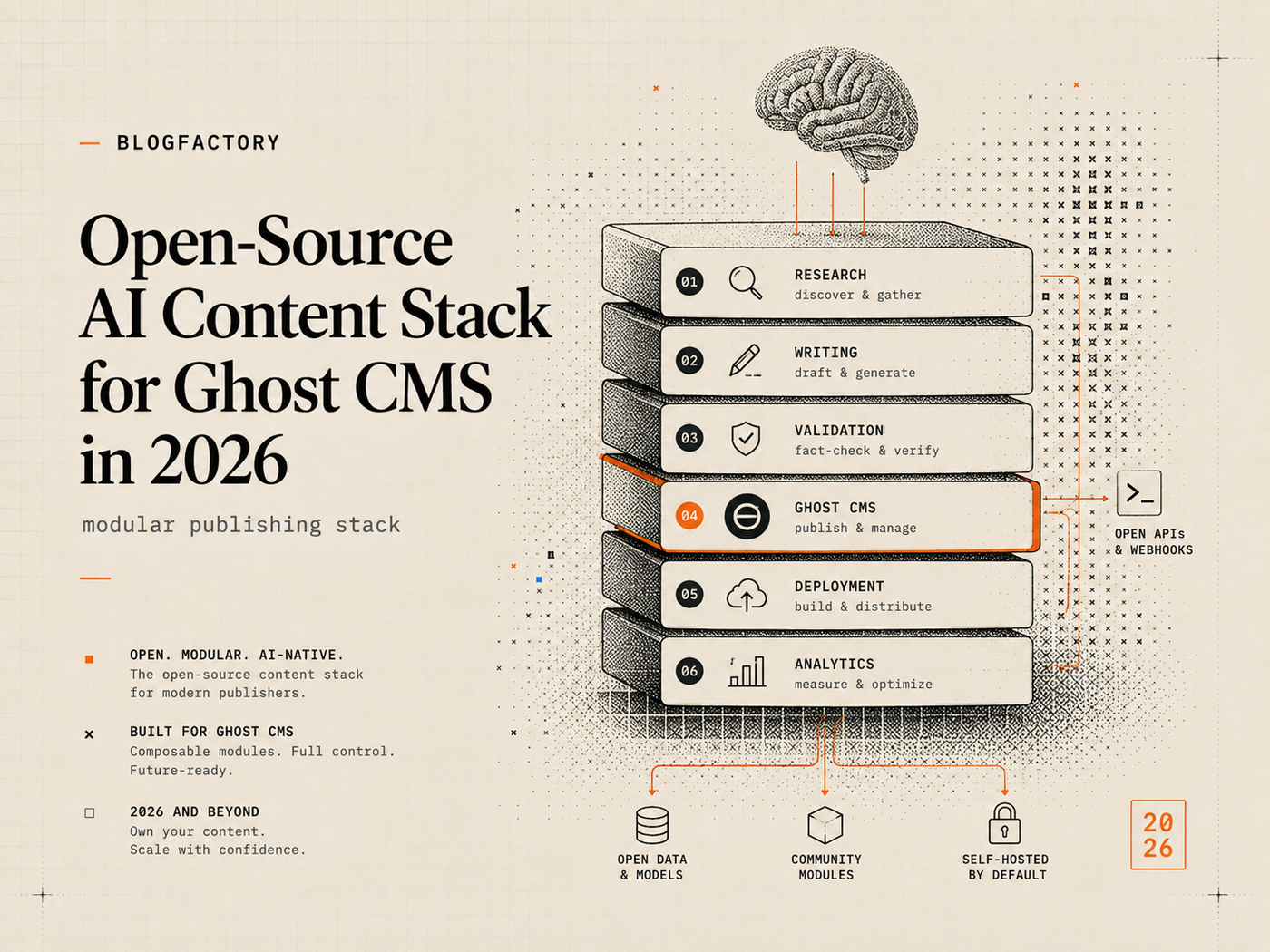
An open-source AI content stack for Ghost CMS should separate seven jobs: model interaction, research procedure, evidence and validation, editorial review, Ghost actions, public delivery, and performance feedback. No single application needs to own the entire pipeline.
A practical 2026 stack can combine a compatible AI client, a portable source-backed writing skill, an optional content-operations control plane, Ghost CMS, a narrow local publishing MCP server, a frontend or Ghost theme, and first-party search analytics. Humans remain responsible for claims, positioning, approval, and public transitions.
Key points
- Open source describes licensing and source availability, not automatic privacy, local execution, security, or zero cost.
- Keep the durable editorial workflow separate from the rapidly changing model layer.
- Use reusable skills or documented procedures for research, claims, metadata, images, and validation.
- Give AI clients a bounded Ghost tool surface rather than arbitrary administration.
- Treat draft creation, scheduling, publishing, deployment, and public verification as separate capabilities.
- Document data flow, credentials, licenses, update ownership, backups, and incident response for every layer.
- Start with a minimal stack and add orchestration only when team scale or workflow complexity justifies it.
What an open-source AI content stack needs
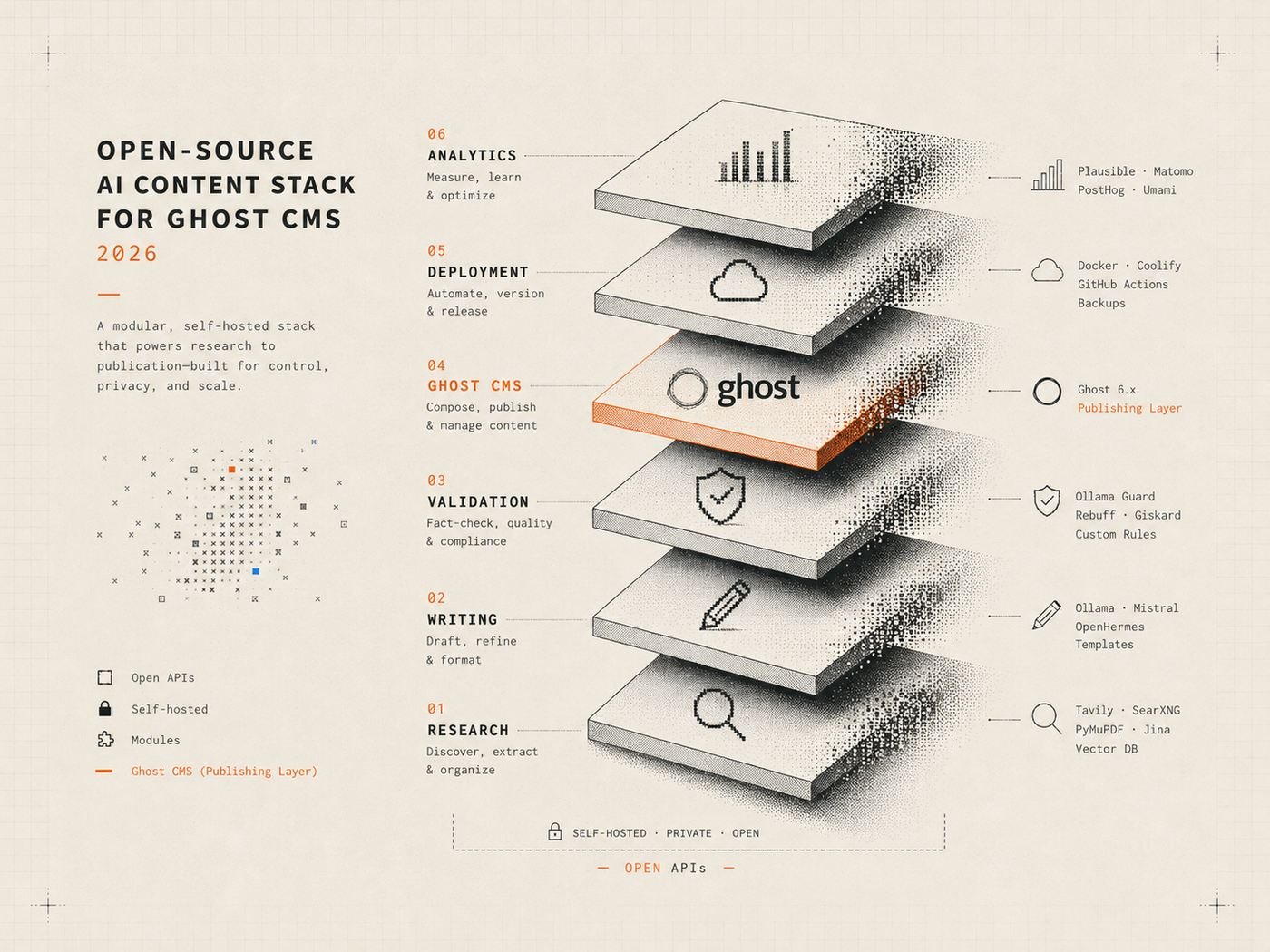
A content stack is the set of systems and procedures used to turn an idea into a maintained public page. For Ghost, the stack must cover more than generation.
At minimum, it needs to answer:
- Which model or AI client performs the work?
- How does the system research current sources and existing site content?
- How are claims, proprietary evidence, and citations tracked?
- Where do drafts, versions, reviews, and approvals live?
- Which Ghost operations can the AI perform?
- How are images created, reviewed, uploaded, and attributed?
- How does the public site update and how is the result verified?
- How does search and engagement evidence drive refreshes?
The stack is complete when each responsibility has an owner and the handoffs are observable. It does not need to be one monolithic application.
Open source does not mean fully local or private
An open-source interface may still send prompts, sources, and drafts to a proprietary model API. A self-hosted application may call external search, analytics, image, storage, and CMS services. A local MCP server may hold a production Ghost key and install dependencies from a public package registry.
Document the actual data path:
- What content leaves your infrastructure?
- Which provider receives it and under what account or contract?
- Where are prompts, logs, files, embeddings, and backups retained?
- Which services receive credentials?
- Who can access the system and revoke that access?
Open source gives you the ability to inspect and modify original project code according to its license. It does not remove operational responsibility.
Layer 1: AI client and model provider
The AI client is where operators request research, planning, writing, review, and tool use. It may be a desktop assistant, coding agent, command-line client, or a custom application.
The model layer can use a hosted proprietary model, an open-weight model served locally or privately, or several providers selected by task. The stack should avoid storing durable editorial logic only inside one provider-specific system prompt.
Evaluate the client and model together:
- quality for research, synthesis, editing, and structured output;
- web, file, shell, image, and MCP capabilities;
- context and file-size limits;
- data retention and organization controls;
- cost, rate limits, latency, and availability;
- support for reusable skills or project instructions;
- permission visibility and auditability.
The model is replaceable. Your sources, drafts, approvals, CMS records, and performance history should remain usable when the preferred provider changes.
Layer 2: reusable research and writing procedure
The procedure defines how an article moves from a brief to a reviewable package. Store it as a maintained skill, repository instructions, or another versioned artifact rather than rewriting a long prompt for every post.
A strong procedure covers:
- required audience, market, keyword, voice, CTA, and product inputs;
- existing-site and duplicate-content checks;
- search-intent and competitor research;
- source priorities and claim classifications;
- proprietary-evidence requirements and stopping conditions;
- article patterns, metadata, internal links, FAQs, and image fields;
- refresh, audit, and validation behavior.
Source-Backed Blog Writer is one open, portable Agent Skill for this layer. It is licensed under CC BY 4.0 and includes a provider-neutral workflow plus a Python standard-library validator.[1]
The Agent Skills vs prompts guide explains why the stable method belongs in a skill while the changing article brief remains a prompt or structured input.
Layer 3: sources, evidence, and deterministic validation
The stack needs current-source access or a controlled way to supply documents. Search results alone are not enough. Material claims should resolve to primary documentation, reliable secondary context, proprietary evidence, reproducible calculations, or clearly labeled analysis.
Use a claim ledger that records the claim, classification, source, verification date, limitation, and status. Keep unverified claims visible until they are removed, narrowed, or supported.
Deterministic validation should check what software can measure consistently: metadata lengths, required sections, heading hierarchy, citation numbering, duplicate FAQs, image fields, unresolved placeholders, and package completeness.
Validation does not prove that the source supports the sentence or that the article is useful. Human evidence review and editorial judgment remain required.
The guides to AI citations and fact-checking AI content provide the detailed claim workflow.
Layer 4: content operations and human review
A solo publisher may manage drafts and approvals in files, Git, a task tracker, or the AI client. A team managing many sites and revisions usually needs a control plane that stores content state, destinations, evidence, reviews, runs, and audit history.
Useful capabilities include:
- multi-site workspaces and site-scoped access;
- draft versions, diffs, comments, blockers, and approvals;
- brand voice and product context;
- search data and refresh opportunities;
- usage, model, and cost tracking;
- reviewed CMS draft delivery;
- run monitoring and failure receipts.
BlogFactory is an open-source, self-hostable content-operations platform for this layer. Its Community repository is licensed AGPL-3.0-only and uses a draft-oriented, site-scoped model rather than granting agents unrestricted live publishing.[2]
A control plane is optional. Add it when workflow coordination, team review, multi-site access, analytics, and audit history justify the infrastructure.
The article What Is BlogFactory? explains how this layer differs from an AI writer or CMS.
Layer 5: Ghost CMS action layer
Ghost stores the posts, Pages, authors, tags, images, publication states, and other CMS data. Its Admin API provides authenticated management operations; its Content API supports public content delivery.[3]
Do not give the AI client an arbitrary Admin API dispatcher unless the operator genuinely needs broad Ghost administration. A publishing workflow usually needs a smaller set:
- connection and site checks;
- post, Page, tag, and public-author reads;
- draft creation;
- approved revision-aware changes;
- constrained image uploads;
- schedule planning and application;
- explicit publishing and unpublishing;
- bounded audits and public verification.
Ghost Publisher MCP is an unofficial local-first server for this layer. It is licensed under MIT and deliberately excludes deletion, members, newsletters, themes, arbitrary API calls, and general administration from its publishing-focused surface.[4]
Its read-only, draft-editor, scheduler, and publisher profiles register different tools. Draft creation is always draft-only, while publishing, scheduling, unpublishing, approved changes, and deployment require separate controls.
Review the Ghost MCP server comparison when the workflow needs broader Ghost administration or deeper native authoring.
Layer 6: images and media
Images may come from designers, screenshots, diagrams, licensed libraries, open repositories, AI generation, or a combination. The stack needs an explicit review and storage workflow regardless of origin.
Track:
- source, creator, license, and attribution;
- article placement and version;
- dimensions, format, compression, and filename;
- alt text and caption;
- private or sensitive information;
- factual accuracy and deceptive elements;
- the Ghost asset URL after upload.
Restrict automated local uploads to approved directories. Validate the file and read the Ghost draft back after attaching the image.
Open-source image tooling can handle compression, resizing, and metadata removal, while image generation may still rely on a proprietary model. Document the distinction.
Layer 7: public delivery and verification
A standard Ghost theme can publish directly from the CMS. A headless implementation adds a frontend framework, build or revalidation process, CDN, routing, sitemaps, and another set of failure states.
For headless sites, separate:
- Ghost state: the content has the expected published status.
- Deployment state: the build, revalidation, or cache action completed.
- Public state: the trusted URL returns the expected rendered output.
A live verifier should check HTTP status, title, canonical URL, selected metadata, feature image, and accidental noindex directives. It should not claim that the page is indexed or ranked.
The headless Ghost publishing guide covers deploy hooks, route templates, caches, and partial failures.
Layer 8: search analytics and content refresh
Publishing is not the end of content operations. The stack needs a feedback loop for search performance, engagement, broken pages, stale facts, product changes, and reader feedback.
Google Search Console is not open source, but it provides first-party search evidence that can be incorporated into an otherwise open stack. Label metrics by source and avoid presenting correlation as a guaranteed cause.
Use analytics to identify:
- pages with declining or expanding demand;
- high-impression questions the page answers poorly;
- content cannibalization and internal-link gaps;
- stale versions, prices, laws, or product features;
- published pages whose metadata or delivery is broken;
- articles that should be consolidated, redirected, or retired.
Refresh selectively. Preserve useful material, update stale claims and sources, record changes, validate the revision, and handle publication dates honestly. The AI content refresh guide provides the full process.
Minimal open-source stack for a solo Ghost publisher
A solo publisher can begin with a small stack:
- An AI client with web and file access.
- Source-Backed Blog Writer installed as the reusable editorial procedure.
- A private project folder or Git repository for briefs, sources, drafts, and images.
- Ghost CMS as the content destination.
- Ghost Publisher MCP in read-only or draft-editor mode until the workflow is proven.
- A standard Ghost theme or one documented headless deployment path.
- Search Console and a simple review schedule for refreshes.
The operator can manage approvals through explicit checkpoints and keep the Ghost integration narrow. This stack avoids the cost and maintenance of a separate control plane until it is needed.
Controlled stack for a content team
A team managing several authors, sites, AI providers, or review roles may add:
- BlogFactory or another content-operations control plane;
- centralized identity, role, and site-scoped access;
- shared source, brief, and brand repositories;
- approval queues and immutable revision receipts;
- object storage for reviewed images and artifacts;
- run monitoring, usage, and cost controls;
- staging Ghost and frontend environments;
- backup, secret rotation, audit, and incident-response procedures.
Do not centralize merely to create a larger architecture. The additional system should reduce coordination risk, duplicate credentials, review confusion, or manual handoffs.
Reference architecture
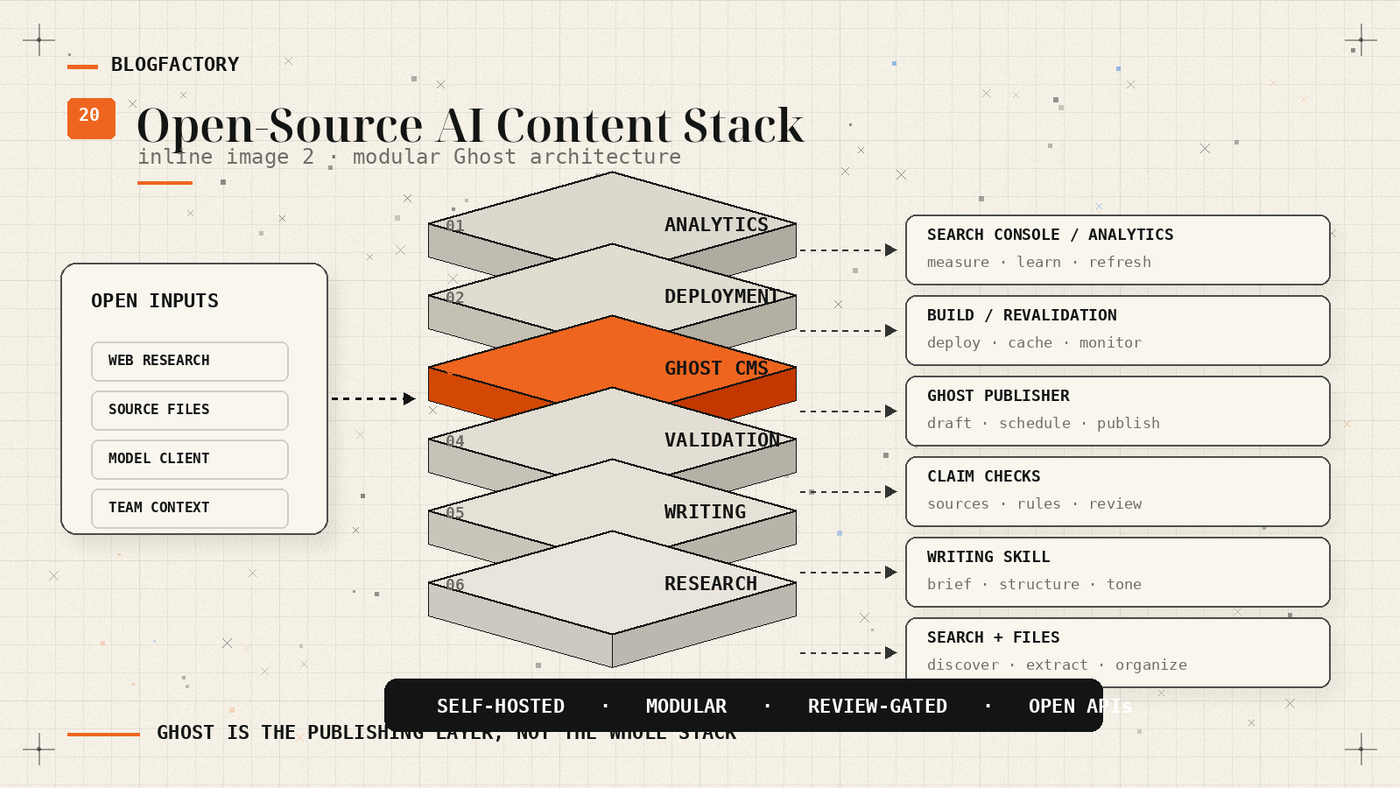
A controlled reference flow looks like this:
Brief and proprietary evidence → AI client with Source-Backed Blog Writer → source and claim review → human approval → optional BlogFactory workspace → Ghost Publisher MCP → Ghost draft → revision-aware review → approved schedule or publish → optional deploy hook → public verification → Search Console and refresh loop
The architecture intentionally includes more than one boundary. The writing skill does not hold the Ghost key. The CMS tool does not decide whether a claim is true. The deployment hook does not prove the page is correct. Analytics do not automatically authorize a rewrite.
The complete AI content workflow for Ghost turns this architecture into an operational sequence.
Security and maintenance checklist
- Document the license and update source for every project.
- Pin or record reviewed versions for production workflows.
- Keep model, search, CMS, storage, and deploy credentials in private secret stores.
- Start connectors read-only and enable narrower write profiles deliberately.
- Review scripts, dependencies, install hooks, and network behavior.
- Use staging for upgrades and public-workflow tests.
- Back up content, databases, files, and configuration.
- Record revision, approval, write, deployment, and verification receipts without leaking secrets.
- Test credential rotation, recovery, and unpublishing procedures.
The Ghost automation security checklist covers the CMS and deployment boundary in detail.
How to choose what belongs in your stack
Evaluate each component against the same questions:
- What exact job does it own?
- What data and credentials can it access?
- What can it read, write, publish, delete, or trigger?
- What evidence does it return after an action?
- How is it updated, backed up, monitored, and revoked?
- What happens when it is unavailable or wrong?
- Can a smaller component or documented manual step solve the problem?
Choose tools by boundary and maintenance cost, not by the number of AI features in the README.
Frequently asked questions
Does every component need to be open source?
No. Many teams combine open-source workflow components with proprietary models, search services, or analytics. Document the boundary and avoid implying that the entire data path is open or local.
Can I run the whole Ghost AI content stack locally?
Many components can run locally or on your infrastructure, but current web research, model inference, Ghost hosting, analytics, image generation, or deployment may still use external services depending on your choices.
Do I need BlogFactory to use the two open-source tools?
No. Source-Backed Blog Writer and Ghost Publisher MCP work independently. BlogFactory becomes useful when you need a multi-site control plane, centralized reviews, search workflows, run history, and draft delivery.
Can Ghost Publisher MCP write the article for me?
It performs Ghost-specific actions. The connected AI client and editorial procedure handle research and writing. Separating those responsibilities keeps CMS authority independent from prose generation.
What is the simplest safe starting point?
Use a reviewed writing skill, keep drafts in a controlled workspace, connect Ghost read-only, create drafts only after editorial approval, and leave scheduling and publishing manual until the team understands the failure modes.
The practical takeaway
A useful open-source Ghost AI stack is modular. It preserves the freedom to change models, clients, deployment systems, and workflow components without losing the content process itself.
Start with a compatible AI client, a source-backed procedure, Ghost, and a narrow draft-oriented connection. Add a control plane, headless deployment, image automation, analytics, and multi-site governance when the real workflow demands them. At every layer, define the job, data flow, permissions, evidence, failure state, license, and maintenance owner. That is what turns a collection of open-source repositories into an operating content stack.
References
[1] Source-Backed Blog Writer repository and license
[2] BlogFactory repository and self-hosted architecture
[3] Ghost Admin and Content API documentation
[4] Ghost Publisher MCP repository and license
[5] Google: creating helpful, reliable, people-first content