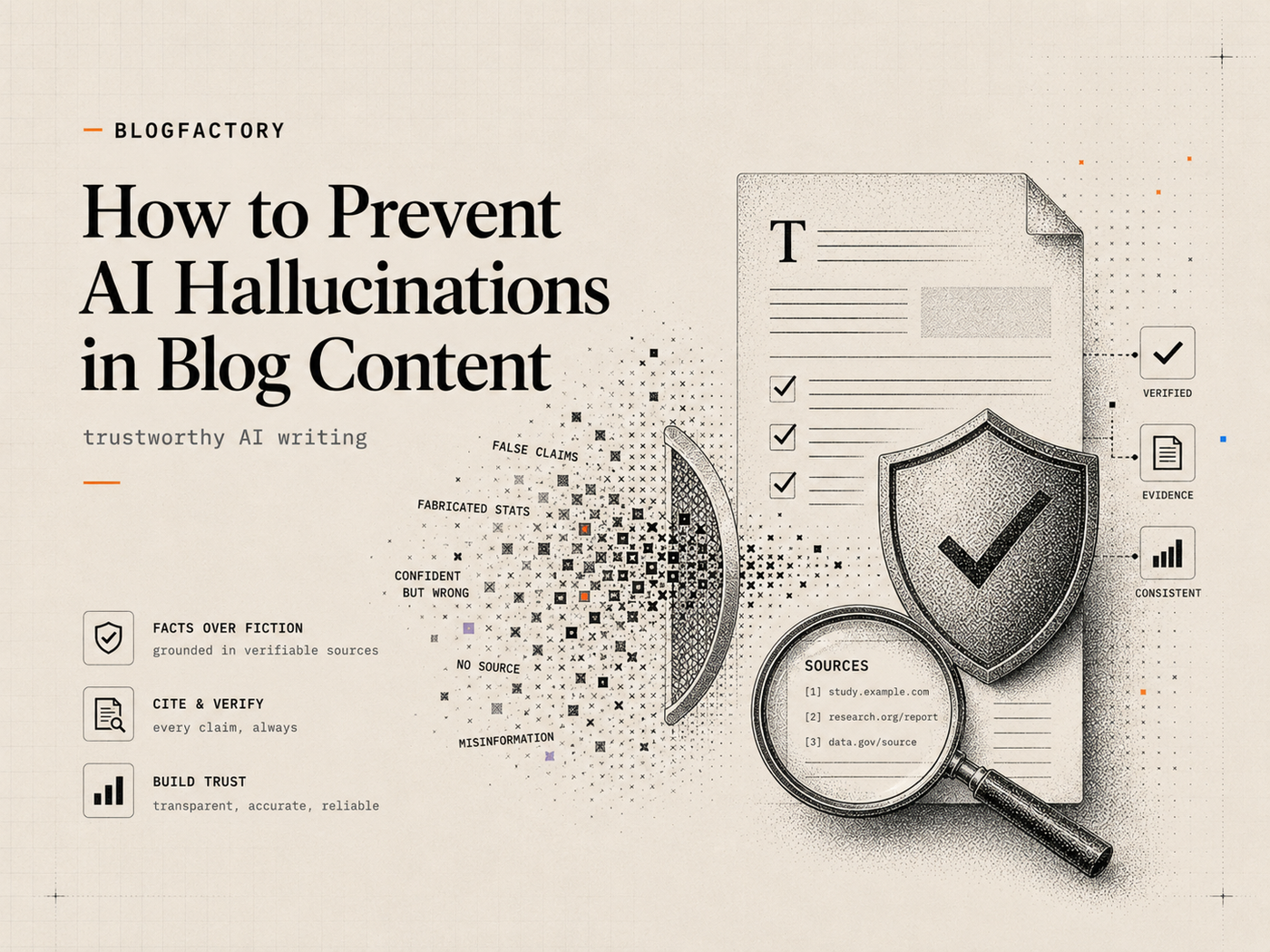
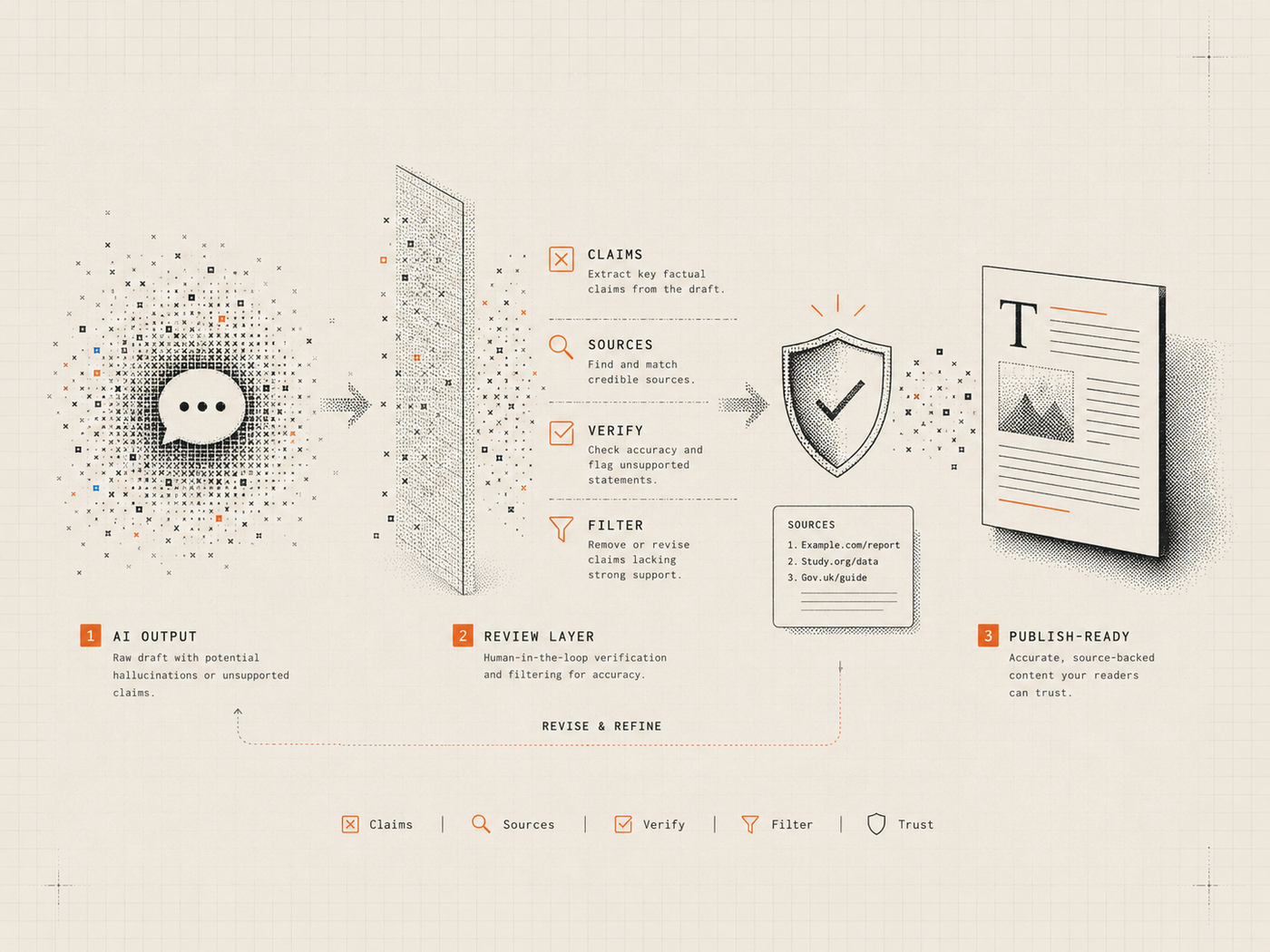
To prevent AI hallucinations in blog content, design the workflow so unsupported claims cannot quietly become polished prose. Research before drafting, classify every material claim, prefer primary sources, attach evidence to exact statements, and stop when proprietary information is missing.
The goal is not to make a language model incapable of error. The goal is to make errors visible before publication and to prevent fluency from being mistaken for evidence.
Key points
- Treat generated statements as draft claims, not verified facts.
- Separate public facts, proprietary evidence, calculations, and editorial analysis.
- Verify every number, date, quotation, product capability, and consequential conclusion.
- Never let the model invent first-hand experience, customer results, credentials, or internal data.
- Use visible blocked or draft states when evidence is unavailable.
- Human review should focus on claim support and scope, not only grammar.
What an AI hallucination looks like in blog content
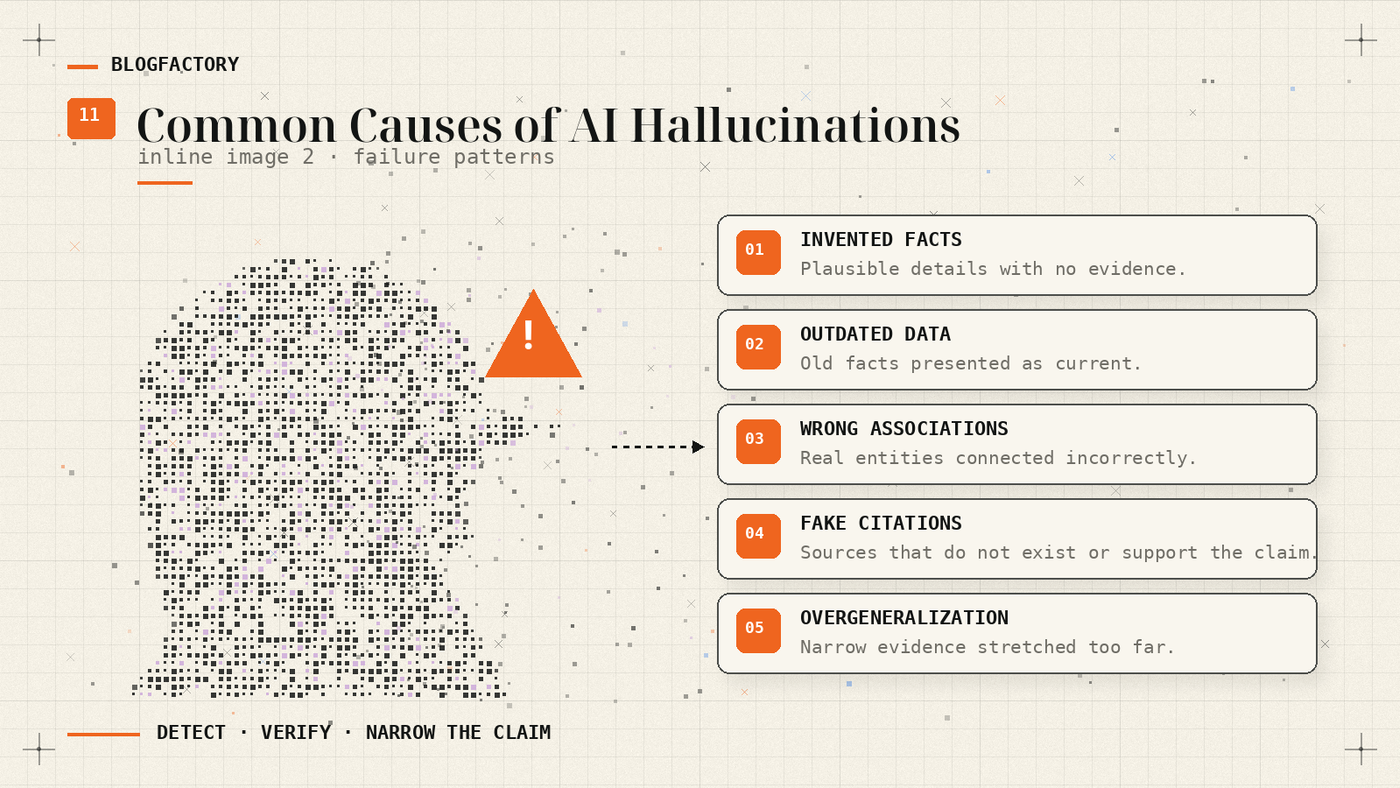
An AI hallucination is an output presented as if it were grounded in reality even though the model lacks adequate support. In a blog article, the error may be obvious—such as a nonexistent report—or subtle, such as exaggerating a limited source into a universal conclusion.
Common forms include:
- invented statistics, dates, prices, product features, or version numbers;
- fabricated quotations, interviewees, credentials, or customer stories;
- citations to pages that do not exist or do not support the claim;
- incorrect summaries of real documentation;
- confident comparisons that were never tested;
- causal claims drawn from simple correlation;
- first-person experience invented to make the article sound authentic.
A sentence can also be technically true but misleading because it omits a date, sample size, exception, dependency, or limitation.
Why “ask the model not to hallucinate” is insufficient
A prompt can remind the model to be cautious, but it cannot independently verify a claim. The model may still produce an answer that resembles patterns from its training or conversation context.
The stronger solution changes the process:
- Require sources before material claims are drafted.
- Track which evidence supports each claim.
- Define what happens when evidence is missing.
- Validate the final package mechanically.
- Have a human check support, wording, and implications.
This makes truthfulness an operating requirement rather than a stylistic preference.
Step 1: define the article’s claim types
Before research, decide what kinds of statements the article is expected to make. Different claims require different evidence.
Public factual claims
Examples include software requirements, laws, product capabilities, official definitions, dates, and published research. Prefer primary documentation or the responsible authority.
Proprietary claims
Examples include internal performance, customer outcomes, field tests, company processes, interview quotations, and first-hand experience. These must come from the organization or an attributable participant.
Calculated claims
Examples include percentages, totals, rates, and comparisons derived from supplied data. Preserve the inputs and formula so the result can be reproduced.
Analysis and recommendations
The author may synthesize evidence and make a recommendation. Label it as analysis rather than claiming that a source directly reached the same conclusion.
This classification prevents all sentences from being treated as interchangeable “content.”
Step 2: research before writing prose
Start with the publishing site. Check whether an existing page already covers the topic and whether it contains useful evidence that should be preserved. Then research the current search intent and relevant external sources.
For software, laws, product features, standards, prices, and other changing facts, verify the current state close to the publication date. Record the verification date rather than assuming the source remains current.
Google’s guidance on generative AI content emphasizes accuracy, quality, relevance, and useful context. It also warns that generating many pages without added value can violate scaled-content-abuse policies.[1][2] Research depth and original value therefore matter more than automated volume.
The AI blog writer with citations guide explains how to connect search intent, sources, and claims.
Step 3: use a source hierarchy
Not all sources carry the same evidentiary weight. Use the strongest source available for the type of claim.
- Primary sources: official documentation, standards, legislation, filings, original datasets, research papers, repositories, and direct statements.
- Reliable secondary sources: reputable reporting or expert analysis that adds independent interpretation.
- Proprietary evidence: supplied internal data, interviews, tests, and first-hand observations.
- Analysis: the article’s disclosed synthesis of supported facts.
Do not cite a roundup that cites another roundup when the original documentation is available. Do not use a competitor’s marketing page as independent proof of its own superiority.
Step 4: build a claim ledger
A claim ledger is a working table that connects facts to evidence before the final prose hides the research structure.
Use columns such as:
- Claim;
- Classification;
- Source;
- Verified date;
- Scope or limitation;
- Status.
Classifications may include primary source, secondary source, proprietary evidence, user-provided, calculated, analysis, or unverified.
An unverified material claim should remain visible in the ledger and block publish-ready status. Do not let it disappear simply because the surrounding paragraph sounds credible.
Step 5: stop when proprietary evidence is missing
The most damaging hallucinations often involve claims that cannot be found on the public web: “we tested 50 products,” “our customers saved 30%,” or “the founder learned this after ten years in the field.”
When the brief needs proprietary evidence but none is supplied, choose one of three responses:
- Block the article and request one concrete input.
- Narrow the article so the unsupported claim is unnecessary.
- Insert an explicit editorial placeholder and label the result as a draft.
Never manufacture a sample, quotation, credential, methodology, or outcome to complete the template.
Step 6: write answer-first, evidence-aware sections
Each section should begin with the answer or central claim, followed by the evidence and necessary context. This makes unsupported assertions easier to identify than when important claims are buried inside long, decorative introductions.
Use specific wording that matches the evidence. Replace “always,” “proves,” “best,” or “causes” with a narrower description when the source supports only one version, sample, observation, or association.
State dates and versions for changing software. State sample size and method for research. State whether a product was tested or reviewed from documentation. State whether a result is maintainer-reported, customer-reported, calculated, or independently measured.
Step 7: map citations to exact claims
After drafting, inspect every sentence containing a number, date, quotation, named outcome, product behavior, legal requirement, or causal statement.
For each claim:
- Open the cited source.
- Locate the exact supporting passage or data.
- Check that the source is current enough.
- Compare the article’s scope with the source’s scope.
- Rewrite, qualify, or remove anything that goes beyond the evidence.
- Confirm that every citation marker resolves to one clear reference.
A source list at the bottom of the article is not a substitute for this claim-level check.
Step 8: use deterministic validation
A script can catch structural defects that increase hallucination risk, including unresolved placeholders, citation numbers with no references, references that are never cited, duplicated FAQ questions, missing metadata, and invalid readiness labels.
Mechanical validation cannot decide whether the source truly supports the sentence. Use it to enforce completeness, then perform human source review.
Source-Backed Blog Writer includes a dependency-free Python validator alongside its editorial workflow.[3] Review the open-source skill to see how blocked, draft, and publish-ready states are handled.
Step 9: focus human review on the highest-risk claims
Human review should not spend equal time on every sentence. Prioritize claims that could mislead readers, damage trust, create legal or commercial risk, or influence an important decision.
Review these first:
- health, legal, financial, security, or regulatory statements;
- product comparisons and competitive disadvantages;
- statistics, prices, dates, and version-specific claims;
- quotes and attributed opinions;
- customer results, internal metrics, and first-hand statements;
- claims of causation, superiority, safety, or guaranteed outcomes.
Then review whether the article answers the reader’s question and adds original value without padding.
Red flags that indicate possible hallucination
- A precise statistic appears without a source or method.
- A quote cannot be found in the attributed source.
- The article claims first-hand testing but no tester, date, sample, or procedure exists.
- A product feature is described more broadly than official documentation.
- Several references have plausible titles but broken or unrelated URLs.
- The article repeatedly uses absolute language unsupported by the evidence.
- A competitor drawback is stated without fair sourcing or methodology.
- The system supplies proprietary results even though none were included in the brief.
A practical anti-hallucination workflow
- Define the topic, reader, search intent, CTA, and allowed claim types.
- Check the site for existing coverage.
- Collect primary, secondary, and proprietary sources.
- Build the claim ledger and record verification dates.
- Approve the questions, material claims, and outline before drafting.
- Write answer-first sections that stay within source scope.
- Map citations and verify each material statement.
- Run deterministic structural checks.
- Complete a human risk-based fact check.
- Keep the article as a draft until unresolved evidence is supplied or removed.
For a reusable review procedure, continue with How to Fact-Check AI-Generated Content.
Frequently asked questions
Can citations eliminate AI hallucinations?
No. Citations can also be invented, irrelevant, or misinterpreted. Open each source and compare it with the exact claim.
Should every sentence have a source?
No. Common explanations and clearly labeled analysis may not need citations. Specific facts, numbers, quotations, product behavior, and consequential claims usually do.
Can a model verify its own article?
It can help identify claims and compare text with supplied sources, but independent source access, deterministic checks, and human judgment are still needed.
What should happen when a claim cannot be verified?
Remove it, narrow it, request evidence, or leave a visible editorial placeholder and mark the package as a draft. Do not present it as fact.
Does human review guarantee accuracy?
No. Human reviewers can also miss errors. Structured claims, source mapping, checklists, and specialist review improve the process but do not create certainty.
The practical takeaway
Preventing AI hallucinations is less about finding a perfect prompt and more about building a workflow that refuses unsupported certainty.
Classify claims, research first, use strong sources, track evidence, stop when proprietary inputs are missing, match wording to source scope, validate the package, and direct human attention to the highest-risk statements. The model may still propose an error, but the process makes that error far less likely to reach publication.
References
[1] Google: guidance on using generative AI content