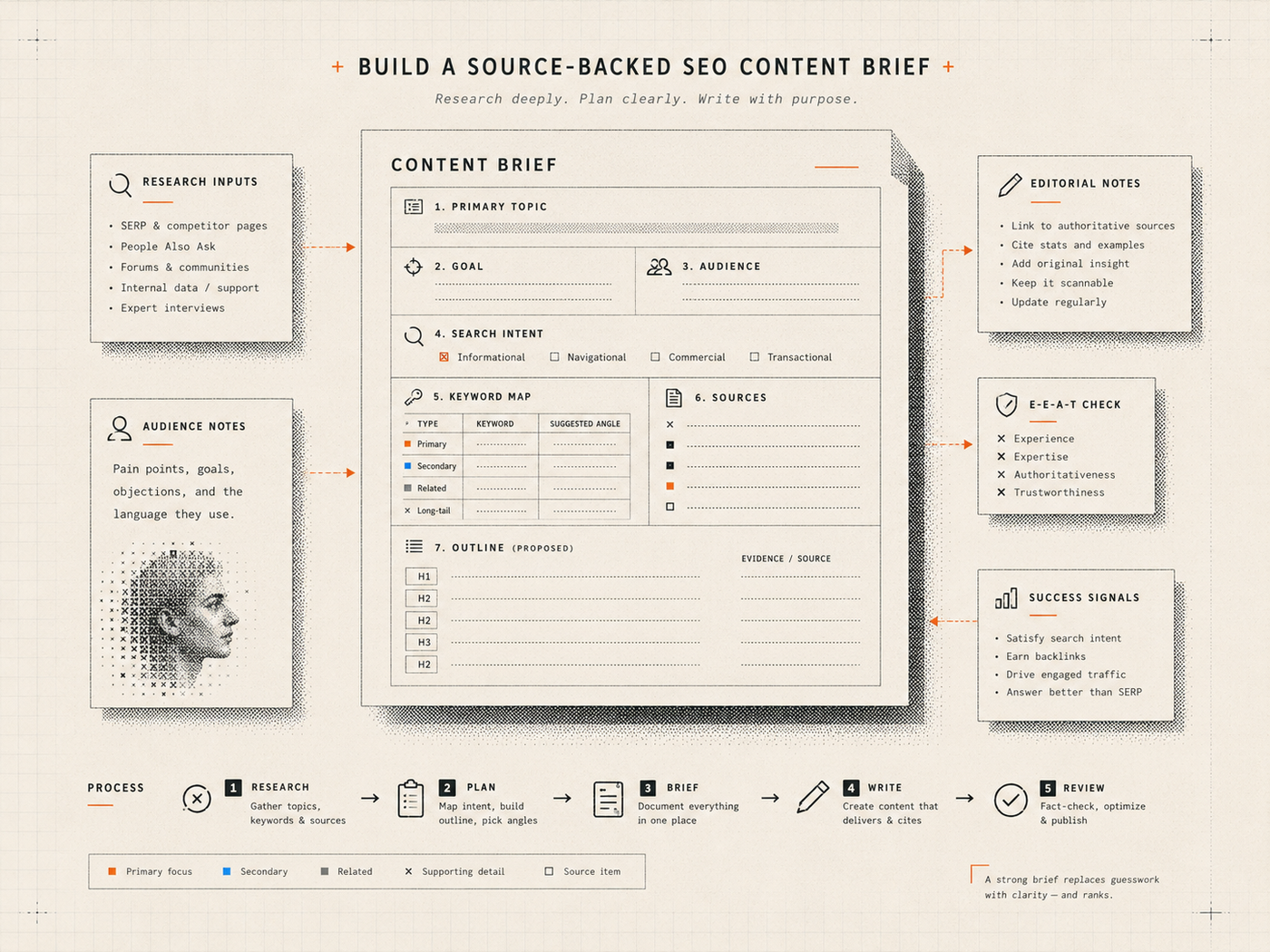
A source-backed SEO content brief defines what the article must answer, why it deserves to exist, which evidence may support it, what proprietary value the publisher can add, and how the final draft will be reviewed. It is the contract between search research and article production.
The brief should be completed before long-form drafting. This prevents the writer from producing 1,500 polished words for the wrong intent, duplicating an existing page, or discovering too late that the core product claim has no verifiable evidence.
Key points
- Start with the publishing site, not the competitor results.
- Define the audience, market, reader job, primary keyword, and CTA before outlining.
- Check whether an existing page already satisfies the same search intent.
- Review relevant organic results to identify expected coverage and defensible information gain.
- List material claims and evidence sources before the prose hides them.
- Require real proprietary evidence when the article depends on experience, data, or outcomes.
- Approve the questions, claims, gap, outline, links, and CTA before drafting high-value content.
What is a source-backed SEO content brief?
An SEO content brief is a structured plan for a page intended to satisfy a search need. A source-backed brief goes further by identifying the evidence behind material claims and separating public facts, proprietary information, calculations, and editorial analysis.
A useful brief should let an editor answer five questions before authorizing a draft:
- Does this page serve a real and distinct reader need?
- Does the site already have a page that should be refreshed instead?
- What questions must the article answer to satisfy the intent?
- Which important claims can be supported, and by what evidence?
- What original value will make the article more useful than a summary of existing results?
The brief is not a guarantee of rankings. It is a quality-control document that makes assumptions and dependencies visible before production begins.
Step 1: define the publishing context

Begin with the information that determines what “useful” means for this assignment.
Record:
- publishing domain and relevant content section;
- target market, language, and geography;
- primary audience and level of expertise;
- reader problem or job to be done;
- primary keyword or topic;
- brand voice and prohibited language;
- desired CTA and destination;
- author identity and credentials when relevant;
- deadline, review owner, and delivery format.
A keyword without audience and market context is ambiguous. “Best CMS” means something different to a solo newsletter writer, an enterprise developer, and an agency managing 50 client sites.
The CTA should follow the reader’s intent. An informational definition article may invite the reader to explore a guide, while a comparison can direct the reader to an installation or product page after the decision criteria are clear.
Step 2: check the publishing site for competing content
Search the publishing domain for the primary keyword, close variants, related entities, and pages serving the same reader job. Review titles, headings, body content, metadata, freshness, internal links, and current search performance when analytics are available.
Do not conclude that there is no duplicate merely because the exact title is absent. A page called “Content Automation Explained” may already satisfy the intent behind “What Is AI Content Automation?”
Classify the result:
- No meaningful overlap: proceed with the new article.
- Partial overlap: define a narrower audience, intent, or decision stage.
- Substantial overlap: refresh or consolidate the existing page.
- Obsolete page: plan replacement and redirect treatment.
Record the exact existing URLs reviewed and the reason the new page will not cannibalize them.
The broader AI SEO content workflow connects this site research to drafting, review, and CMS delivery.
Step 3: classify the search intent
Classify the dominant intent as informational, commercial investigation, transactional, navigational, or mixed. The label should describe what the reader needs to accomplish, not merely the words in the query.
Informational intent
The reader wants to understand a concept, process, problem, or method. Lead with a direct answer and explain the subject clearly before introducing the product.
Commercial investigation
The reader is comparing options or deciding what to use. Include transparent methodology, consistent criteria, limitations, and fair situations where another option is stronger.
Transactional intent
The reader wants to install, configure, buy, download, or perform a task. Put prerequisites and steps early and remove unnecessary conceptual delay.
Navigational intent
The reader seeks a particular product, page, repository, or brand. A blog article should not compete with the product page unless it answers a distinct question.
State the intent and the reader’s expected next step in the brief.
Step 4: review the most relevant organic results
Inspect the top relevant organic pages, excluding ads, video-only results, social posts, and pages that do not match the intended reader. Three strong results are often enough to identify the shared pattern without turning the brief into a complete market study.
For each page, record:
- article type and intended audience;
- main questions and sections;
- sources, examples, methodology, and proprietary evidence;
- freshness and time-sensitive claims;
- useful visual or comparison formats;
- important omissions or weakly supported conclusions.
Do not copy wording or use competitor pages as the published article’s evidence. Competitor review reveals expected coverage and gaps; authoritative sources support factual claims.
Step 5: define the target questions
Write three to five questions the article must answer. These questions are more useful than a list of isolated keywords because they describe the reader’s information need.
For an article about an AI blog writer with citations, target questions might be:
- What does a citation-enabled AI writer actually do?
- Why can cited AI content still be inaccurate?
- How should claims and sources be mapped?
- What happens when proprietary evidence is missing?
- How can a team evaluate the final package?
Each major H2 should answer one distinct target question or advance the reader’s decision. Remove sections that merely repeat another question with different wording.
Step 6: identify a defensible content gap
A content gap is not simply a keyword competitors failed to mention. It is useful information, evidence, structure, or perspective that improves the reader’s ability to understand or act.
Defensible gaps include:
- a current primary source missing from older articles;
- a practical implementation workflow;
- a fair decision framework instead of a promotional feature list;
- first-hand evidence with disclosed method and limitations;
- a clearer explanation for a neglected audience;
- a risk, failure mode, or limitation competitors omit;
- a reusable checklist, template, or calculation.
State the gap in one sentence and explain how the outline will cover it. “More comprehensive” is too vague.
Google’s people-first content guidance asks whether a page provides original information, substantial value, clear sourcing, and comprehensive coverage compared with other results.[1] Use those questions as editorial tests, not as a ranking formula.
Step 7: build the keyword and entity set
Create a focused set of useful terms that the article will naturally need to explain the subject. Include the primary keyword, close variants, important entities, subtopics, and long-tail questions.
Do not pad the brief with awkward synonyms or prescribe a keyword density. The terms should help the writer cover the topic accurately, not force repetitive phrasing.
Report search volume or difficulty only when a named data source supplies it. Mark estimates and date the dataset. A language model should not invent demand metrics.
Step 8: create the source plan and claim ledger
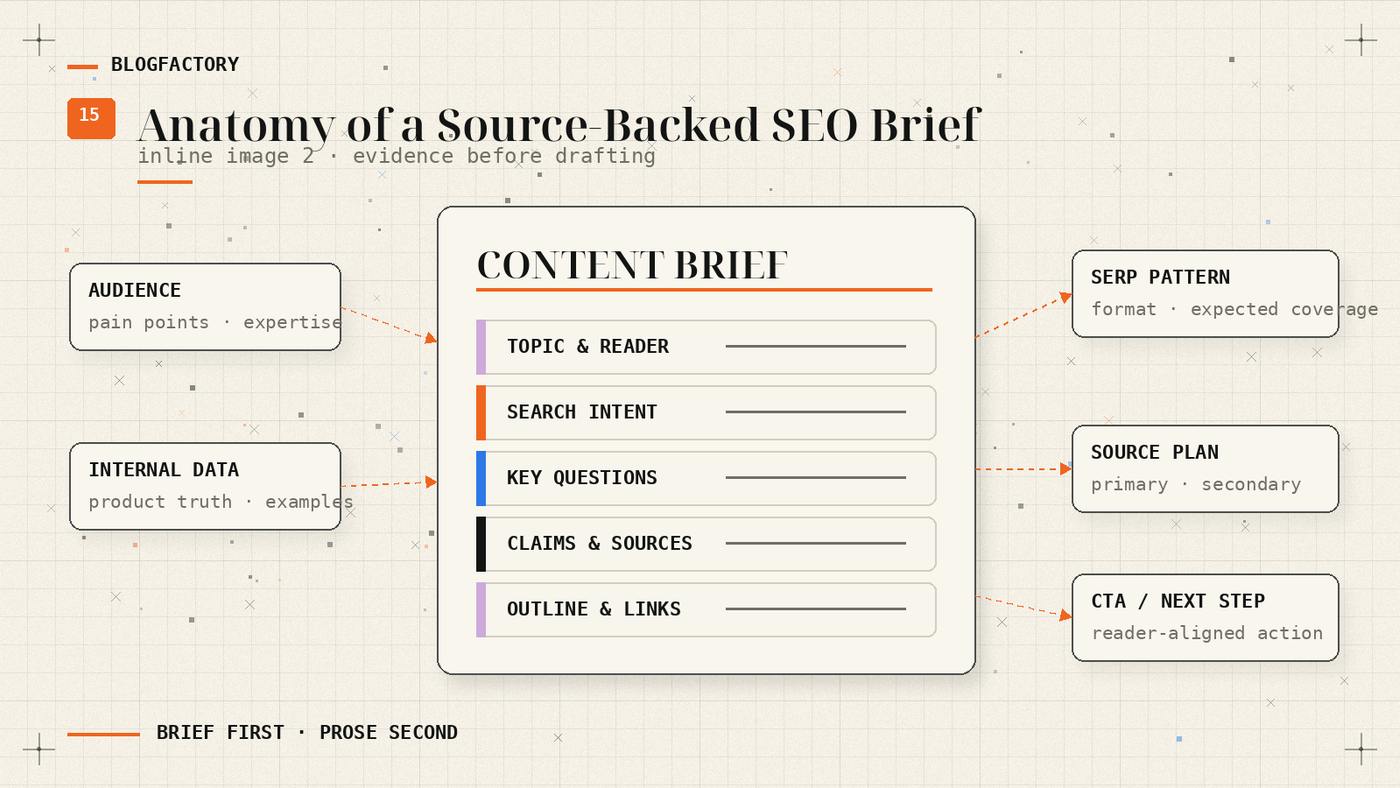
List the material claims the article expects to make before writing them into prose. Then identify the evidence category and source for each one.
Use a claim ledger with:
- Claim;
- Classification;
- Source or evidence owner;
- Verified date;
- Scope or limitation;
- Status.
Classifications can include primary source, secondary source, proprietary evidence, user-provided, calculated, analysis, or unverified.
Prefer primary sources for technical behavior, versions, prices, laws, standards, dates, and research results. Use reputable secondary sources for independent context. Label original synthesis as analysis.
The fact-checking guide provides a fuller claim verification workflow for the finished article.
Step 9: secure the proprietary evidence
Identify at least one real source of original value when the article requires experience or product proof. This might be an internal test, interview, implementation log, customer workflow, dataset, event observation, or expert decision framework.
Record:
- who supplied the evidence;
- when and how it was produced;
- sample, method, inputs, and exclusions;
- what may be quoted or published;
- limitations that must accompany the claim.
If the evidence is missing, mark the brief blocked, narrow the angle, or approve a visible placeholder. Never ask the writer to “make it sound like we tested it.”
Step 10: identify verified internal links
Find existing pages that help the reader understand the topic or take the next step. Verify the live URL and write a descriptive anchor based on the destination.
The brief should identify:
- one broader pillar or category page;
- one closely related explanatory article;
- the most relevant product or installation page;
- an adjacent article that should link back after publication.
Do not invent URLs or force links where the destination does not help the reader. Note missing destinations as future content opportunities.
Step 11: choose the article pattern
Choose a format that matches the reader’s job rather than defaulting to the same generic tutorial.
Possible patterns include:
- What-is or definition guide;
- informational how-to;
- commercial how-to;
- best-of roundup;
- alternatives article;
- direct comparison;
- pillar guide;
- news or current-development analysis;
- refresh of an existing page.
Explain the choice. A query about “best Ghost MCP server” needs a methodology-led comparison; “how to install Ghost MCP” needs prerequisites and steps.
Step 12: outline for information gain
Build the outline from the target questions, claim plan, and content gap. Every H2 should answer a distinct question or advance the decision.
For each section, note:
- the direct answer or key claim;
- required evidence or example;
- the new information it adds;
- useful table, checklist, diagram, or screenshot;
- relevant internal link;
- whether a product CTA belongs there.
Remove any section whose purpose is only to restate an earlier point or reach an arbitrary word count.
Step 13: approve the brief before drafting
For high-value, product-led, regulated, comparison, or resource-intensive content, stop after the brief and obtain approval.
The approver should review:
- two or three title options;
- search intent and reader job;
- duplicate-check outcome;
- target questions and gap;
- material claims and unresolved unknowns;
- proprietary evidence and limitations;
- outline and intended information gain;
- CTA and internal links.
Approval at this stage is cheaper than rewriting a complete article whose core angle or claims were wrong.
Reusable source-backed SEO brief template
- Working title:
- Publishing domain:
- Audience, market, and language:
- Primary keyword or topic:
- Search intent and reader job:
- Duplicate-check result and reviewed URLs:
- Top relevant organic pages and shared pattern:
- Three to five target questions:
- Defensible content gap:
- Primary and related terms:
- Material claims and source plan:
- Proprietary evidence and provenance:
- Article pattern and rationale:
- Proposed H2 and H3 outline:
- Verified internal links:
- CTA and placement:
- Voice, author, and samples:
- Unknowns and blockers:
- Approver and status:
Common content-brief mistakes
Starting from competitor headings
This creates derivative coverage before the team has defined its own reader, evidence, or information gain.
Ignoring existing site content
The writer may create a second page for the same intent when a refresh would consolidate authority and reduce maintenance.
Treating keywords as the outline
A list of terms does not explain the reader’s questions, evidence needs, or decision sequence.
Inventing proprietary proof
A placeholder labeled “add customer quote” is acceptable. A plausible quote or result created by the model is not.
Approving only the title
The title does not reveal unsupported claims, duplicate intent, a weak gap, or an outline that cannot deliver the promised answer.
How Source-Backed Blog Writer creates the brief
Source-Backed Blog Writer is a portable Agent Skill that defines this research and planning sequence. In approval mode, it stops before drafting and presents title options, target questions, outline, intended information gain, material claims, unresolved unknowns, CTA, and internal-link targets.[2]
The skill also requires a duplicate check, intent classification, useful related terms, source discipline, a claim ledger, and real proprietary evidence for publish-ready commercial or editorial content.
It cannot provide trustworthy search volume, rankings, pricing, proprietary facts, or current sources when the client lacks those inputs. Missing material evidence blocks the workflow rather than authorizing fabrication.
Review the free workflow on the Source-Backed Blog Writer page.
Frequently asked questions
How long should an SEO content brief be?
Long enough to resolve the intent, evidence, gap, outline, links, and blockers. A simple definition may need one page; a regulated comparison may require a detailed research package.
Should the brief include search volume?
Only when a named keyword-data source supplies it. Record the market, date, and whether the figure is exact, modeled, or estimated.
How many competitor pages should be reviewed?
Review enough relevant organic pages to identify the expected pattern and gaps. Three strong matches are often sufficient for an ordinary article.
Can AI create the whole brief automatically?
AI can perform much of the research and structure when it has current tools and sources. A human still needs to supply or approve proprietary evidence, product truth, positioning, risk, and the final direction.
When should the team skip a new article?
Skip or redirect the assignment when an existing page already satisfies the intent and the proposed article has no distinct audience, evidence, or reader value.
The practical takeaway
A strong SEO brief reduces expensive writing mistakes before they happen. It proves that the page has a distinct job, a supportable claim set, and a reason to exist.
Define the publishing context, check the site, classify the intent, review relevant results, identify target questions and information gain, build the source and claim plan, secure proprietary evidence, verify internal links, choose the correct article pattern, and approve the outline. Then drafting becomes execution of an evidence-backed plan rather than exploration inside polished prose.
References
[1] Google: creating helpful, reliable, people-first content