
AI can write a draft in seconds. That does not mean a content team can safely move from a prompt to production in seconds.
Between an idea and a published article sit the parts that actually make content operations difficult: source evidence, search performance, revisions, SEO metadata, brand context, review, approvals, destination selection and a record of what changed. When AI agents enter that workflow, the question is no longer simply, “Can the model write?” It becomes, “What should the agent be allowed to do, with which site, using which data, and who approves the result?”
That is the problem BlogFactory is built around.
BlogFactory is an open-source, self-hostable content operations platform designed to give AI agents useful but bounded authority over editorial work. Agents can help research, create and revise content, work with Search Console data and prepare CMS drafts. Humans remain in control of review, approval and the final publishing decision.
In other words, BlogFactory is not trying to replace your CMS, your SEO stack or your editorial judgment. It sits between those systems and the AI agents increasingly doing the work.
What does BlogFactory actually do?

BlogFactory brings the operating context around AI-assisted content into one workspace. A typical flow looks like this:
Source evidence → agent or human draft → revision and SEO metadata → review and preflight → CMS draft
The important word at the end is draft.
BlogFactory deliberately separates content production from live publishing. An agent can do meaningful work without automatically gaining the ability to push unreviewed content onto a production site.
That makes the platform useful for teams that want more automation without turning their website into an experiment in unsupervised publishing.
BlogFactory is not another AI writer
There are already hundreds of tools that can generate a blog post from a title or keyword. The hard part is not producing 1,500 words. The hard part is operating content consistently across a real site.
A production content workflow needs answers to questions such as:
- Which page is losing search visibility?
- Is the Search Console data complete or still preliminary?
- Does an existing article already cover this topic?
- Which version of the draft is being reviewed?
- What changed between revisions?
- Are important SEO fields missing?
- Which CMS destination should receive the final draft?
- Did an agent already perform this operation?
- Can the agent delete content or expose credentials?
A generic AI writer usually does not own that context. BlogFactory is designed around it.
The result is closer to a control plane for content operations than a text generator.
BlogFactory is not a CMS either
A content management system such as WordPress, Ghost, Drupal or a headless CMS is responsible for storing and delivering content to a website or application.
BlogFactory has a different job.
Think of the relationship like this:
AI agent → BlogFactory → human review → CMS draft → publish
The CMS is still the destination. BlogFactory manages the work that happens before content is handed off to that destination.
This separation becomes more valuable as teams use multiple sites, several AI models, different editorial contributors and increasingly autonomous agents. Instead of giving every agent direct administrative access to every CMS, you can put a narrower operational layer in the middle.
How BlogFactory uses MCP
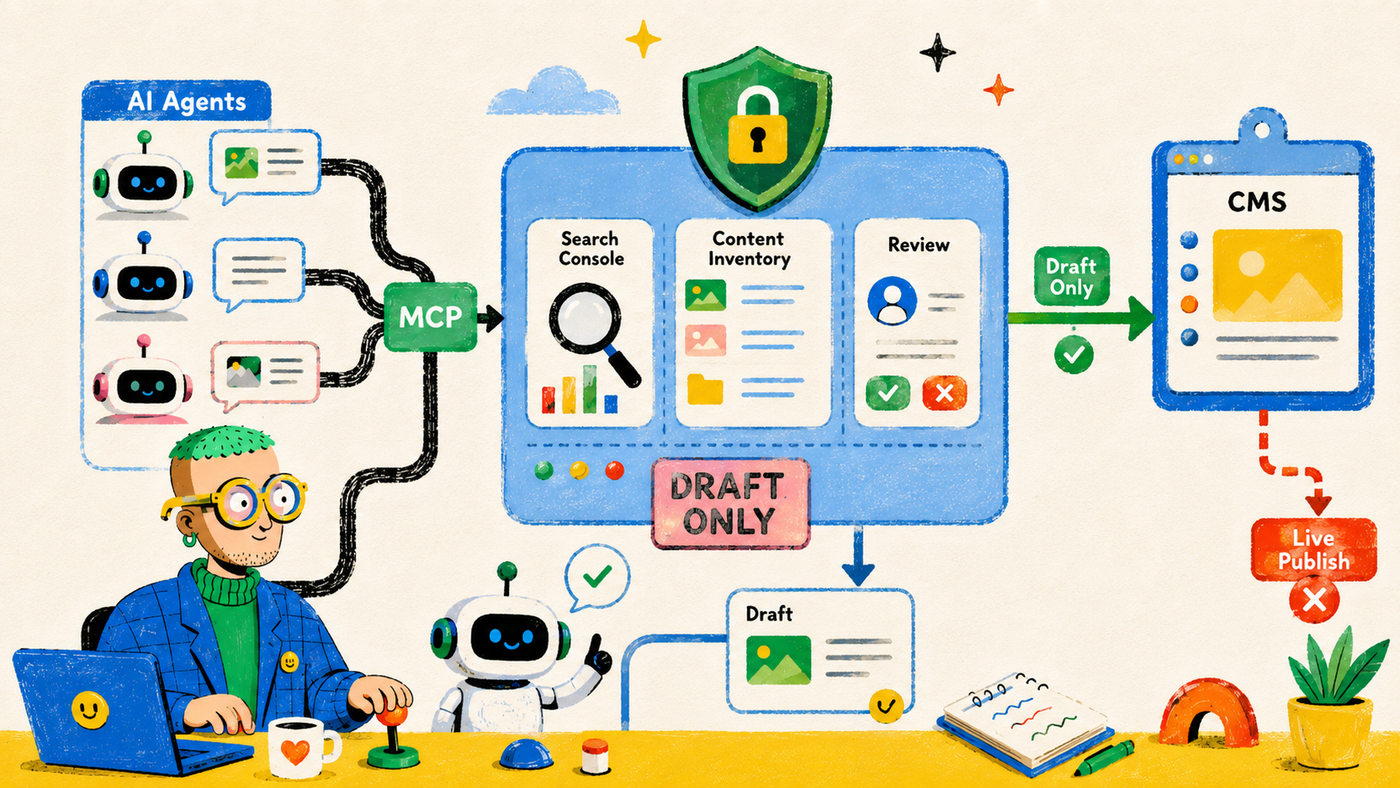
A major part of BlogFactory is its support for the Model Context Protocol (MCP).
MCP is a standard that lets compatible AI clients connect to external tools and data in a structured way. Instead of copying Search Console numbers into a chat or pasting an entire article every time you want an edit, an MCP-connected agent can call approved tools directly.
BlogFactory exposes a site-scoped MCP work layer for tasks including:
- listing approved sites and content
- reading posts
- creating caller-authored drafts
- generating drafts
- updating existing drafts with revision checks
- reading Search Console dashboards and insights
- inspecting URLs and sitemaps
- reviewing a post before delivery
- pushing an approved version to a CMS as a draft
The important design choice is that MCP access is intentionally bounded. BlogFactory does not turn an AI conversation into a general-purpose administrator account.
Site-scoped access matters
The useful question in agentic software is not only “What tools exist?” It is “What can this particular connection do?”
BlogFactory connections can be scoped to a site. That means an agent working on one property does not automatically need access to every other property in the workspace.
This is a more practical model for agencies, operators managing multiple brands, and teams that want to experiment with AI without flattening all of their permissions into one powerful token.
It also creates a cleaner mental model: the agent gets the authority needed to do the current editorial job, not unlimited control over the system.
Search Console becomes part of the workflow
SEO work often breaks because analytics and execution live in separate tools.
A marketer notices a drop in Search Console, opens another platform to investigate, creates a ticket somewhere else, briefs a writer in a document, receives a draft, reviews it in another interface and finally moves it to the CMS.
BlogFactory is designed to shorten that distance.
Search Console context can be used to identify opportunities and turn them into concrete content work. The platform distinguishes complete data from preliminary data and can surface pages, queries and trends without pretending that correlation is a guaranteed ranking cause.
That is especially useful for content refreshes. Instead of asking an agent to “improve this article” in isolation, the workflow can begin with real first-party search performance.
A better loop looks like this:
- Identify a page with declining or expanding search demand.
- Inspect the queries and performance around that page.
- Decide whether the right action is a refresh, expansion, internal link or new article.
- Create or revise the draft.
- Review SEO and editorial blockers.
- Send the reviewed version to the CMS as a draft.
- Publish when a human is satisfied.
The model is not autonomous publishing. It is evidence-assisted execution.
Why BlogFactory does not auto-publish live
“Fully autonomous content” sounds efficient until an agent makes a confident mistake.
A live publishing permission can turn a hallucinated fact, broken link, accidental duplicate, wrong destination or malformed article into a production problem instantly.
BlogFactory takes a different position: agents should have enough authority to remove repetitive work, but the system should maintain a hard ceiling around higher-risk actions.
That is why the platform focuses on draft delivery rather than live publication.
The workflow supports review and preflight before content is delivered. Version conflicts can block stale edits. Multiple destinations require explicit selection. Repeating the same delivery is designed to avoid creating duplicate external drafts.
These are operational details, but they are exactly the details that separate an AI demo from a system a content team can trust.
Open source and self-hosting
BlogFactory is open source and licensed under AGPL-3.0-only. The Community version can be self-hosted in your own infrastructure.
The canonical deployment uses Docker Compose with components for the web application, API, PostgreSQL, S3-compatible object storage and scheduled work. The application is designed so that a self-hosted Community instance does not need to send its content to BlogFactory’s own domain. Your configured AI, CMS and Google integrations are the external systems involved in the workflows you choose to enable.
Self-hosting is relevant for teams that care about:
- infrastructure control
- data residency
- custom integrations
- inspecting and modifying source code
- avoiding unnecessary platform lock-in
- choosing their own AI providers
It also means there is an operational responsibility. Open source does not remove the need for backups, upgrades, secrets management or infrastructure monitoring. It gives you control over those decisions.
Bring your own AI
BlogFactory is designed around the idea that the content workflow should not depend on a single model vendor.
The model is one part of the system. Your sources, drafts, review process, search data and CMS delivery should not need to be rebuilt every time the preferred AI model changes.
That is an important architectural distinction in 2026. Model quality and pricing are moving quickly. Content infrastructure that is tightly coupled to one provider can become obsolete much faster than the editorial workflow itself.
A “bring your own AI” approach keeps the durable part — the process — separate from the rapidly changing model layer.
Who is BlogFactory for?
BlogFactory is most relevant to teams that already feel the operational complexity of content.
SEO teams
SEO teams can connect first-party search performance to the work required to update or create pages, while keeping a review step before CMS delivery.
Content teams
Editors can maintain revisions, review the current version and control what moves downstream instead of passing raw AI output around in disconnected chats.
Agencies
Agencies managing multiple sites benefit from site-scoped access and a clearer separation between agent work and client publishing environments.
Developers building AI workflows
MCP gives developers and agent users a structured way to connect compatible clients to content operations without building a new one-off interface for every model.
Multi-site operators
When one team manages several websites, a single operational layer can reduce the number of credentials and workflows that need to be duplicated across tools.
BlogFactory vs a typical AI content tool
| Capability | Typical AI writer | BlogFactory |
| Generate article text | Yes | Yes |
| Read structured site content | Sometimes | Yes |
| Track revisions | Limited | Yes |
| Search Console workflows | Often separate | Built into the operating workflow |
| Human review before CMS handoff | Optional | Core design principle |
| CMS delivery | Often direct publish | Draft-only delivery |
| Agent access via MCP | Varies | Core interface |
| Site-scoped permissions | Rare | Yes |
| Self-hosting | Varies | Yes |
| Open source | Varies | Yes |
The goal is not to win every row in a feature checklist. The point is that BlogFactory is solving a different layer of the problem.
The bigger idea: AI needs operational boundaries
Content teams are moving from “AI helps me write” to “AI performs work across my stack.” That transition changes what matters.
Prompt quality still matters. Model choice still matters. But permissions, provenance, revision safety, data access and approval become equally important.
If an agent can act, it needs boundaries.
If an agent can edit, it needs version awareness.
If an agent can send content to a CMS, the team needs to know what was reviewed and where it is going.
BlogFactory is an attempt to make those constraints part of the product rather than a collection of team conventions.
Getting started with BlogFactory
You can run BlogFactory locally from the public repository or use the documented Docker Compose self-hosting path. The project includes documentation for architecture, MCP, operations, deployment and contribution.
If your current workflow is a collection of Search Console tabs, AI chats, spreadsheets, documents and CMS drafts, the easiest way to understand BlogFactory is to think about the gap between those tools.
That gap is what BlogFactory is trying to become: the place where search evidence turns into agent work, agent work turns into a reviewed revision, and a reviewed revision turns into a CMS draft — without handing the publish button to the model.
Explore BlogFactory on GitHub
BlogFactory is open source, so you do not have to take a marketing page’s word for how it works. Read the code, inspect the architecture, review the MCP implementation, run it locally or contribute to the project.