
Content marketing gets most of the attention. Content operations is what makes content marketing possible at scale.
It is the system behind the articles, landing pages, updates, briefs, reviews, approvals, metadata, source material and publishing workflows that readers eventually see.
When a company has five blog posts, content operations can be informal. A writer, editor and CMS may be enough.
When a company has hundreds of pages, several websites, multiple contributors, an SEO program and AI agents generating or updating content, informal processes begin to break.
That is where content operations becomes a discipline.
What is content operations?
Content operations is the people, process, technology and governance used to plan, create, manage, review, distribute and improve content consistently.
Content ops is not simply “content project management.” It covers the entire operating system around content.
That can include:
- content inventory
- research and source management
- editorial briefs
- production workflows
- revisions
- approvals
- SEO metadata
- brand standards
- permissions
- CMS handoff
- analytics
- refresh cycles
- archiving and consolidation
The goal is to make good content repeatable rather than dependent on heroic individual effort.
Content operations vs content marketing
The two are related but not interchangeable.
Content marketing asks:
- Who is the audience?
- What should we say?
- Which topics matter?
- How will content create demand or organic traffic?
- Which channels should we use?
- What business outcome are we trying to influence?
Content operations asks:
- How does an idea become an approved asset?
- Where do sources live?
- Which version is current?
- Who reviews what?
- Which fields are required?
- How does the content reach the correct destination?
- How do we know which pages need updates?
- What can an AI agent change?
Marketing defines much of the strategy. Operations makes execution reliable.
Content operations vs a CMS
A content management system is a critical part of content operations, but it is not the whole system.
The CMS manages content for publication. It typically provides:
- content fields
- user accounts
- drafts
- publishing states
- page rendering or APIs
- media management
Content operations extends upstream and downstream.
Before the CMS, there may be search research, briefs, source evidence, AI generation and editorial review. After publication, there may be Search Console analysis, refresh planning and performance reporting.
If the team uses five disconnected tools to complete those steps, the CMS does not magically become the coordination layer.
That gap is where content operations software and processes live.
Why content operations matters more in the AI era
AI dramatically lowers the cost of generating text.
That sounds like a pure productivity gain. In reality, it moves the bottleneck.
When draft creation becomes cheap, the expensive parts become:
- deciding what is worth creating
- supplying reliable context
- checking facts
- avoiding duplicate content
- keeping brand consistency
- reviewing changes
- managing permissions
- deciding what reaches production
In other words, AI makes operations more important, not less important.
A company that can generate 500 drafts per week but review only 20 does not have a generation problem. It has an operating-system problem.
The traditional content workflow
A simple traditional workflow might look like this:
Idea → brief → writer → editor → CMS → publish
It worked because most of the context traveled with humans.
The writer remembered the brand voice. The editor knew which pages already existed. The SEO manager checked Search Console separately. The content manager knew which CMS destination to use.
The process could remain informal because people filled the gaps.
The AI-native content workflow
An AI-native workflow may include:
- a Search Console integration identifying opportunities
- a crawler collecting page data
- an agent researching the topic
- a model creating a brief
- another model generating a draft
- automated metadata checks
- a human reviewer
- a CMS integration
- an analytics loop after publication
Now context needs to move between systems reliably.
That requires explicit rules.
The workflow becomes something like:
Signals → prioritization → evidence → agent work → revision → review → delivery → measurement
This is content operations for the agent era.
The seven parts of modern content operations
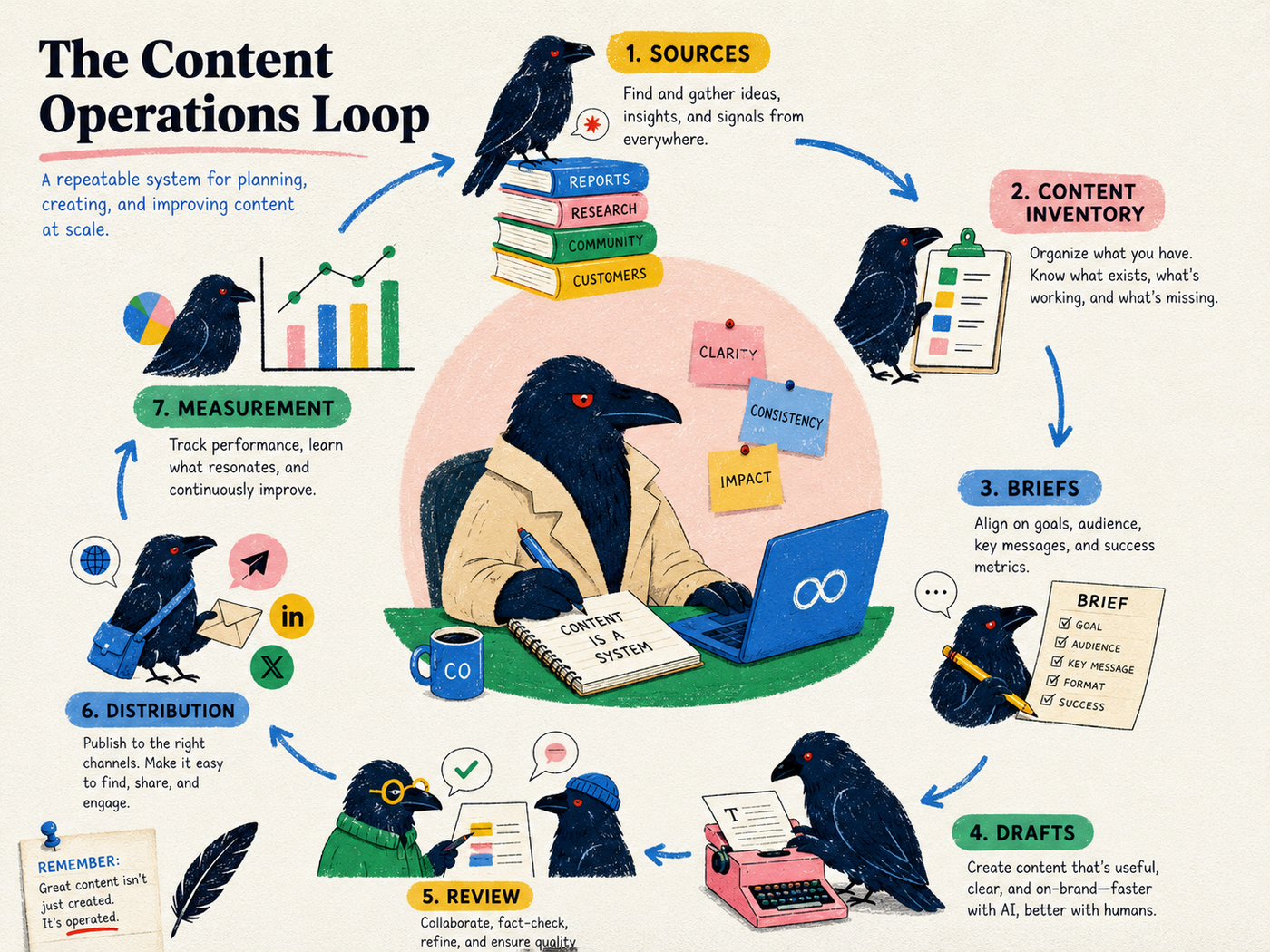
1. Sources and evidence
Content should have a traceable relationship to the information it uses.
Sources may include:
- internal documents
- subject-matter expert interviews
- product data
- customer research
- official documentation
- Search Console
- analytics
- external research
AI makes this more important because a model can produce plausible material even when it does not have reliable evidence.
2. Content inventory
You need to know what already exists.
A content inventory can help answer:
- Which URL covers this topic?
- Is there already a similar article?
- Which pages are outdated?
- Which content belongs to which site?
- Which pages are strong candidates for internal linking?
Without inventory awareness, AI generation can create duplication at extraordinary speed.
3. Planning and prioritization
Not every opportunity deserves a new article.
Content operations should support several action types:
- create
- update
- consolidate
- redirect
- internally link
- optimize metadata
- investigate
- leave unchanged
A mature team prioritizes work based on expected value, not how easy it is to generate another page.
4. Drafting and revisions
AI increases the number of contributors to a draft.
A page may be touched by a human writer, an SEO agent, a brand reviewer and an editor. Revision awareness becomes important because the system needs to know which version is current.
A reliable workflow should make changes visible and reduce the risk of stale updates overwriting newer work.
5. Review and preflight
Review should happen with context.
A reviewer needs more than the article body. Useful review information can include:
- change summary
- source provenance
- SEO metadata
- warnings
- blockers
- destination
- current revision
The easier it is to review intelligently, the less likely people are to approve mechanically.
6. Distribution and CMS delivery
Content eventually needs to reach a publishing system.
This can be automated without fully automating publication.
A strong pattern is:
approved content → CMS draft → final preview → human publish
The transfer is automated. The public decision is not.
7. Measurement and refresh
Content operations is cyclical.
After publication, performance data can identify new work:
- declining pages
- rising queries
- low CTR opportunities
- newly important topics
- outdated content
- internal-link opportunities
The output of analytics becomes the input for the next editorial cycle.
What is a content operations platform?
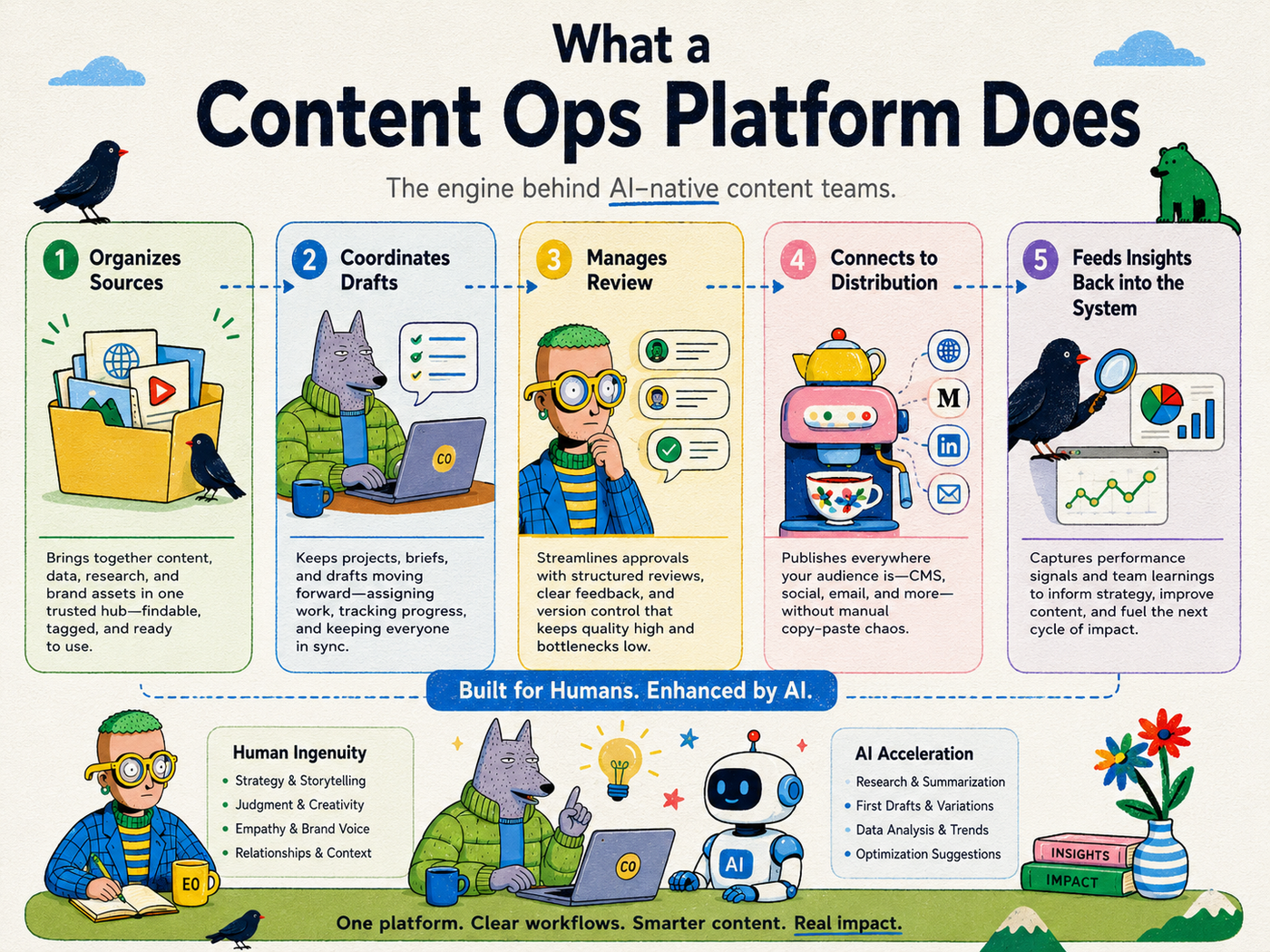
A content operations platform helps centralize some or all of that workflow.
The exact feature set varies, but useful capabilities include:
- multi-site content visibility
- source context
- content inventory
- drafts and revisions
- workflow states
- review queues
- SEO metadata
- search performance data
- permissions
- CMS destinations
- audit history
- AI/agent integrations
The goal should not be to create another place where content gets stuck.
A good platform reduces the amount of context people reconstruct manually between tools.
Content operations and AI agents
AI agents introduce a new dimension: authority.
A chatbot produces an answer. An agent can perform actions.
That means the content operations system has to consider:
- authentication
- scope
- read permissions
- write permissions
- deletion permissions
- publishing permissions
- credentials
- auditability
The safest design is usually not “give the agent an admin API key.”
Instead, give it a bounded set of tools tied to the job it should perform.
A research agent may only need read access. A drafting agent may need draft creation and revision. A delivery agent may need permission to create a CMS draft but not publish live.
This is the principle of least privilege applied to content work.
Why MCP matters for content operations
The Model Context Protocol is emerging as a standard way for AI clients to interact with tools and data.
For content operations, MCP can reduce the need to create a custom integration for every AI client.
An MCP-enabled content platform can expose operations such as:
- find posts
- read a draft
- create a draft
- update a revision
- inspect search performance
- request review information
- deliver an approved draft
The protocol itself does not define your editorial policy. The application still needs to decide which tools exist and what each authenticated connection is allowed to do.
That separation is healthy.
Content operations metrics that actually matter
Production volume is easy to measure, but it is rarely the best indicator of operational quality.
Useful metrics include:
Time from opportunity to reviewed draft
How quickly can the team convert evidence into something ready for editorial judgment?
Review rejection rate
How often do drafts fail because of factual, brand or structural problems?
Refresh throughput
Can the team maintain existing content, or is every process optimized only for net-new production?
Duplicate/cannibalization rate
How often is new content created for topics already covered?
Time spent on manual transfer
How much editorial time is wasted copying metadata, documents and formatting between systems?
Organic outcomes
Ultimately, operations should support business and search results — not become an internal efficiency project detached from performance.
Common content operations problems
The spreadsheet becomes the database
Spreadsheets are excellent tools. They become fragile when they are the only record of content state across hundreds of pages and multiple users.
Every team member has a different workflow
Flexibility is useful until nobody knows which version is approved or where the final draft lives.
AI output has no provenance
If the reviewer cannot tell which sources informed the draft, fact-checking becomes unnecessarily expensive.
The CMS is used as the entire planning system
CMS drafts are not always the best place to manage search opportunities, research, revisions and cross-site priorities.
Automation has too much authority
An integration that can delete, edit and publish everything may be convenient, but the blast radius of one mistake becomes enormous.
How BlogFactory approaches content operations
BlogFactory is an open-source content operations platform built specifically around AI-assisted and agent-driven workflows.
It brings together source context, content inventory, revisions, SEO metadata, Search Console workflows, review and CMS draft delivery.
Through MCP, compatible agents can access site-scoped editorial tools. The system intentionally keeps high-risk operations outside that authority ceiling: agents are not given arbitrary administrative access, credential access or a general live-publishing capability.
A typical flow is:
source evidence → agent or caller-authored draft → revision + SEO metadata → human review + preflight → CMS draft
The important part is not simply that an agent can generate content. The important part is that the agent operates inside the same revision and review system as the rest of the team.
Open-source content operations
Open source is particularly interesting at the operations layer because this layer touches many other systems.
A content operations platform may need to integrate with:
- your CMS
- Google Search Console
- model providers
- internal data
- storage
- authentication
- AI clients
Owning the application can make those integrations easier to inspect and customize.
It also reduces the risk of making one closed vendor the permanent center of your entire editorial architecture.
Self-hosting is not automatically the right choice for every team, but open source preserves options.
A content operations checklist
Ask these questions about your current workflow:
- Can we see all important content in one inventory?
- Do we know why each new page is being created?
- Can reviewers see the sources behind AI-assisted content?
- Is revision history clear?
- Can stale automation overwrite newer work?
- Are SEO metadata and editorial checks part of the workflow?
- Do agents have only the permissions they need?
- Can an agent publish live without human approval?
- Is the CMS destination explicit?
- Can we identify pages that need refreshes from search data?
- Can we switch AI providers without rebuilding the whole process?
- Do we measure outcomes rather than only output volume?
Every “no” is a potential operations problem.
Content operations is becoming infrastructure
The first wave of generative AI focused on creation.
The next wave is about execution.
As agents gain the ability to read data, update systems and move work between tools, content operations becomes less like a project-management concern and more like infrastructure.
The teams that benefit most from AI will not necessarily be the teams generating the most text. They will be the teams that create the clearest operating environment for humans and agents to work together.
That means better context, tighter permissions, faster review and safer delivery.
Explore BlogFactory on GitHub
BlogFactory is open source and self-hostable. If you want to see how an AI-native content operations system handles MCP, revisions, Search Console, review and CMS draft delivery, inspect the project directly.